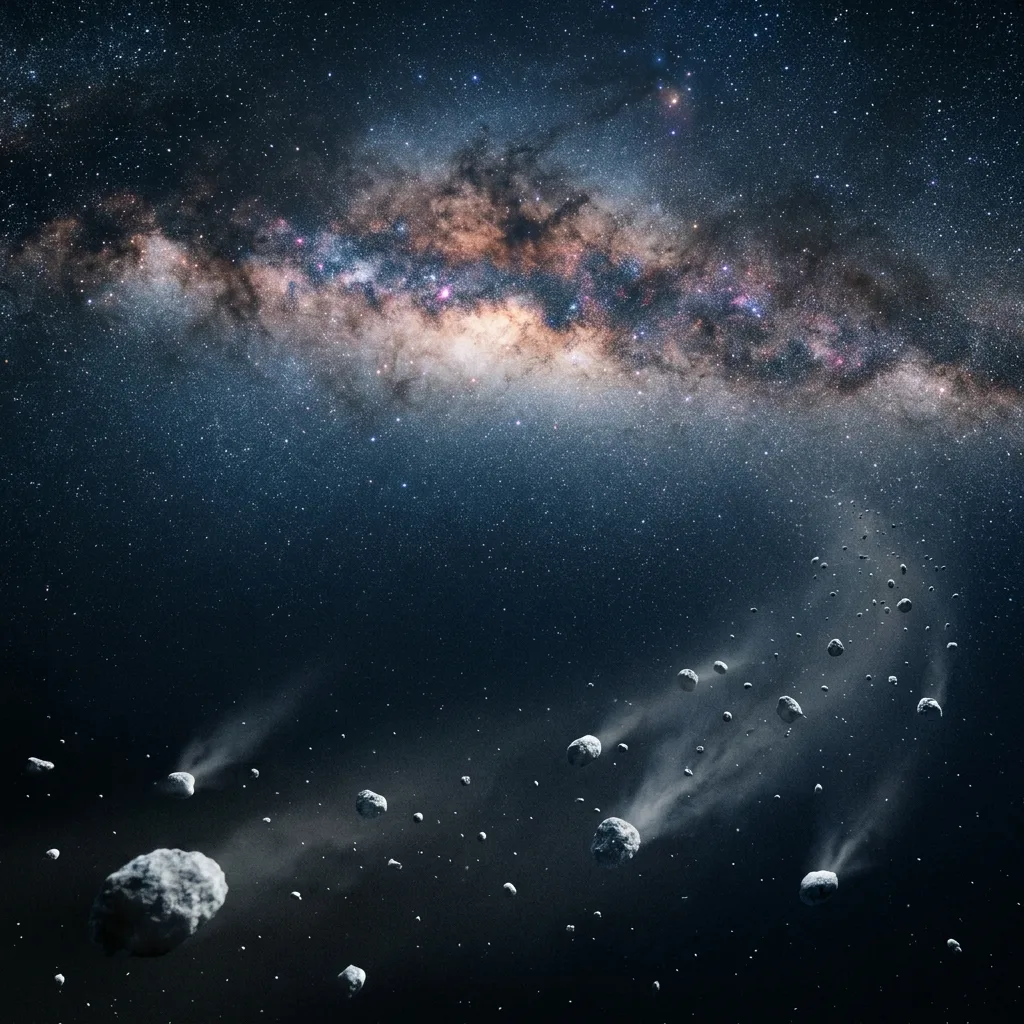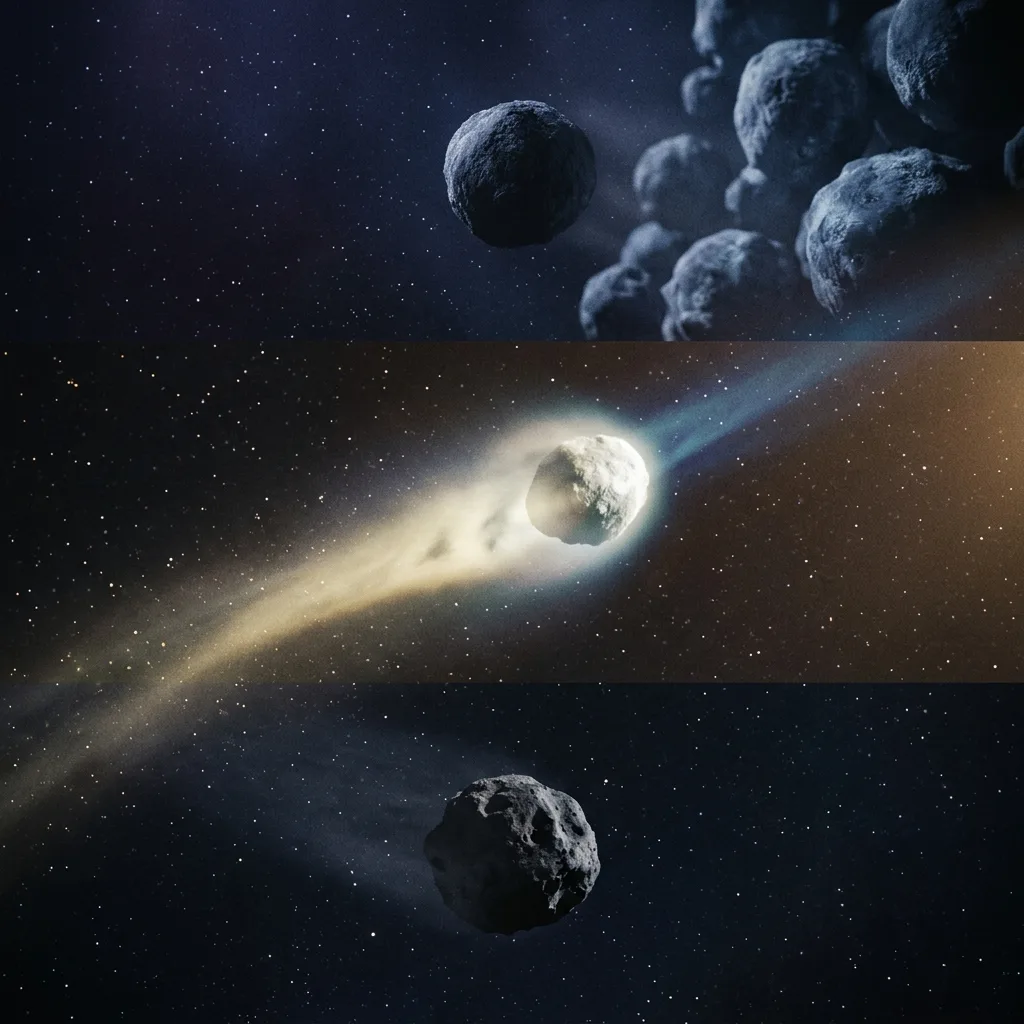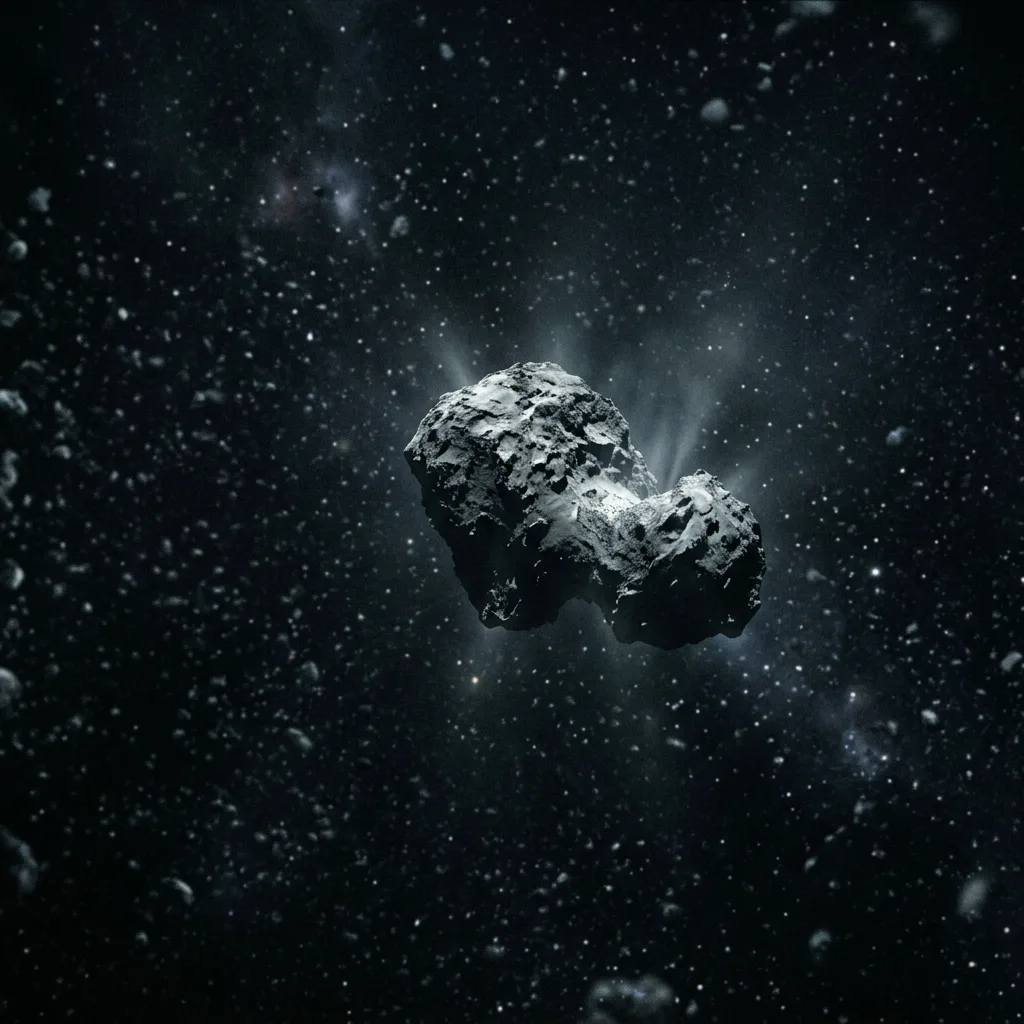
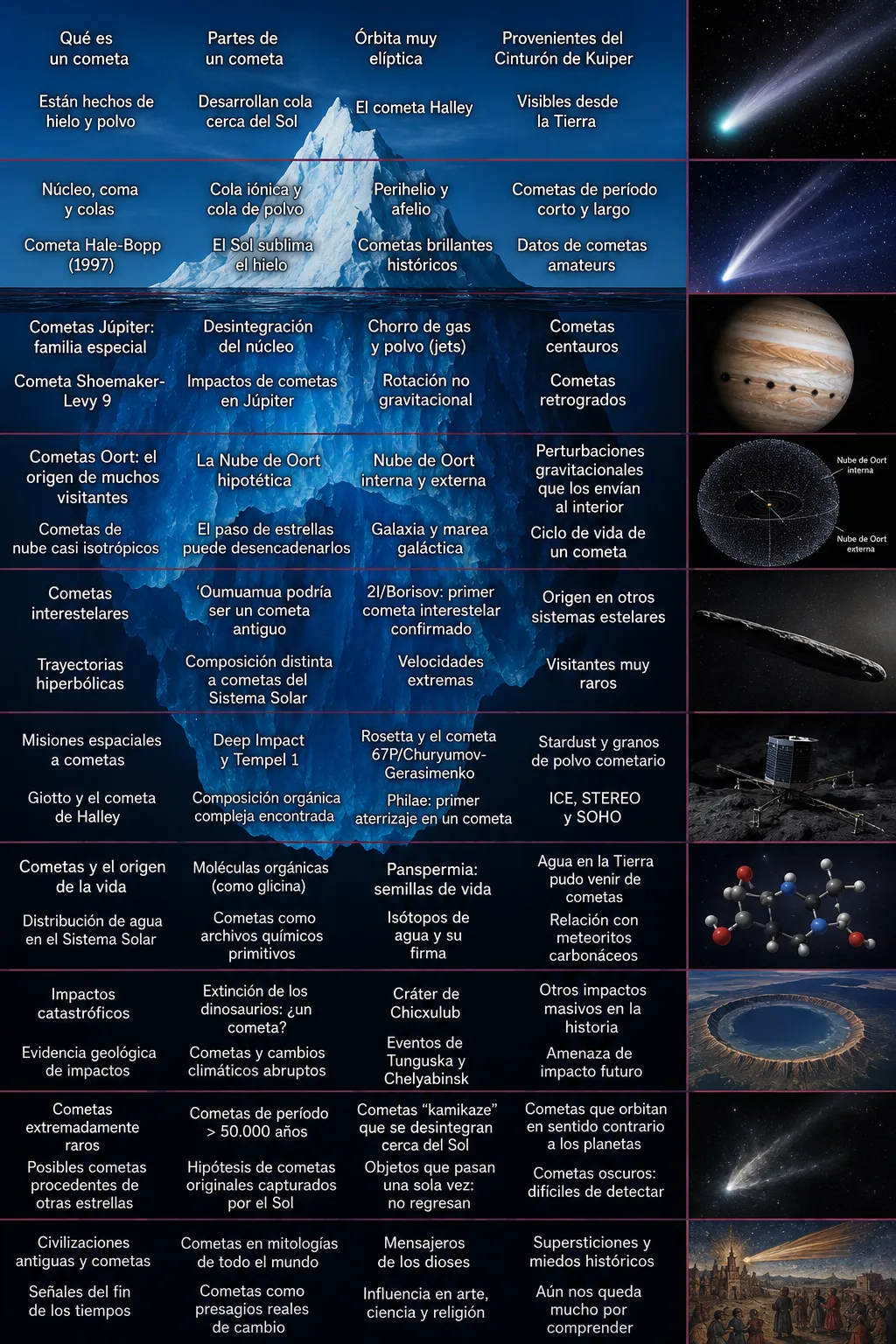
Iceberg of Comets

A journey from the glowing tails crossing the sky to interstellar visitors bringing secrets from other solar systems: discover the origin, mysteries, and threats of cosmic wanderers.

10 levels80 entries18 min read
Iceberg of Comets
Click image to enlarge

Click image to enlarge

1

Surface

0 meters

What we all know about comets. The self-evident truths we see in the sky.

What is a comet

The icy wanderer of the cosmos.

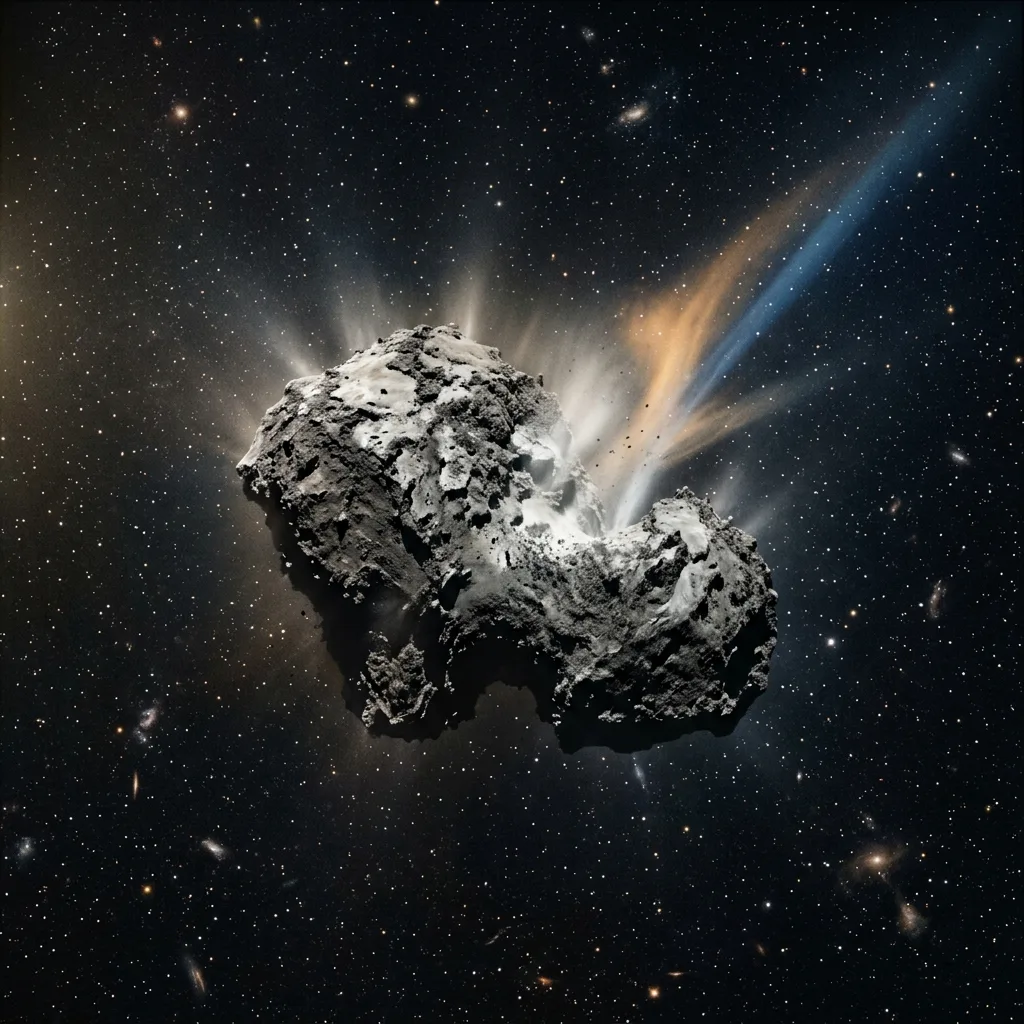
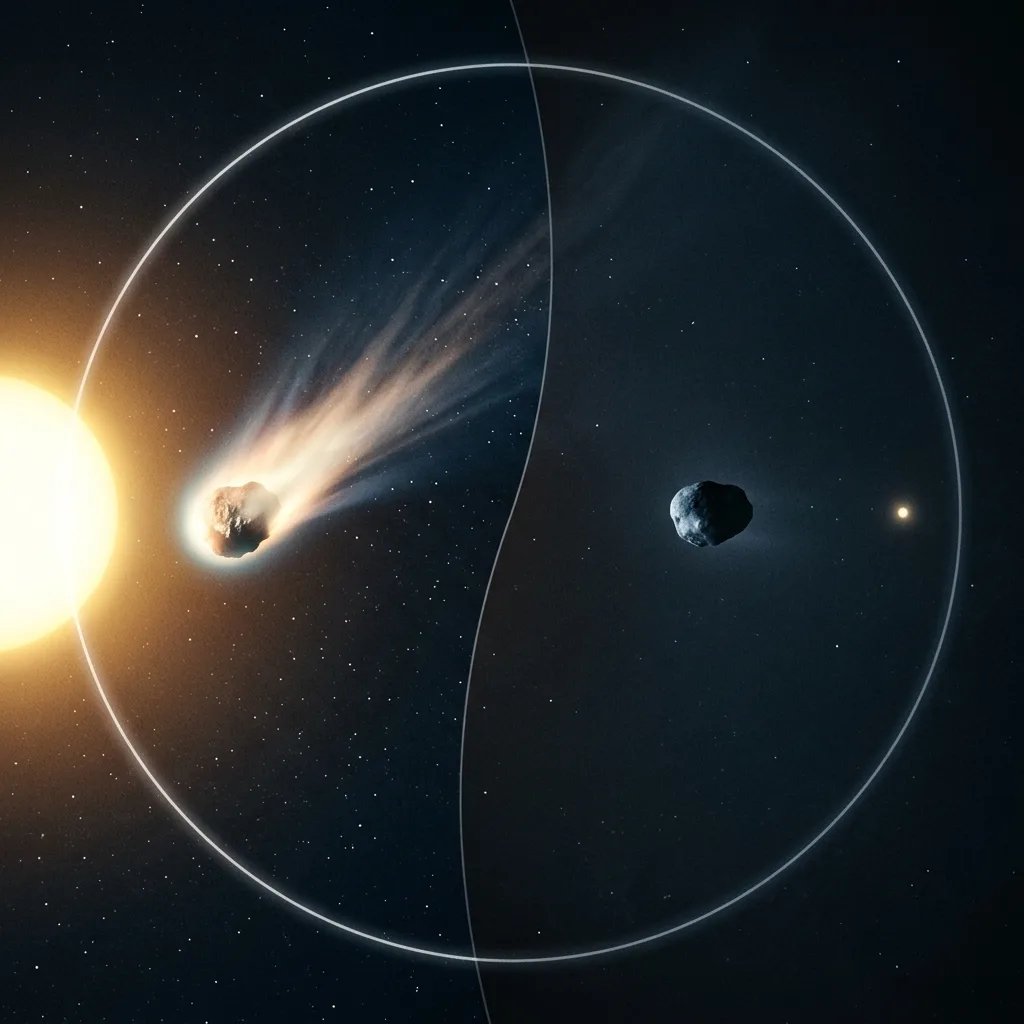
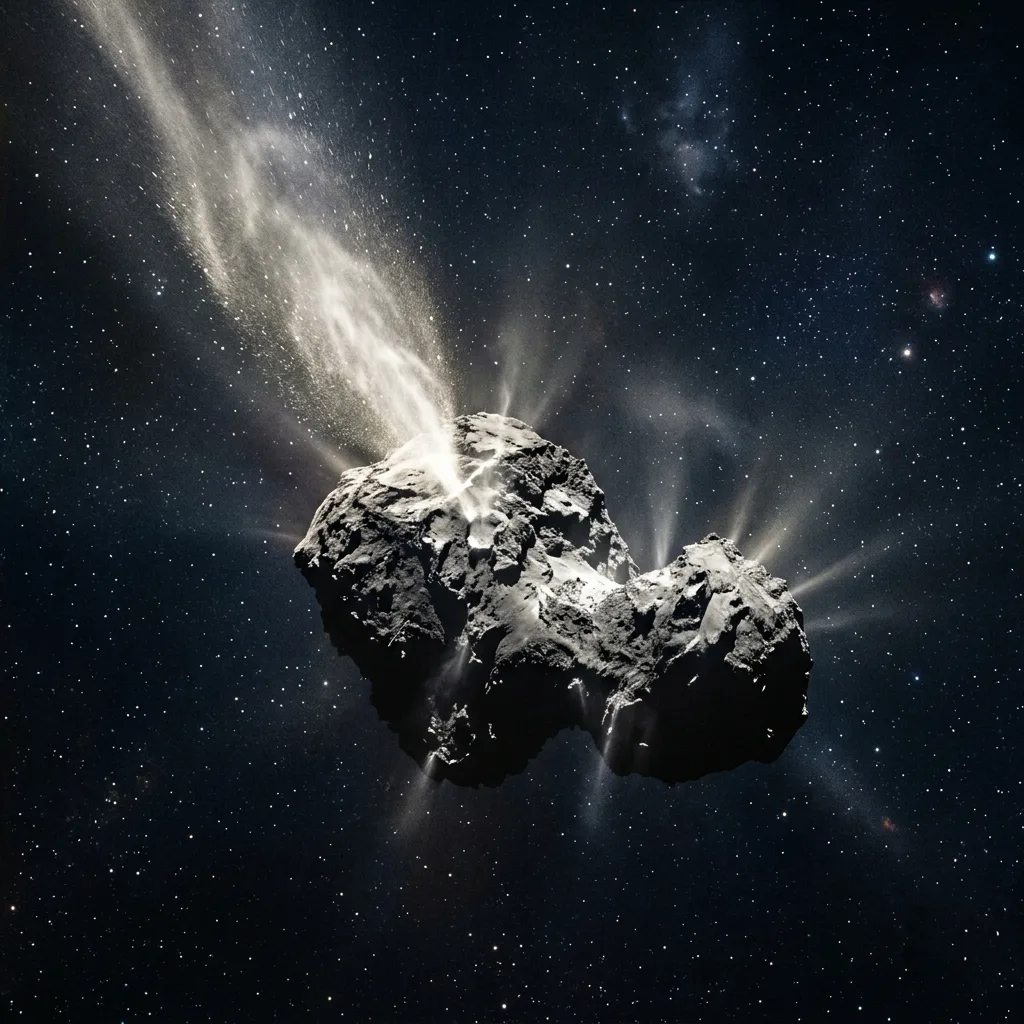
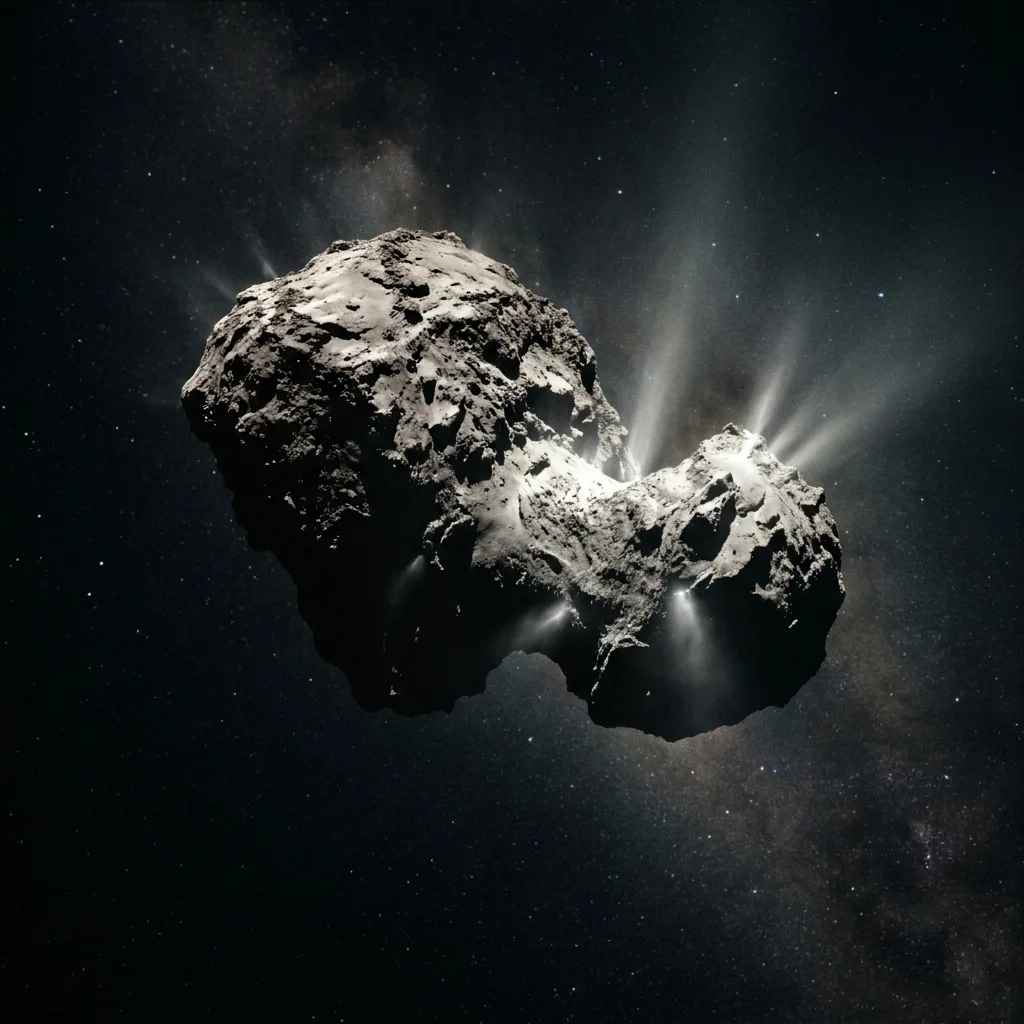
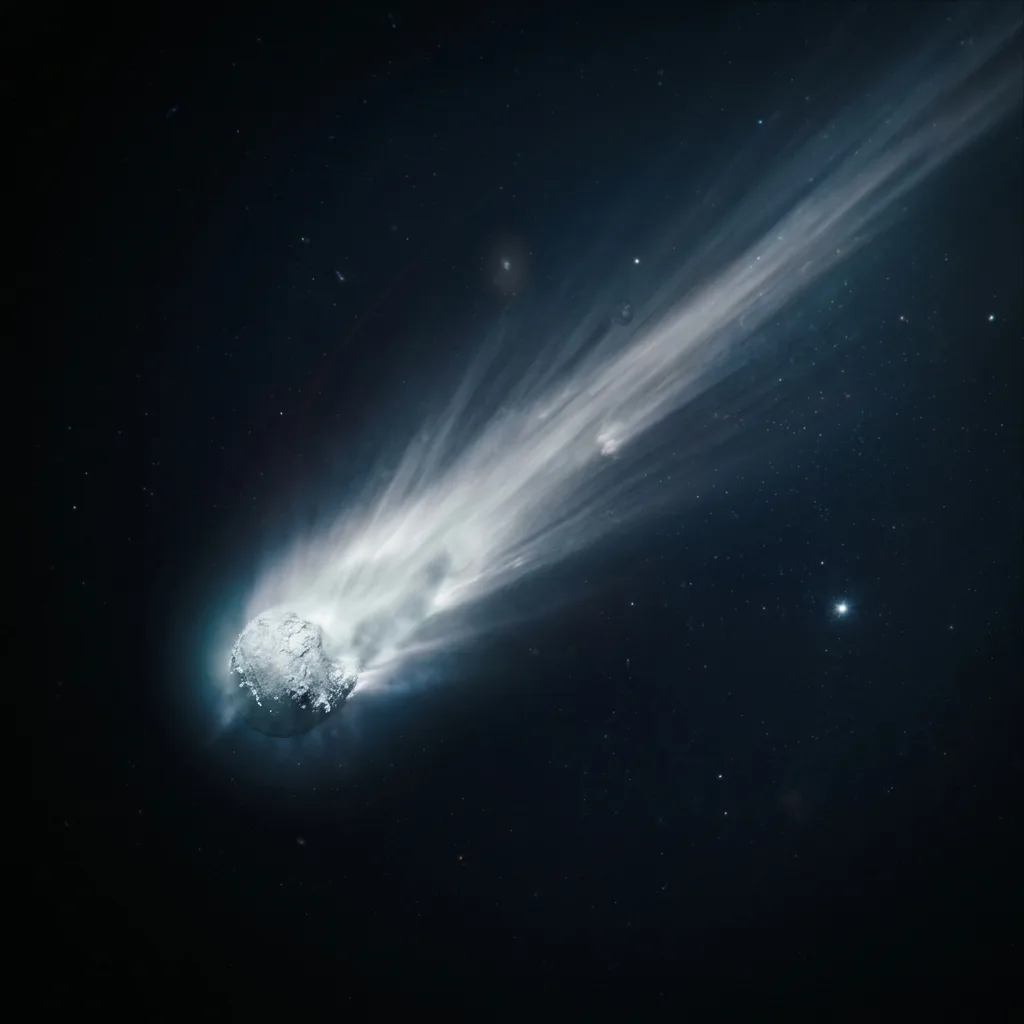
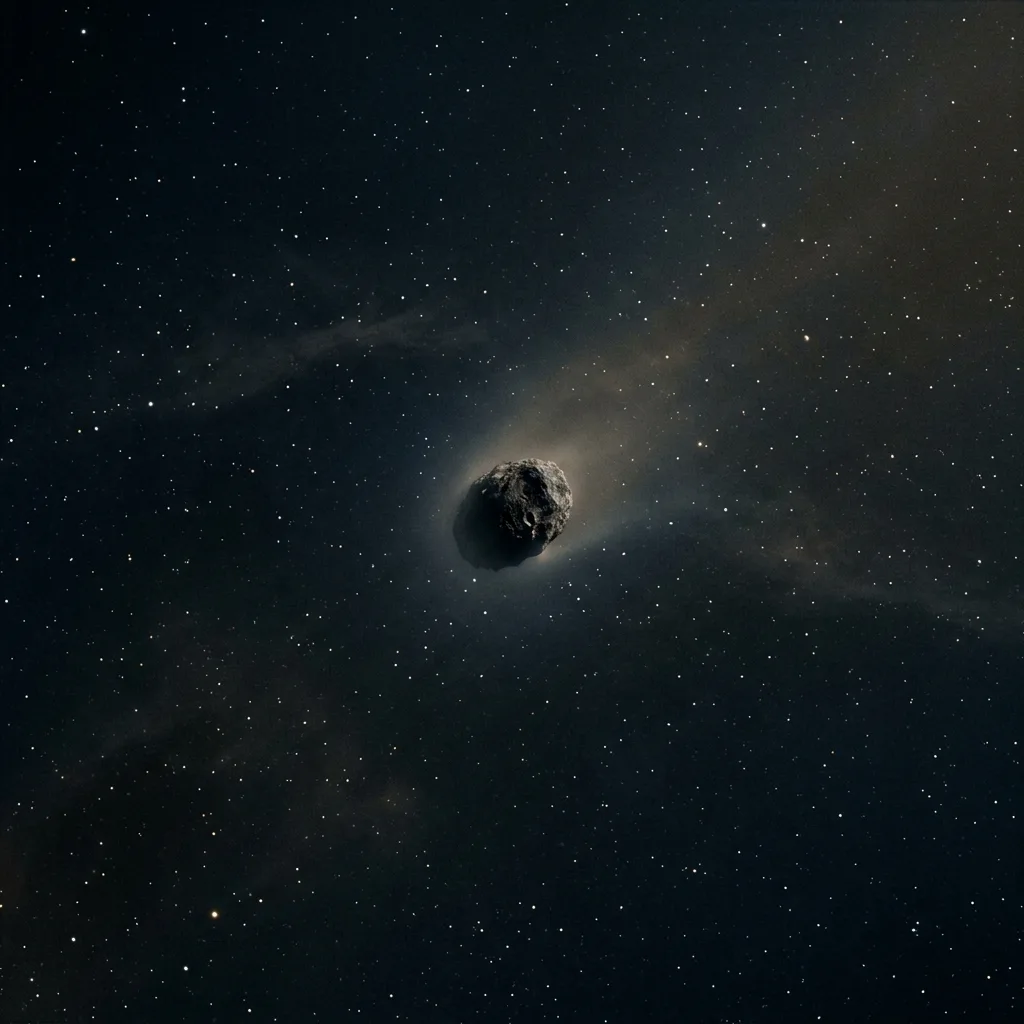
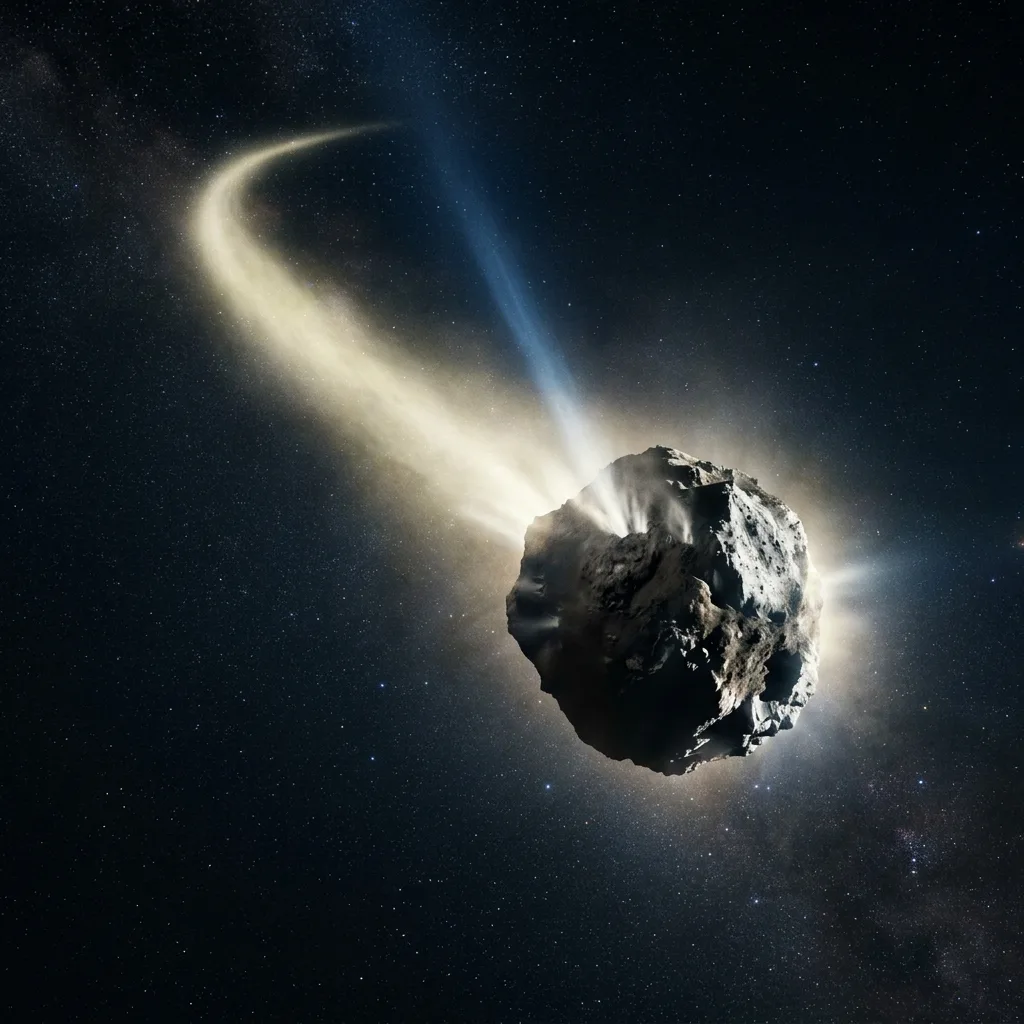
A comet is a celestial body made of ice, dust, and rock orbiting the Sun. As it approaches, solar heat sublimates the ice, creating a glowing tail. They are fossils from the formation of the solar system, travelers surviving for 4.6 billion years.
What is a comet

Parts of a comet

Nucleus, coma, and tail.

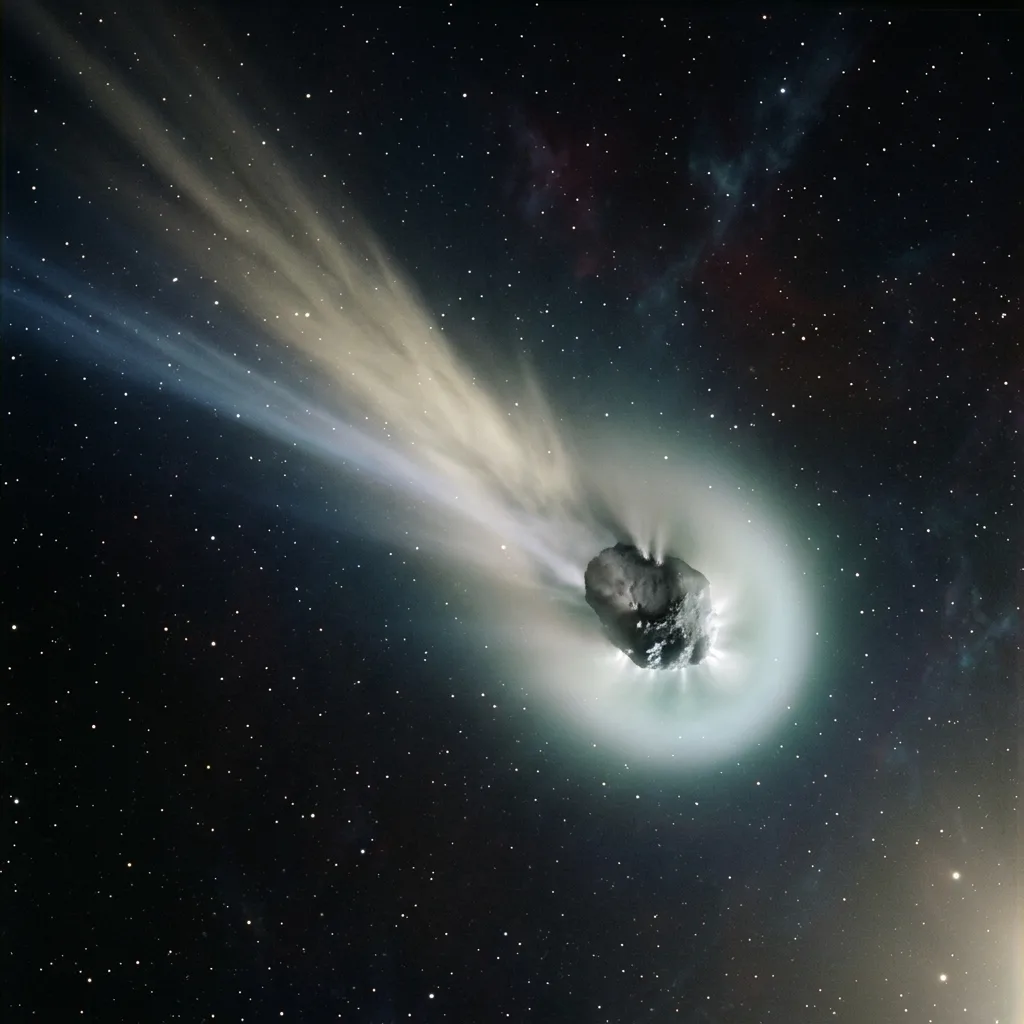
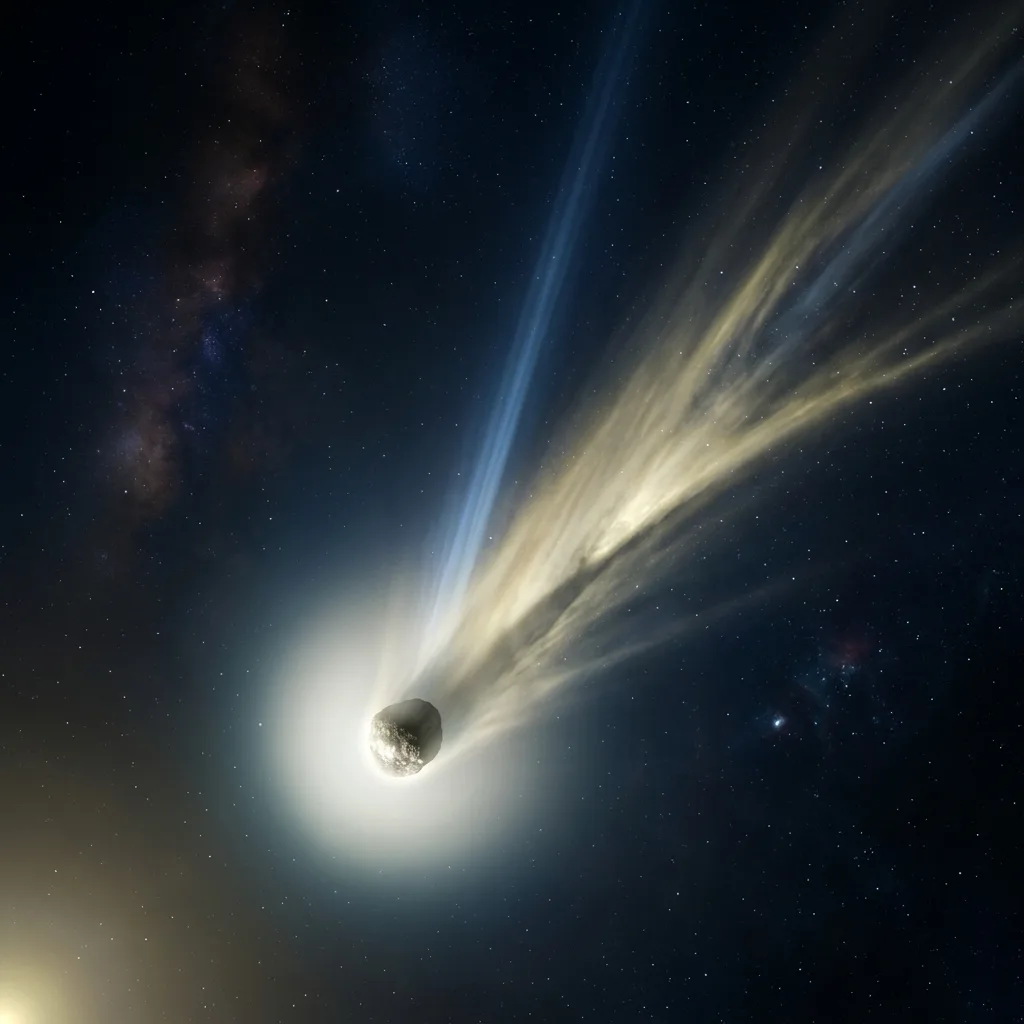
The nucleus is the solid body of ice and rock, just a few kilometers wide. The coma is the cloud of gas and dust surrounding it. The tail extends millions of kilometers, always pointing away from the Sun. Three parts, one cosmic dance.

Parts of a comet

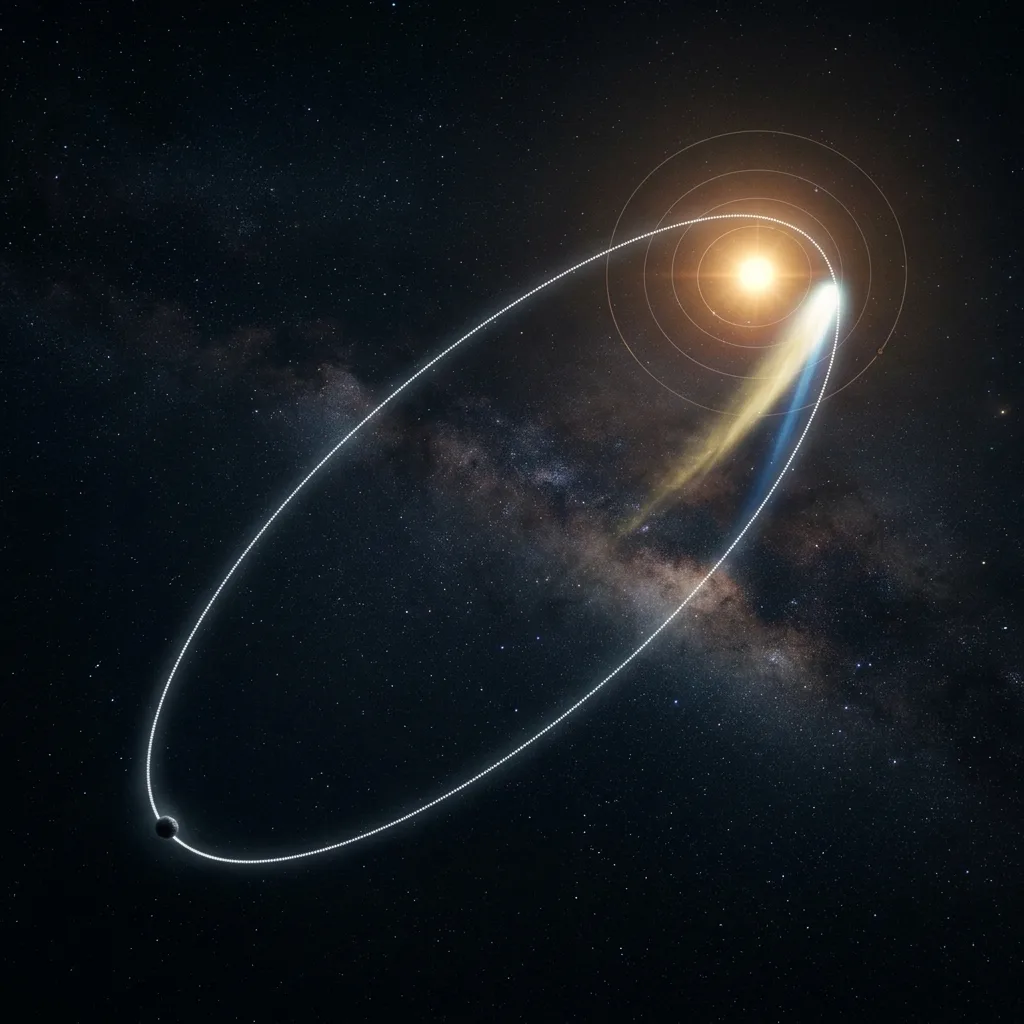
Highly elliptical orbit

Journeys lasting centuries.

Comets follow highly elliptical orbits. Some return every few years, others every thousands or millions. Their orbits take them from the depths of the solar system to the vicinity of the Sun. Extreme travelers of space.

Highly elliptical orbit

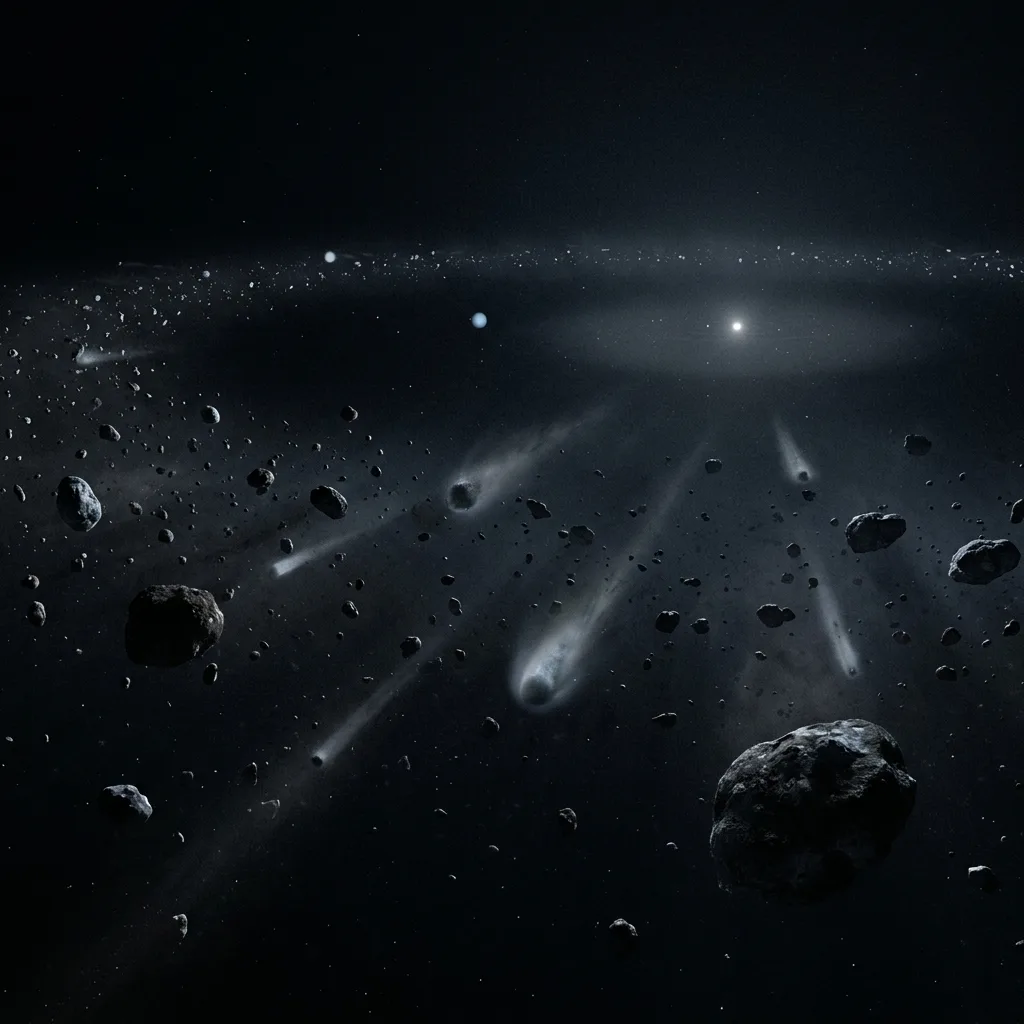
Originating from the Kuiper Belt

The icy ring beyond Neptune.

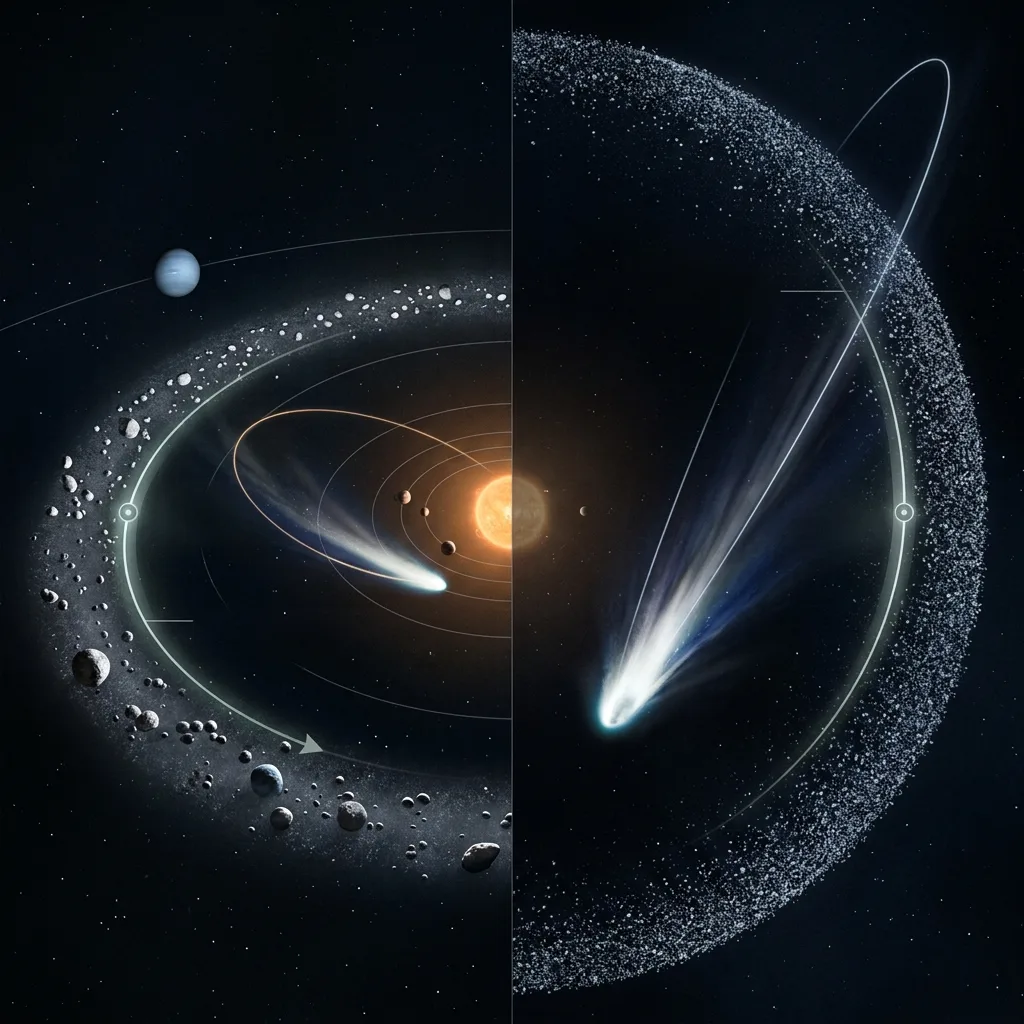
Many short-period comets originate from the Kuiper Belt, a disk of icy objects beyond Neptune between 30 and 50 AU from the Sun. It is the primary reservoir for comets that regularly visit the inner solar system.

Originating from the Kuiper Belt

Made of ice and dust

Dirty snowballs.

Comets are mixtures of water ice, CO₂, methane, ammonia, and rocky dust. Fred Whipple famously dubbed them "dirty snowballs" in 1950. They are time capsules preserving the original recipe of our solar system.

Made of ice and dust

Developing tails near the Sun

Awakening of the wanderer.

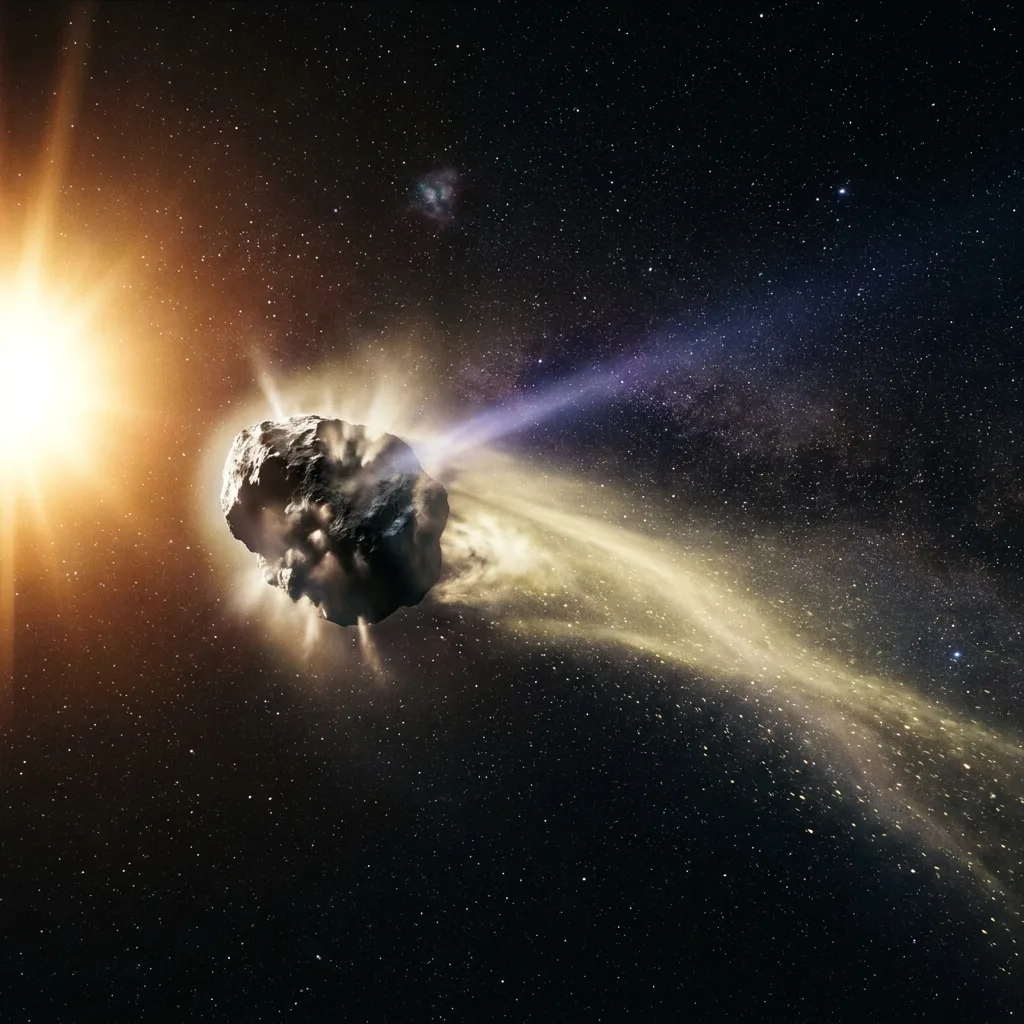
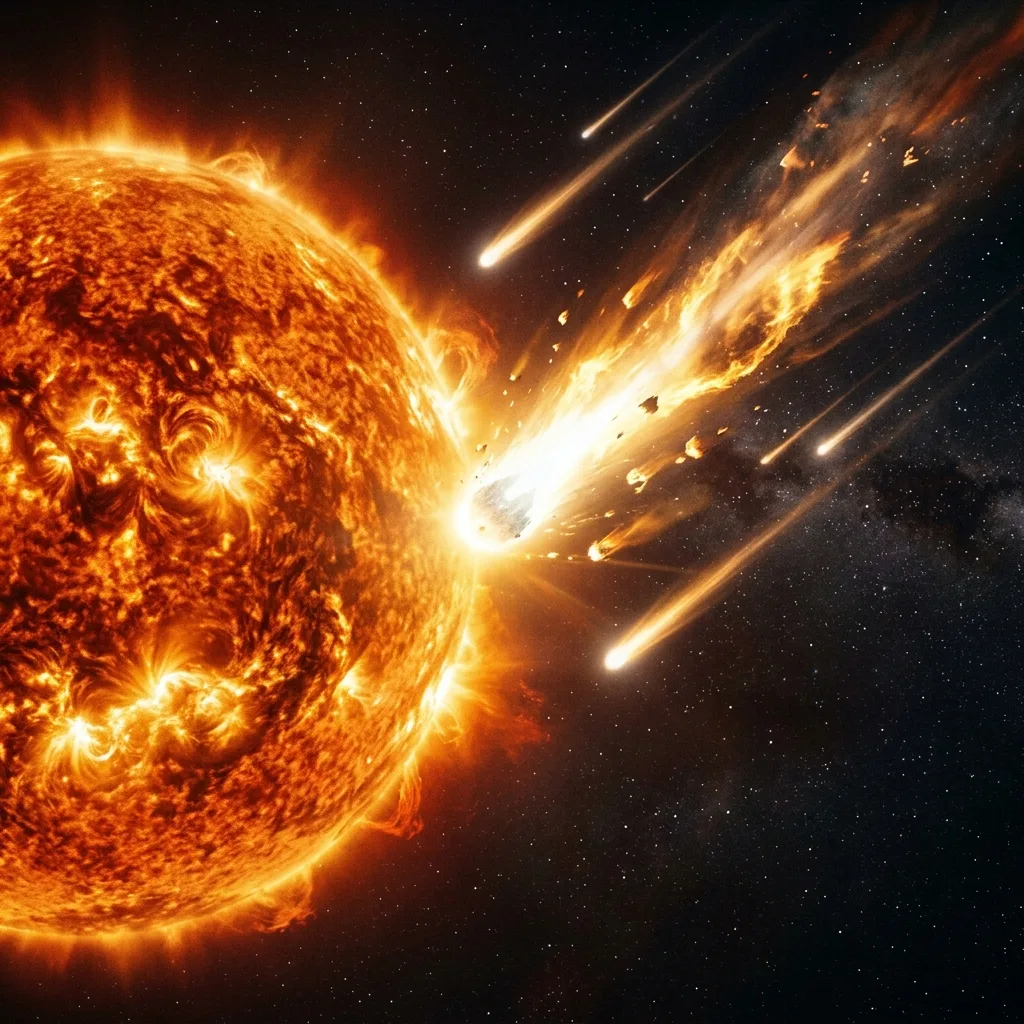
As a comet nears the Sun, solar radiation sublimates its volatile ice, releasing gas and dust that form the tail. At 3 AU from the Sun, the comet awakens. At 1 AU, it glows fiercely. A dramatic cosmic transformation.

Developing tails near the Sun

Halley's Comet

The most famous visitor.

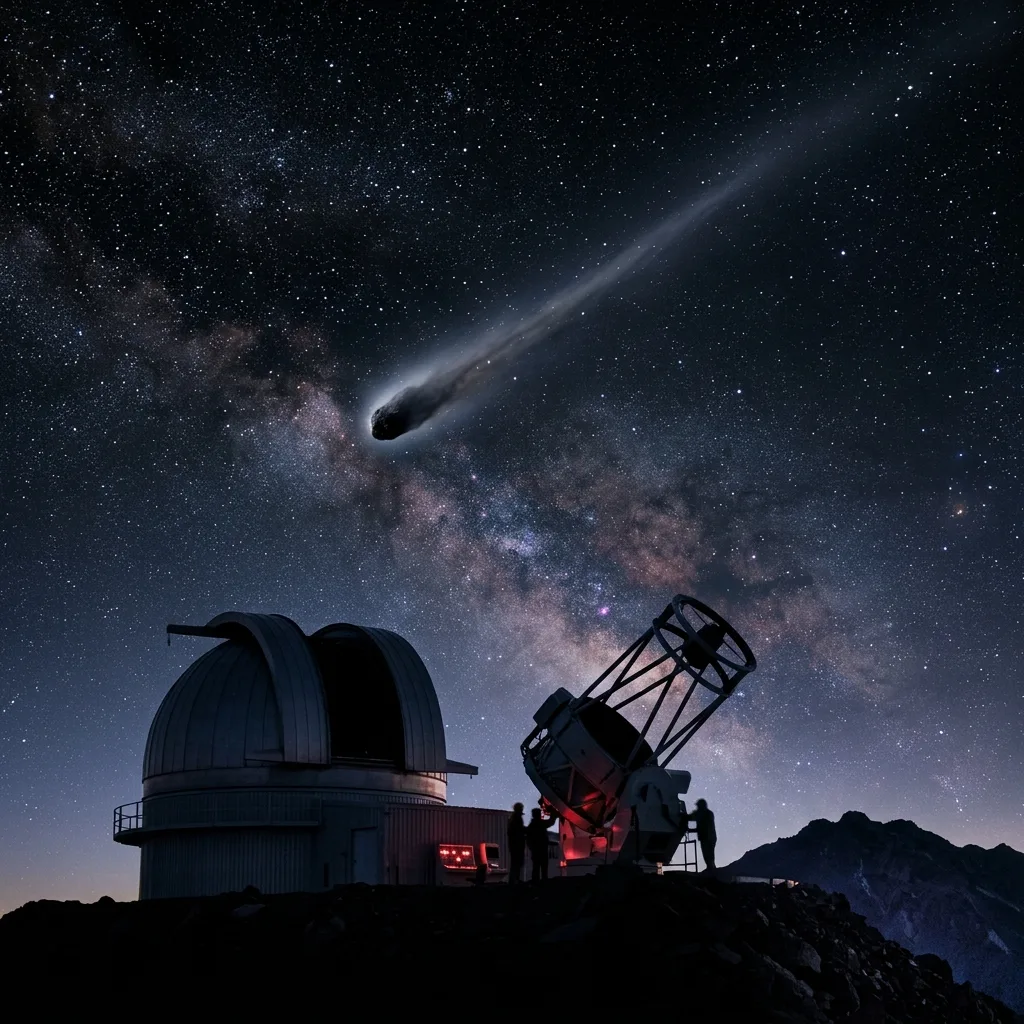
Halley's Comet returns every 75–76 years. Observed since at least 240 BC, Edmond Halley predicted its return in 1705. Last seen in 1986, it will return in 2061. It remains the most studied comet in history.
Halley's Comet

Visible from Earth

Celestial spectacles.

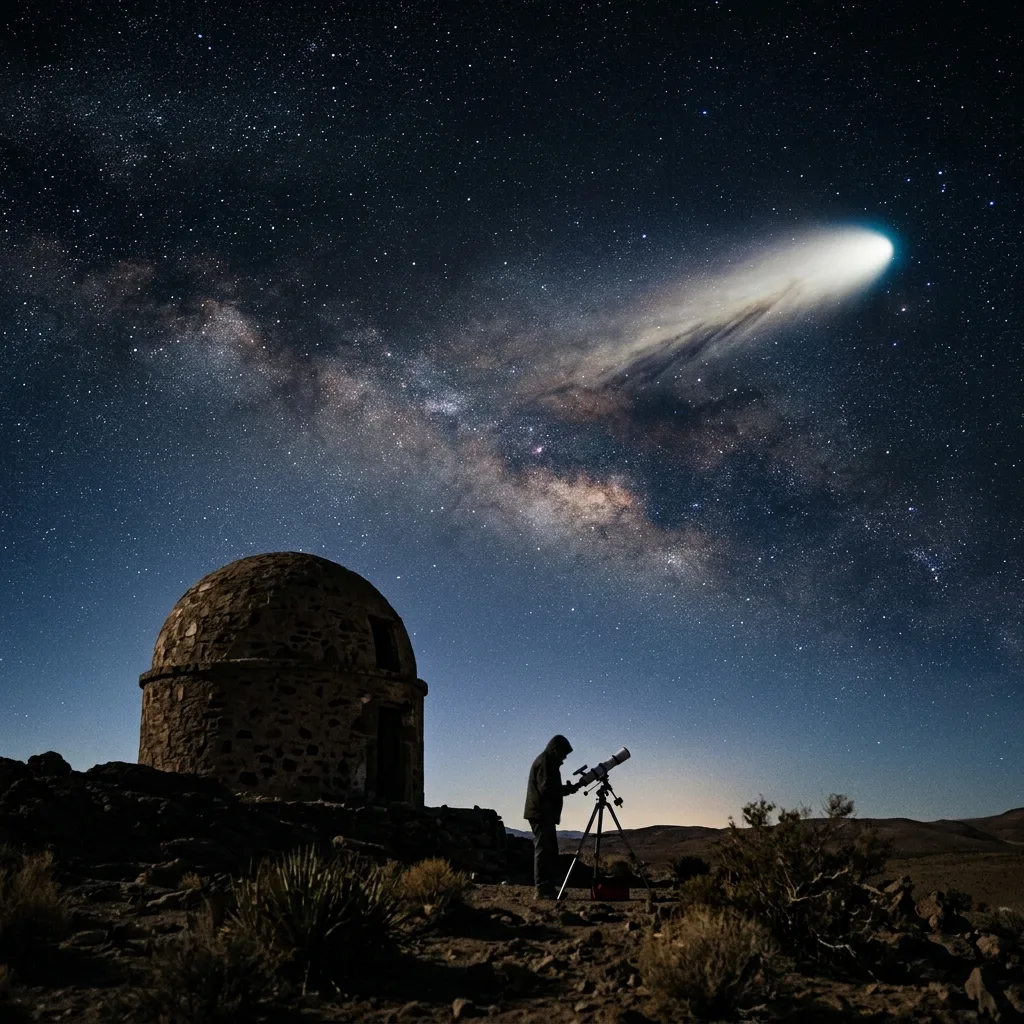
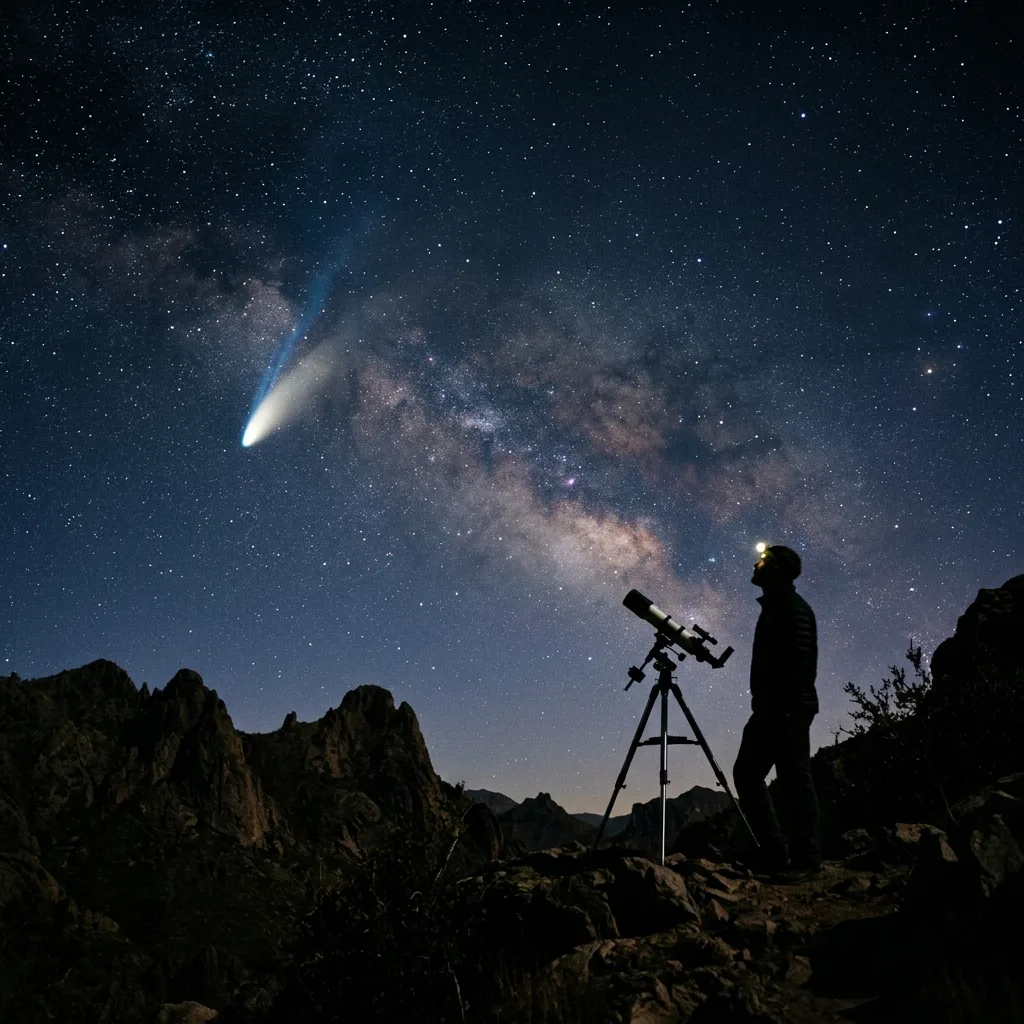
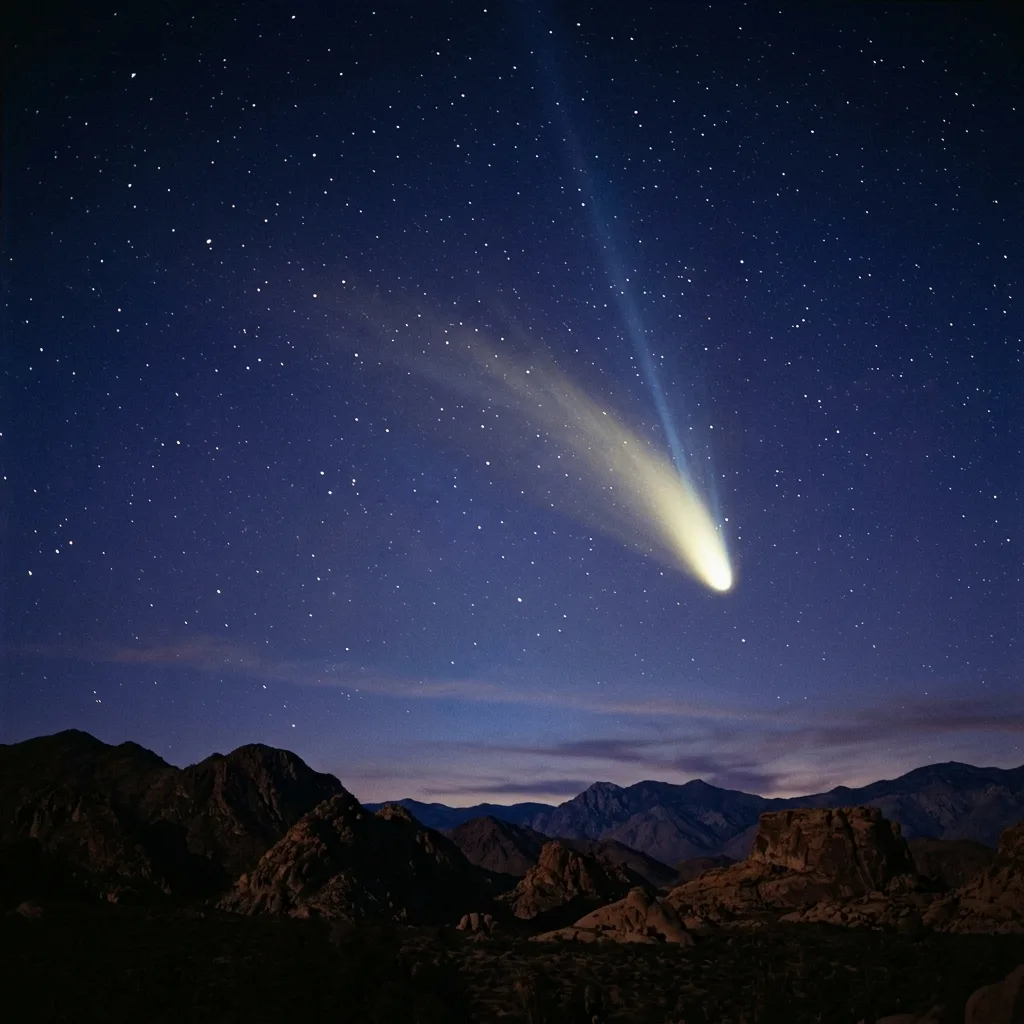
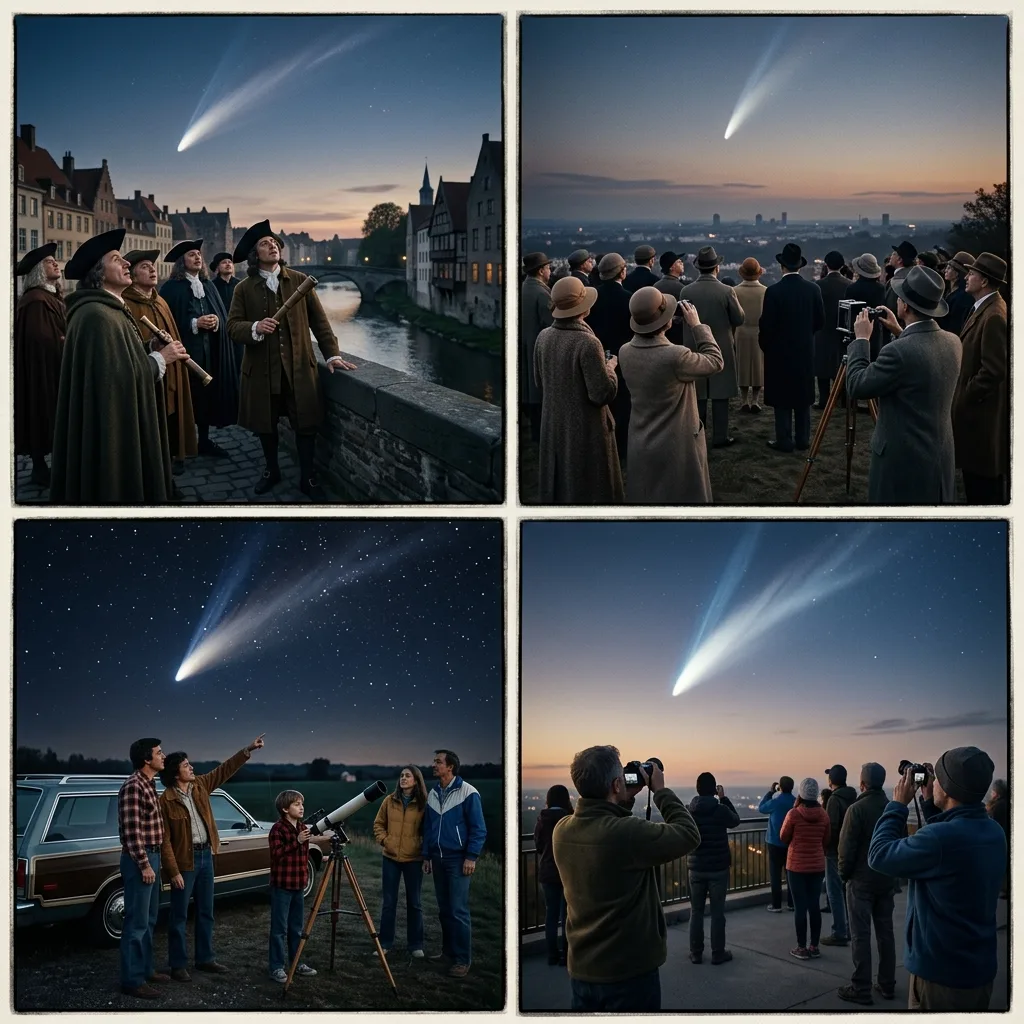
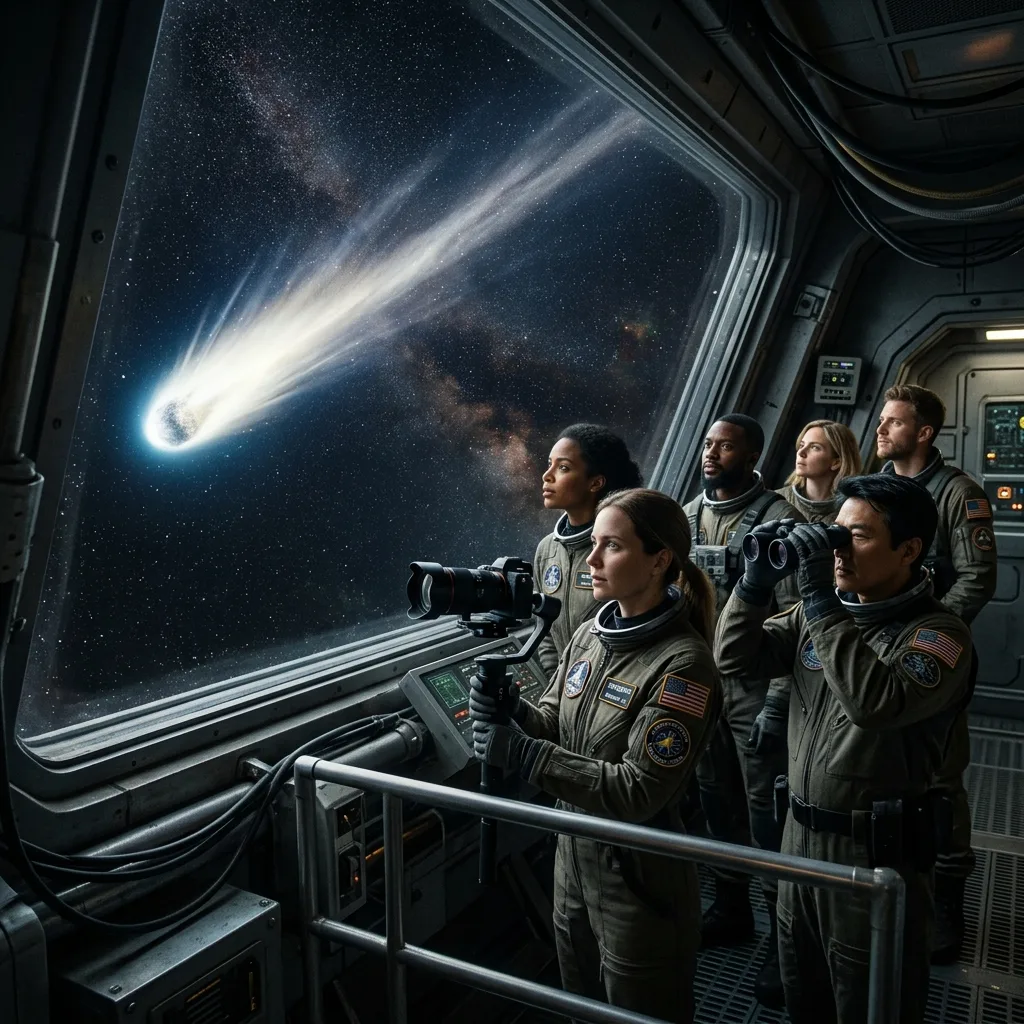
Bright comets can be seen with the naked eye, sweeping across the night sky with luminous tails. Hale-Bopp in 1997 remained visible for a record 18 months, connecting humanity with the cosmos.

Visible from Earth

But the surface only hides the obvious. Comets hold secrets traveling from the origin of the solar system.

2

Basic Knowledge

100 meters

What astronomy has revealed about the structure and behavior of comets.

Nucleus, coma, and tails

Anatomy of a comet.

The nucleus spans between 100 meters and 50 km. The coma can stretch 100,000 km across, while tails extend millions of kilometers. Proportions are deceiving: the solid nucleus is minuscule compared to its total structure.

Nucleus, coma, and tails

Ion tail and dust tail

Two tails, two forces.

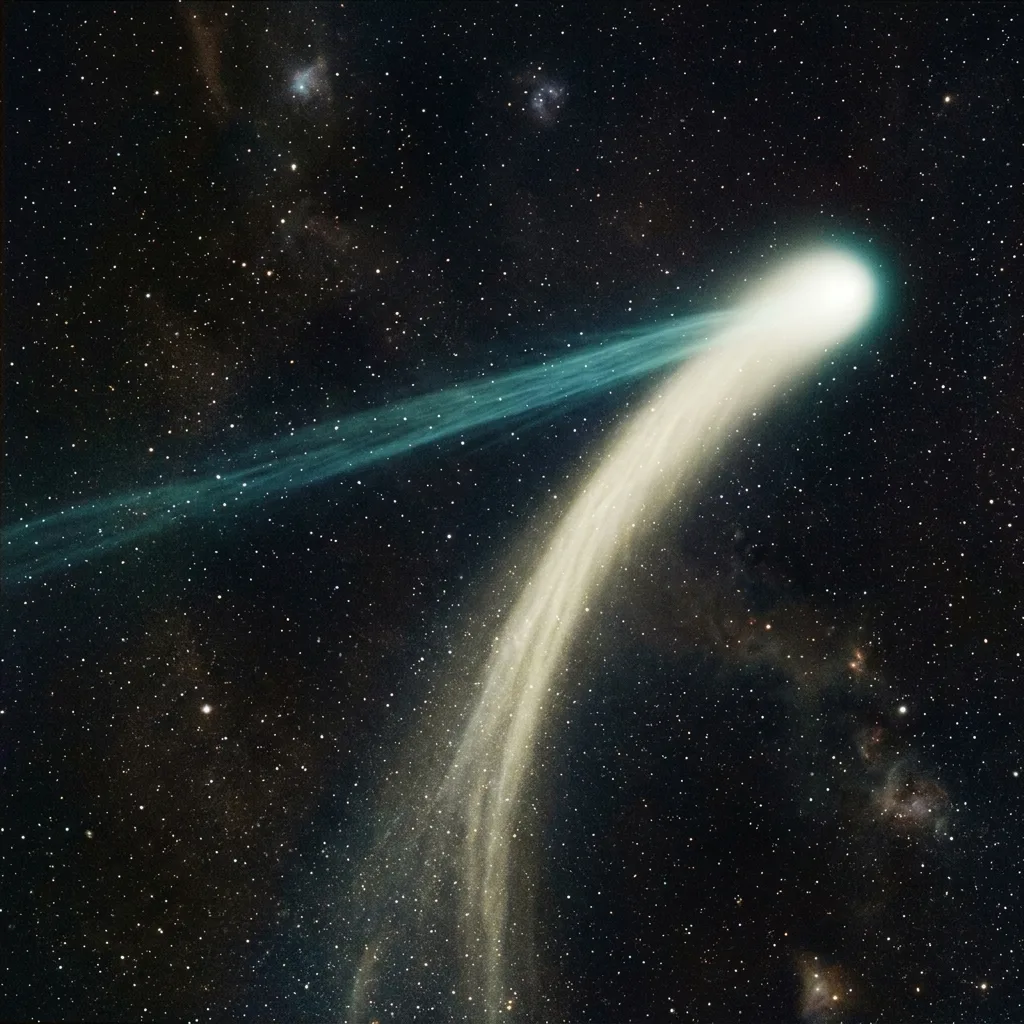
Comets feature two distinct tails: the straight, bluish ion tail driven by solar wind, and the curved, whitish dust tail pushed by radiation pressure. Both point in slightly different directions away from the Sun.

Ion tail and dust tail

Perihelion and aphelion

Extremes of the orbit.

Perihelion is the closest point to the Sun, where activity peaks. Aphelion is the furthest point, where the comet hibernates. The distance gap can span hundreds of AU, a journey between fire and eternal ice.

Perihelion and aphelion

Short-period and long-period comets

Two distinct families.

Short-period comets (< 200 years) originate from the Kuiper Belt. Long-period comets (> 200 years) hail from the distant Oort Cloud. Two origins, two histories, two fates.

Short-period and long-period comets

Comet Hale-Bopp (1997)

The Great Comet of the 20th century.

Discovered in 1995, Hale-Bopp reached peak brightness in 1997. Visible to the naked eye for 18 months, its nucleus measured an enormous 40–80 km across. It will not return until the year 4385.

Comet Hale-Bopp (1997)

Sun sublimating ice

The engine of activity.

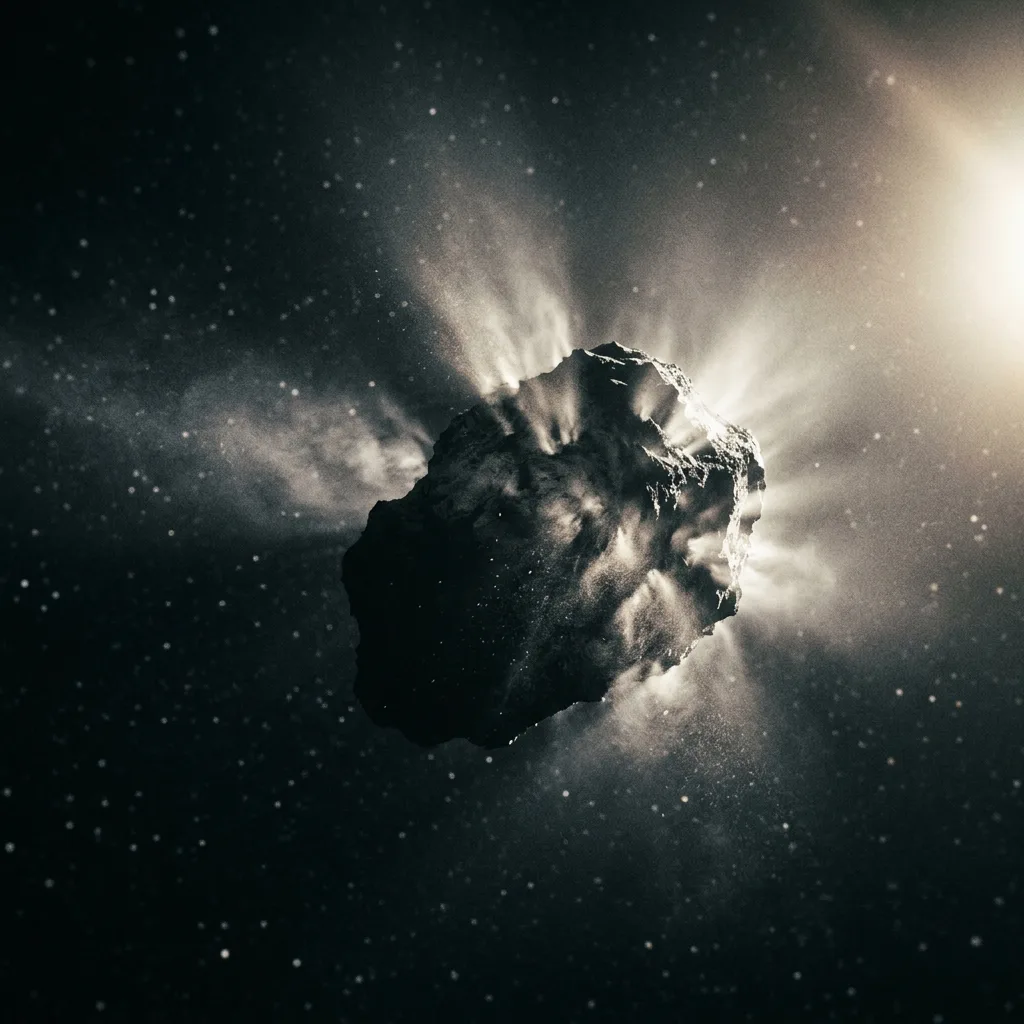
Nearing the Sun, solar radiation heats the nucleus, sublimating ice directly from solid to gas. Escaping gas drags dust particles, swelling the coma. The Sun is the engine awakening the frozen wanderer.

Sun sublimating ice

Historical bright comets

Markings of eras.

The Comet of 1680, the Great Comet of 1811, Comet West in 1976, Hyakutake in 1996. Every generation witnesses a bright comet, a rare event uniting humanity under a shared sky.

Historical bright comets

Amateur comet data

Hunters of the sky.

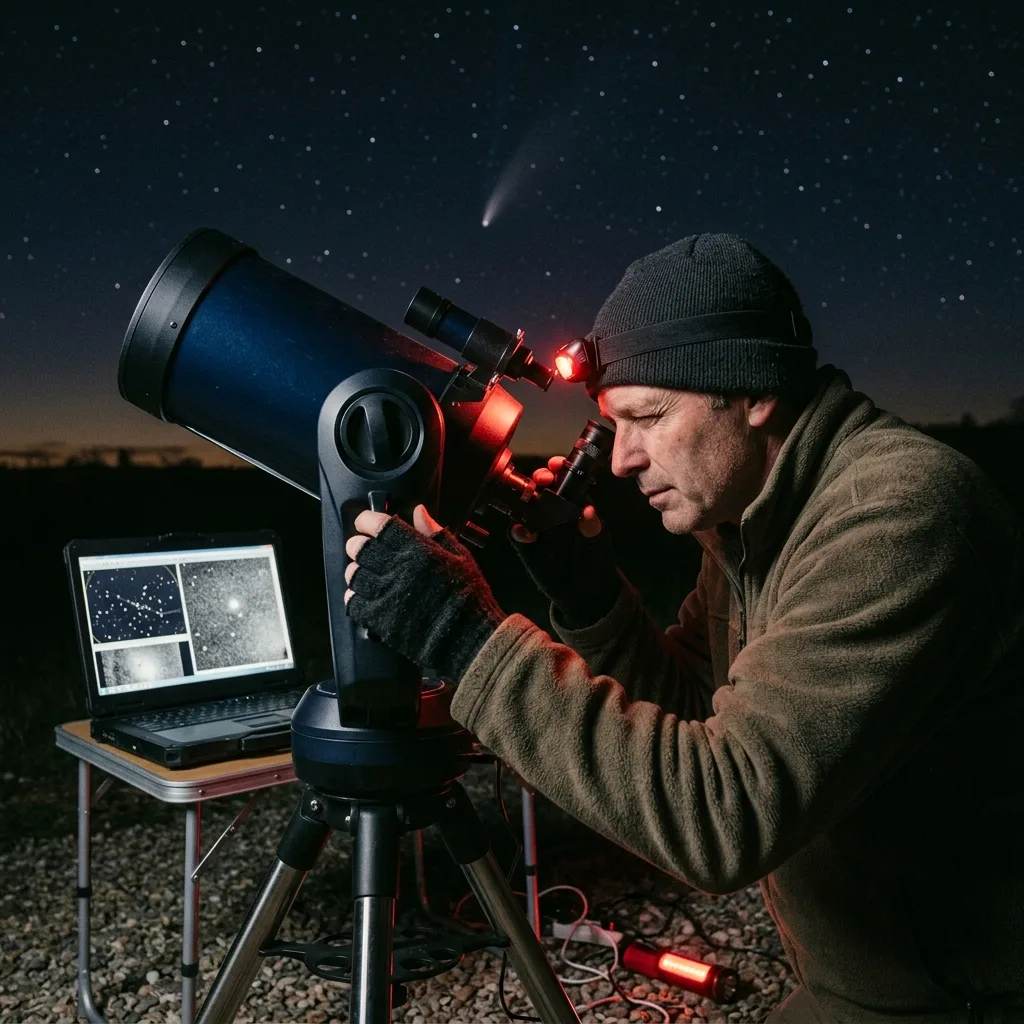
Many comets are discovered by amateur astronomers. Citizen scientists reviewing SOHO spacecraft data have discovered over 4,000 sungrazing comets. Amateur astronomy remains vital in the space age.

Amateur comet data

But there is more beneath the surface. Comets that shaped history and discoveries made by amateurs.

3

Families and Behavior

500 meters

Comet families, planetary interactions, and strange gravitational behavior.

Jupiter-family comets

Captives of the giant.

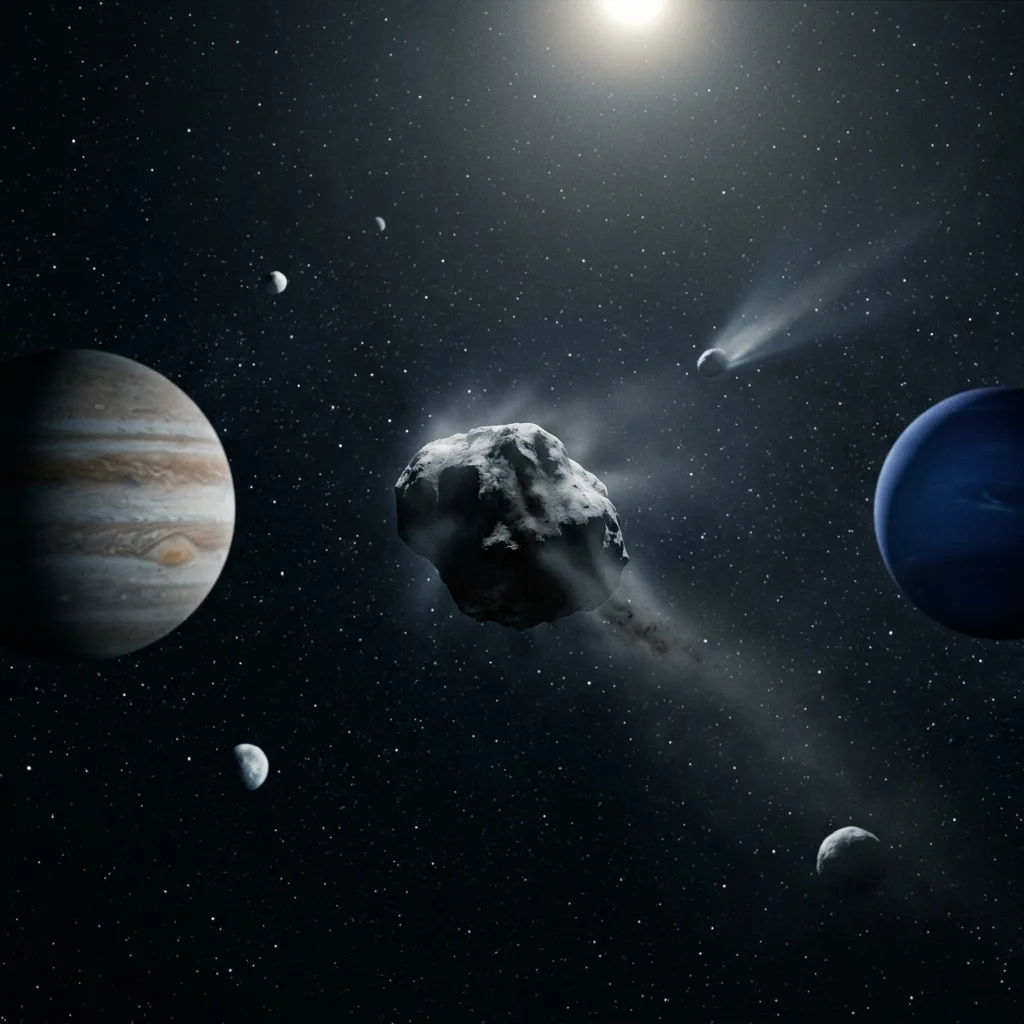
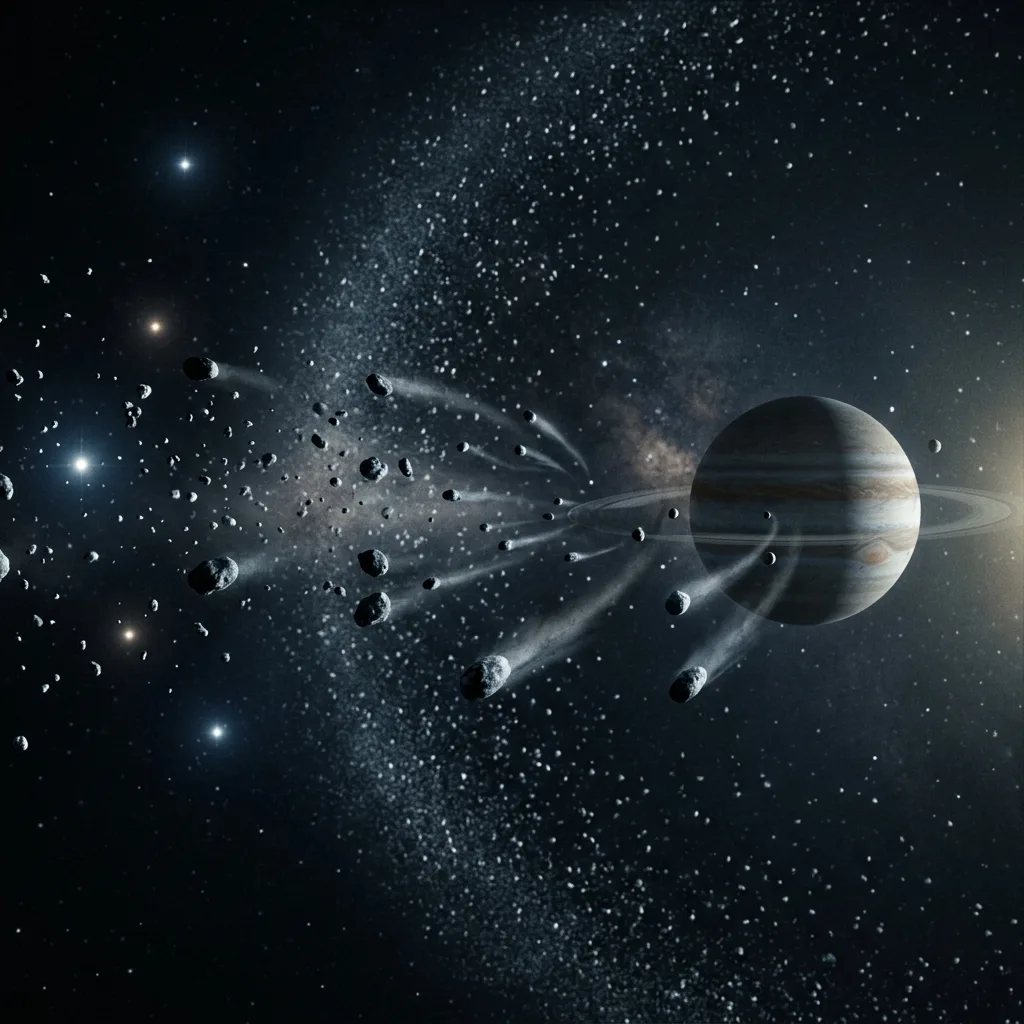
Jupiter-family comets have short orbital periods (5–20 years) shaped by Jupiter's gravity. Captured by the gas giant, Jupiter acts as a cosmic shepherd dictating their orbital paths.

Jupiter-family comets

Nucleus disintegration

Death of a comet.

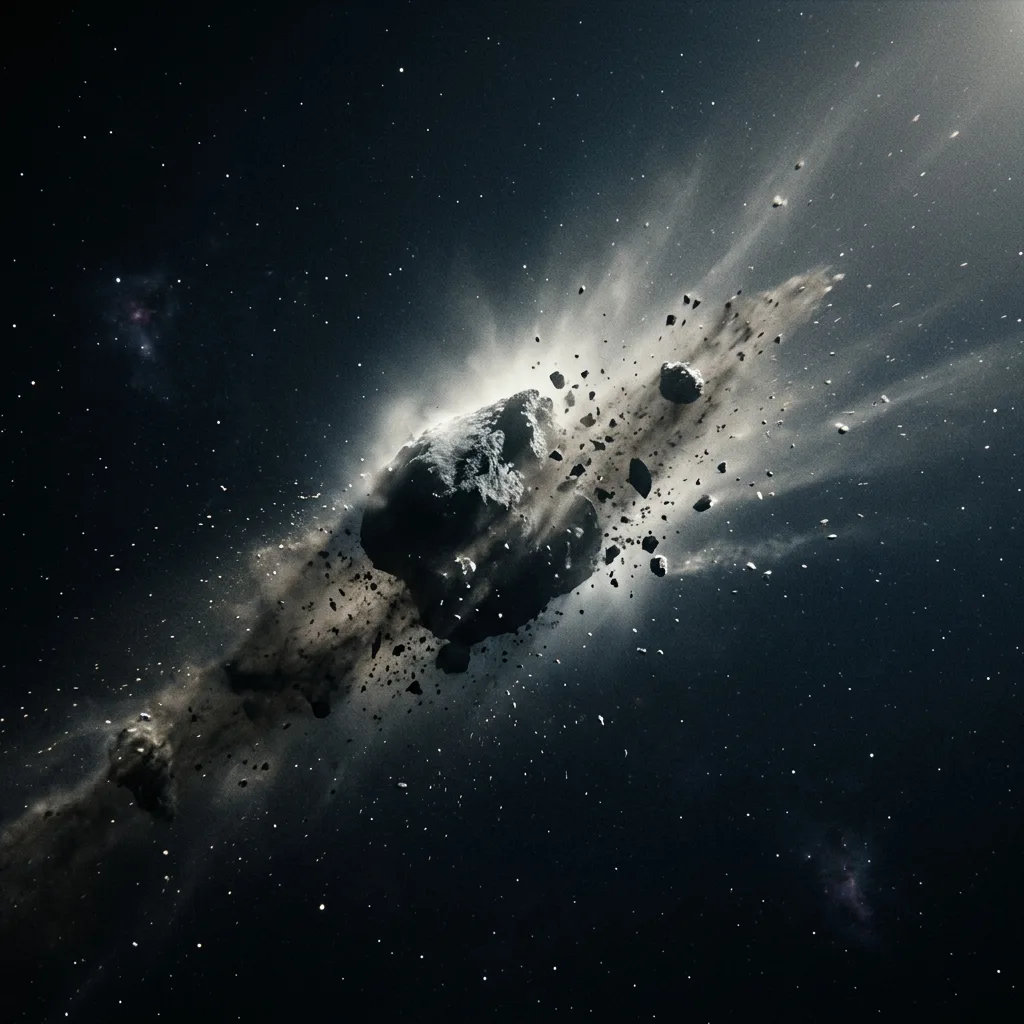
Comets lose mass with every solar pass. Eventually, they disintegrate entirely or turn into inert, asteroid-like rocks. Comet Biela split in 1846; others crumbled under direct observation.

Nucleus disintegration

Gas and dust jets

Geysers of the comet.

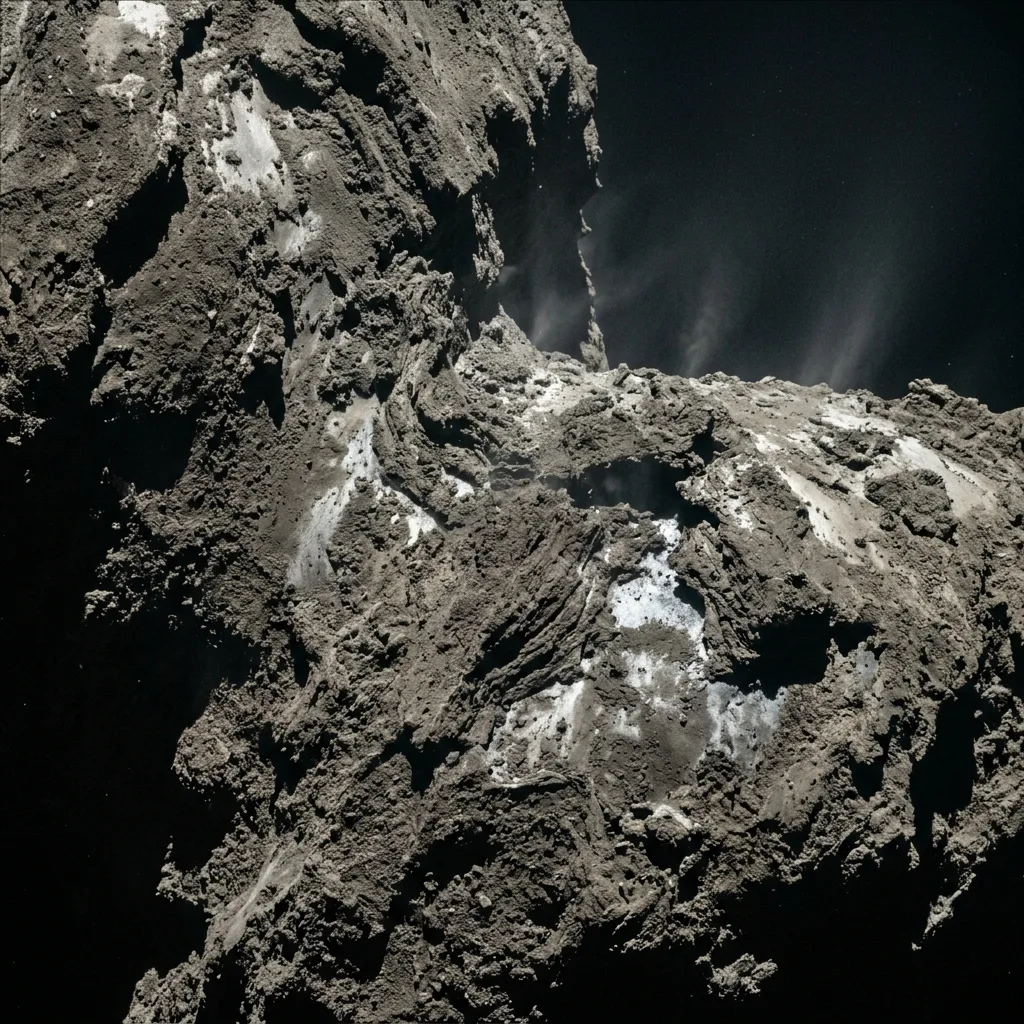
Sublimation is not uniform across a comet. Gas and dust erupt from active vents as powerful jets. These jets act as natural thrusters, altering the comet's spin and orbital trajectory.

Gas and dust jets

Centaur comets

Between two worlds.

Centaurs are hybrid objects orbiting between Jupiter and Neptune with unstable paths. They can evolve into active comets or be ejected from the solar system altogether, caught in transition.

Centaur comets

Comet Shoemaker-Levy 9

The comet destroyed by Jupiter.

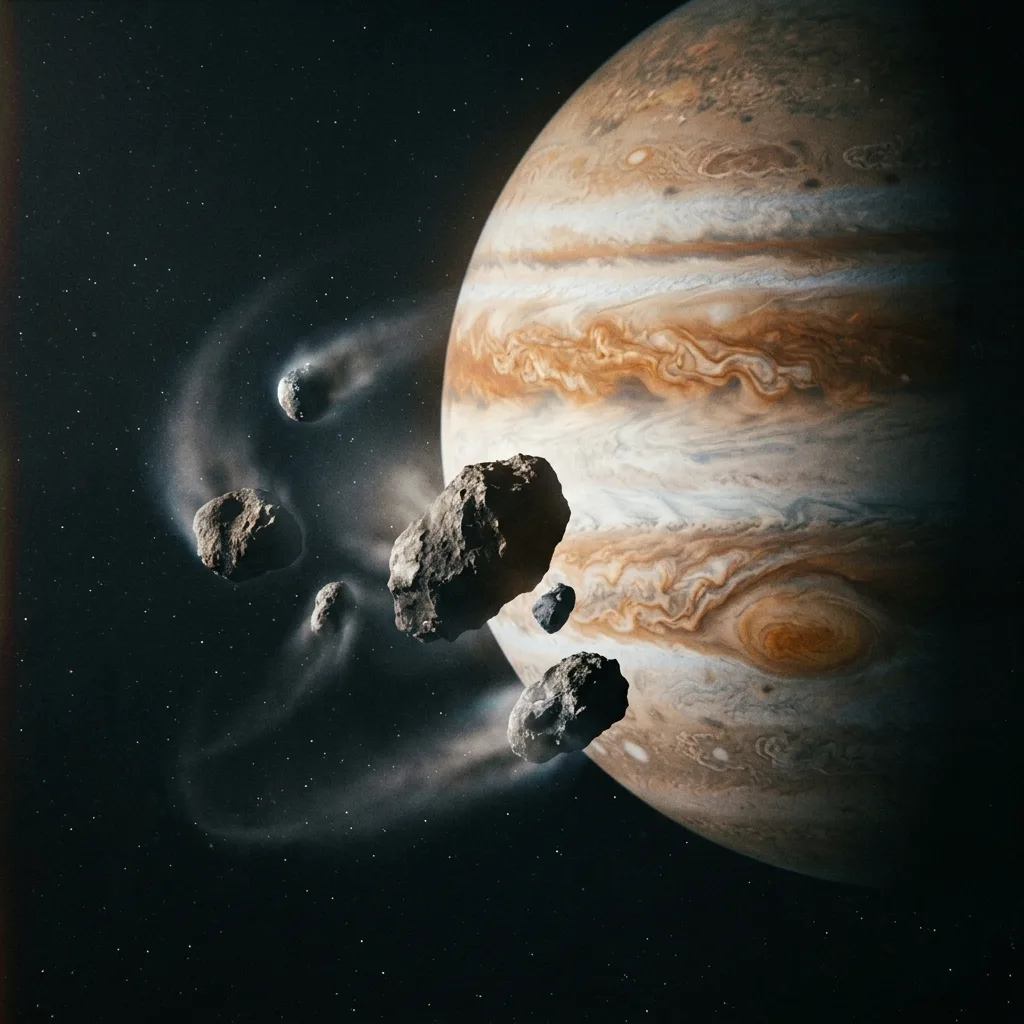
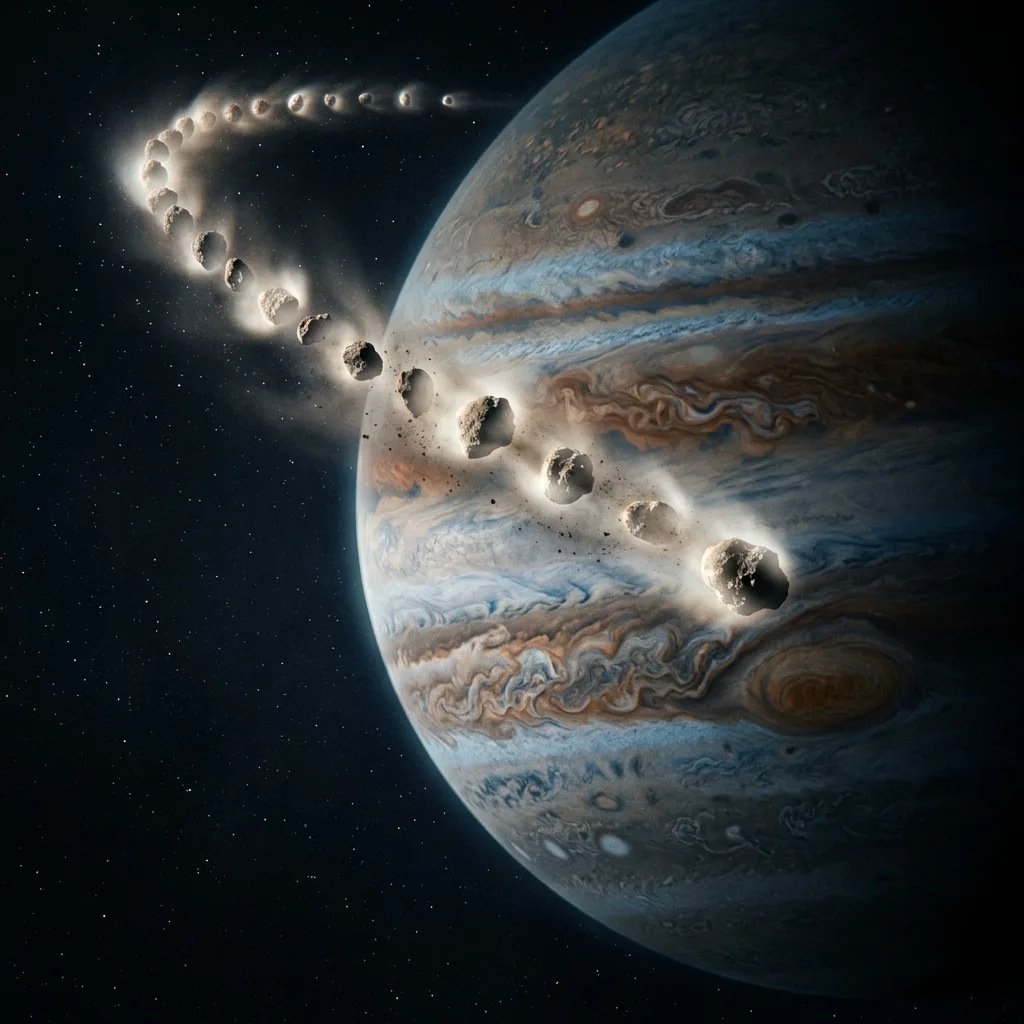
Discovered in 1993, Shoemaker-Levy 9 was ripped into 21 fragments by Jupiter's tidal forces. In July 1994, all fragments slammed into Jupiter—the first observed collision of solar system bodies.

Comet Shoemaker-Levy 9

Comet impacts on Jupiter

Solar system's shield.

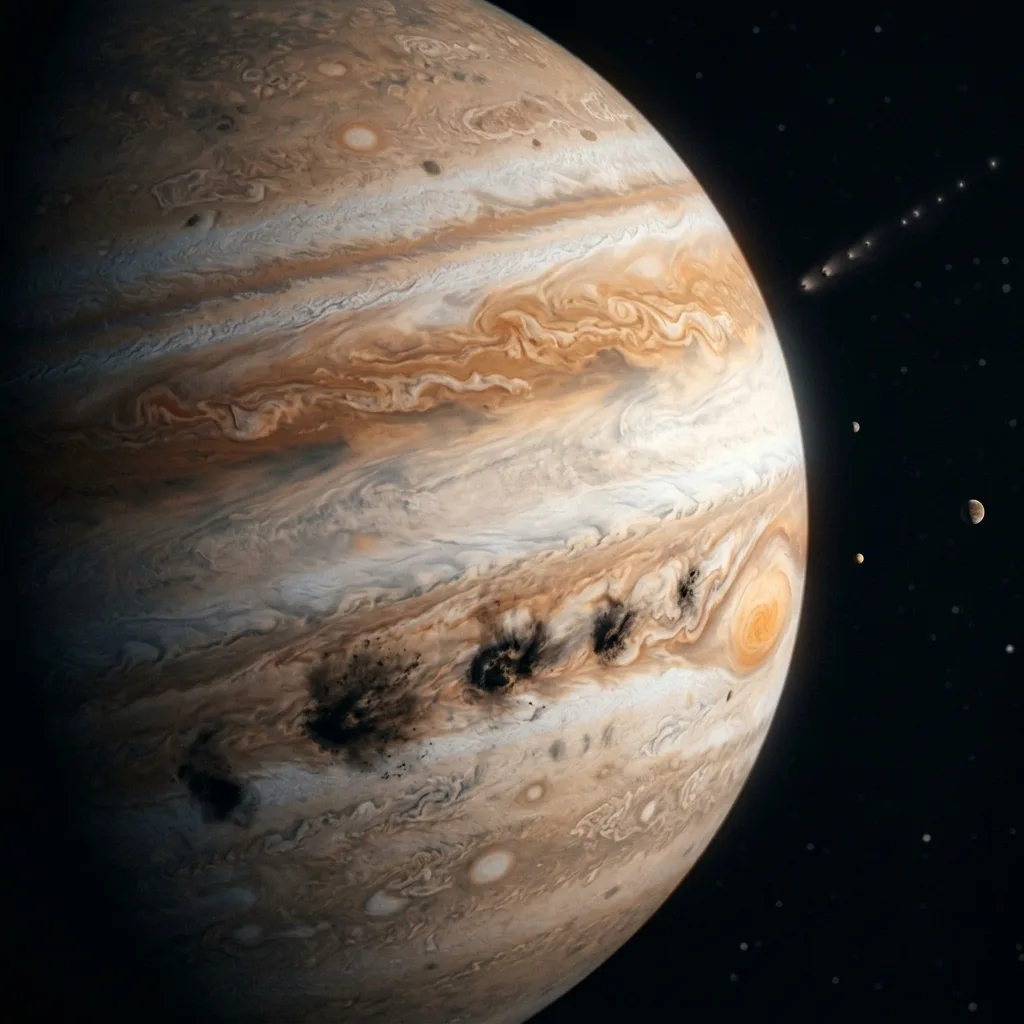
Jupiter acts as a gravitational shield, deflecting or swallowing comets that might otherwise strike Earth. The Shoemaker-Levy 9 impacts left Earth-sized scars in the Jovian atmosphere.

Comet impacts on Jupiter

Non-gravitational acceleration

Self-propelled wanderers.

Outgassing jets act like rocket thrusters, pushing the comet off pure gravitational courses. This non-gravitational acceleration makes long-term orbital predictions challenging.

Non-gravitational acceleration

Retrograde comets

Traveling against the tide.

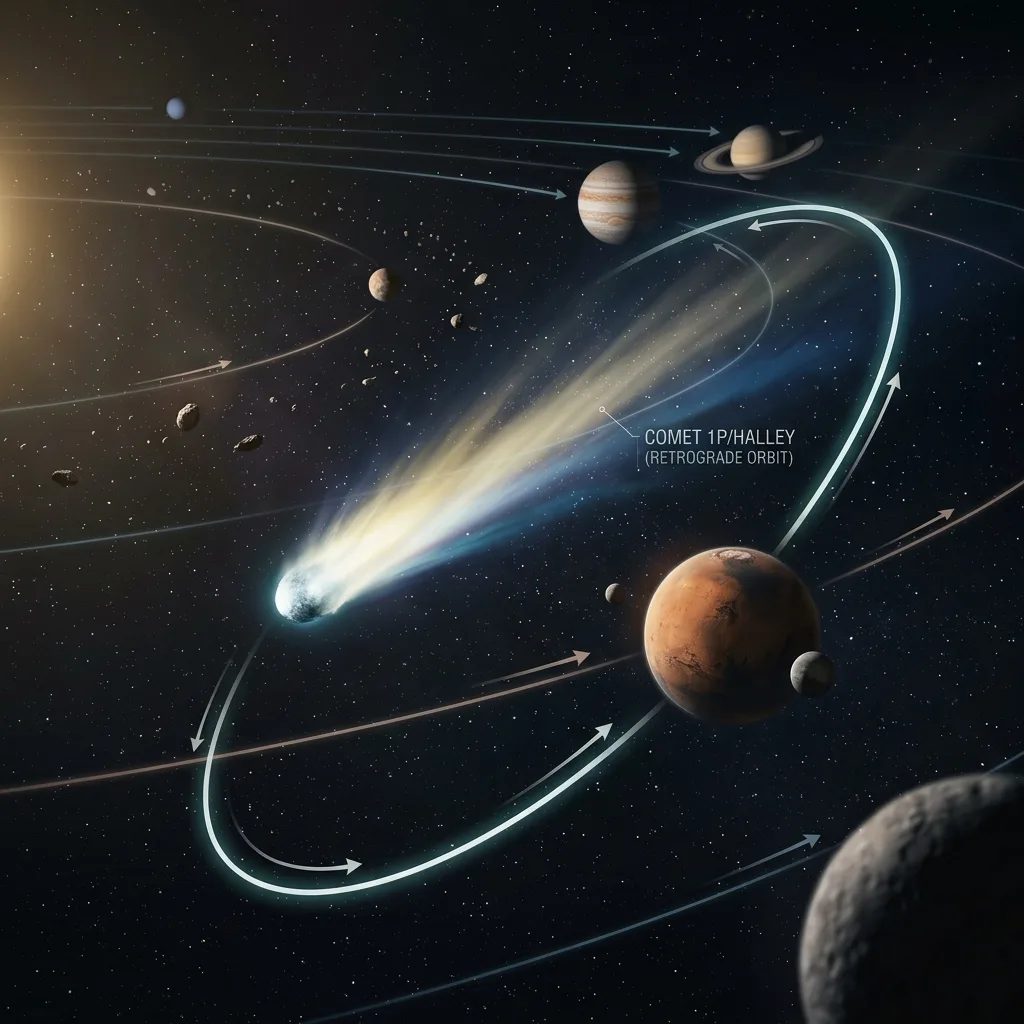
Some comets orbit in reverse relative to planetary motion. Halley's Comet is retrograde. These comets experience high-speed encounters with planets, rendering their orbits chaotic.

Retrograde comets

Comets do not travel alone. They have families, fates, and behaviors defying simple gravity.

4

The Oort Cloud

1,000 meters

The distant realm of long-period comets. The outer boundary of the solar system.

Oort Cloud comets

Long-distance travelers.

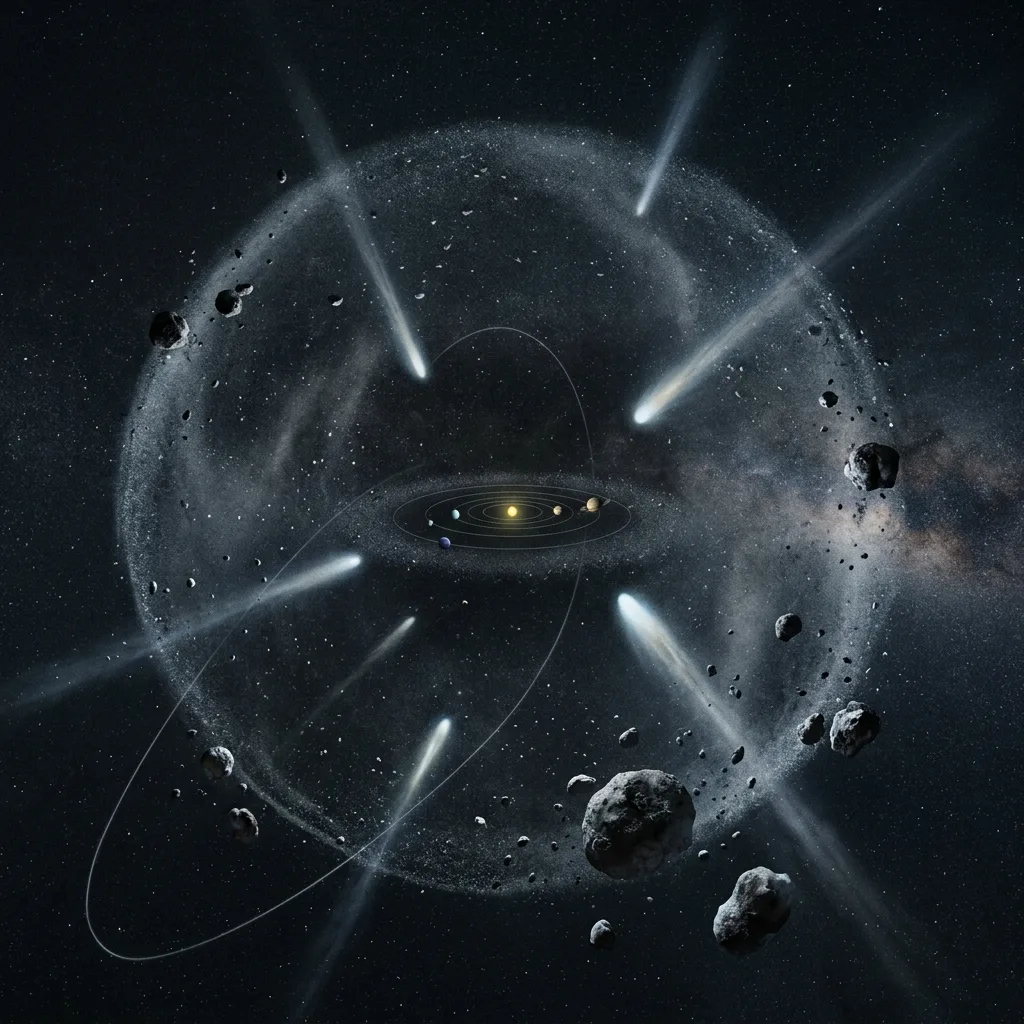
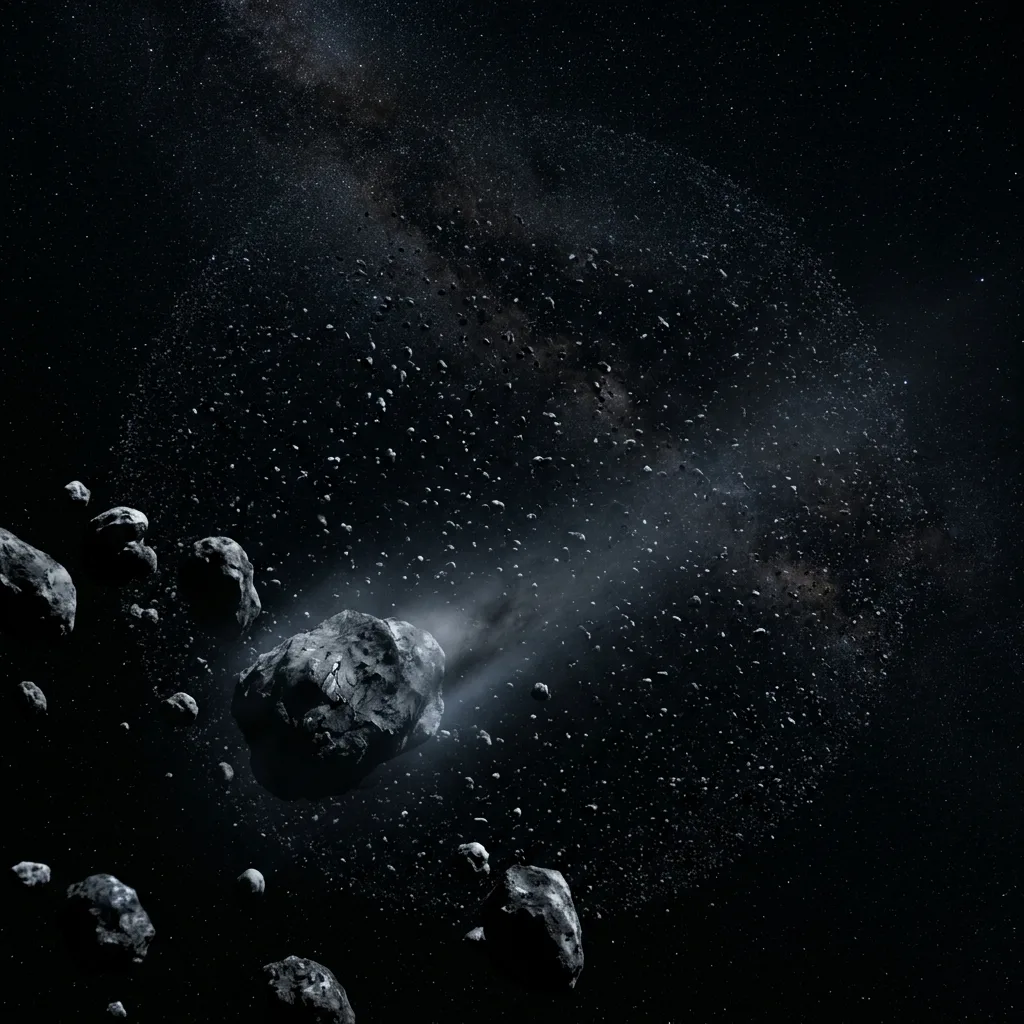
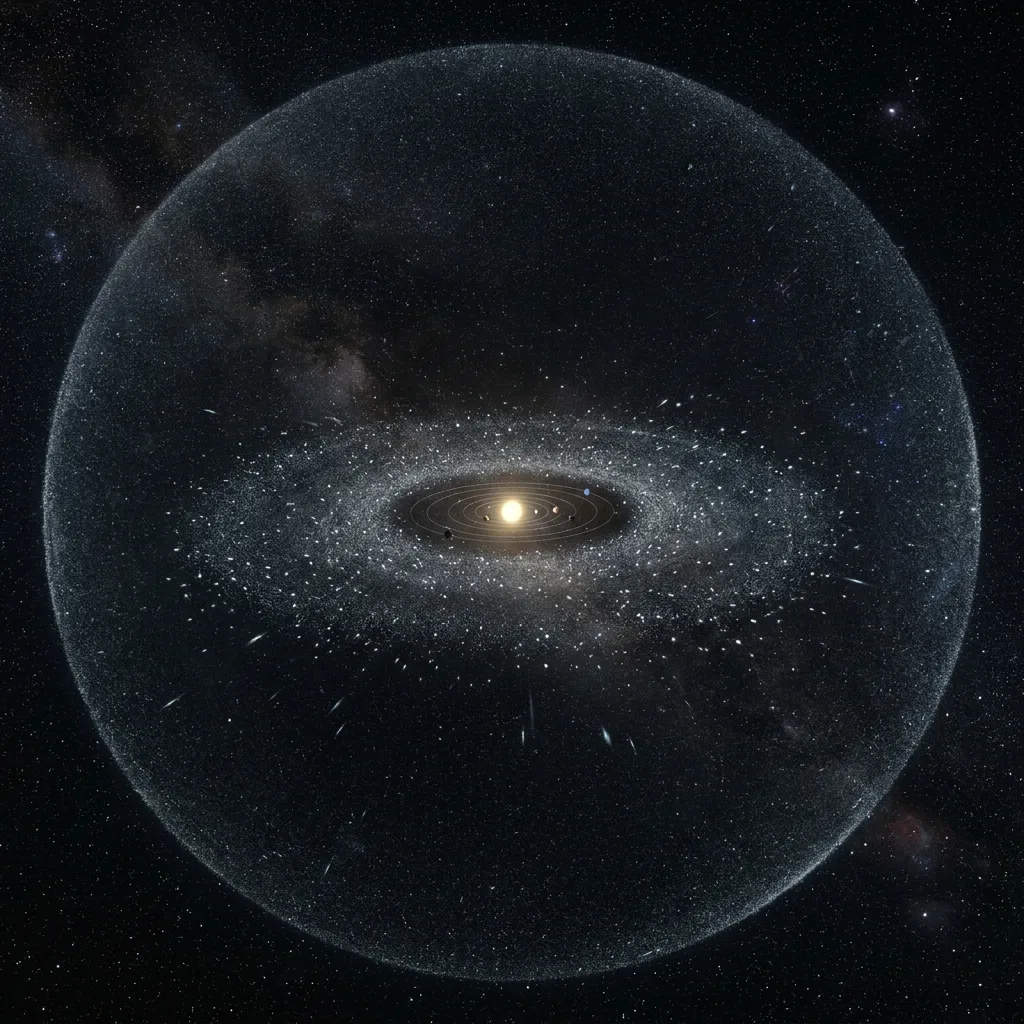
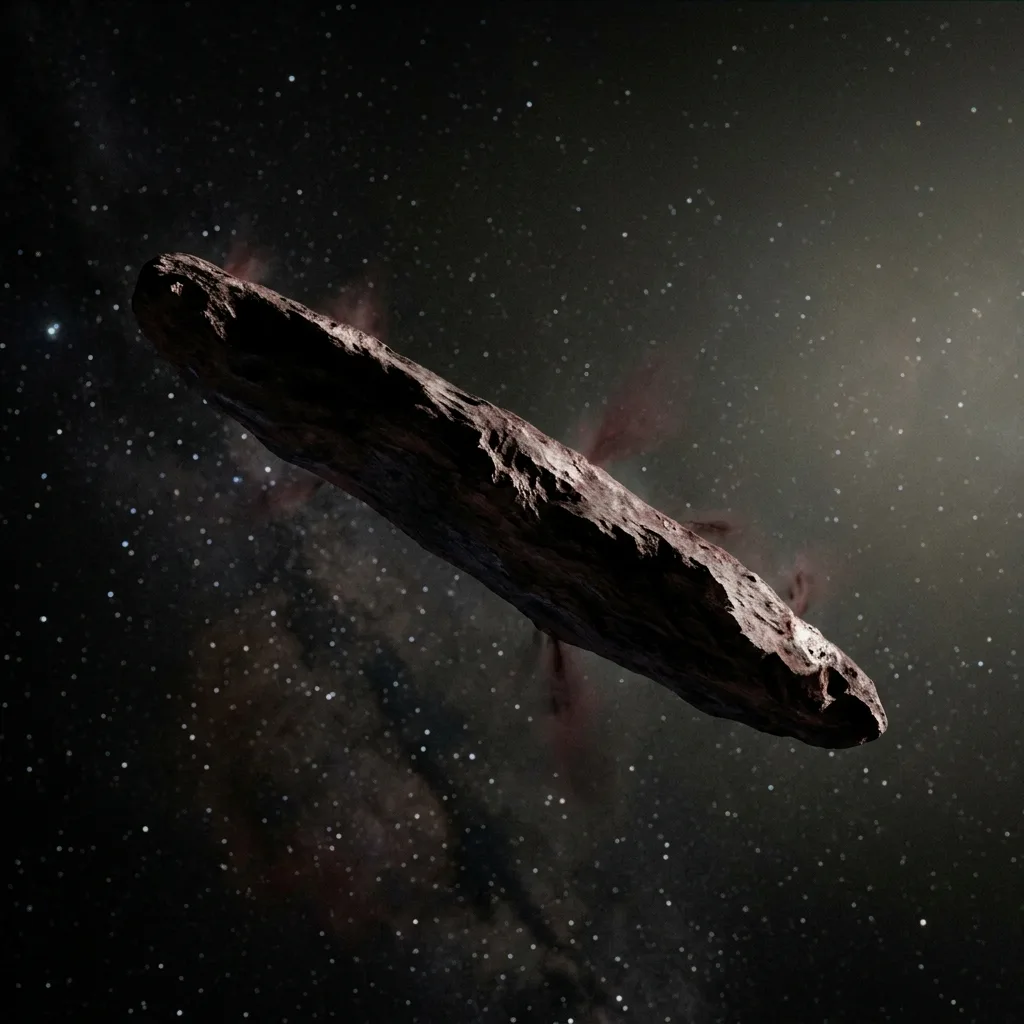
Long-period comets originate from the Oort Cloud, a distant shell of icy bodies surrounding the solar system at 2,000 to 100,000 AU. Their orbits span thousands or millions of years.
Oort Cloud comets

The hypothetical Oort Cloud

The theoretical frontier.

Proposed by Jan Oort in 1950, the Oort Cloud has never been imaged directly. Its existence is inferred from long-period comet orbits. It harbors trillions of icy bodies totaling several Earth masses.

The hypothetical Oort Cloud

Inner and outer Oort Cloud

Two distinct zones.

The inner Oort Cloud (2,000–20,000 AU) is disk-shaped, while the outer region (20,000–100,000 AU) is spherical. The inner is tied to the Sun; the outer is influenced by the galaxy itself.

Inner and outer Oort Cloud

Gravitational perturbations sending comets inward

Cosmic nudges.

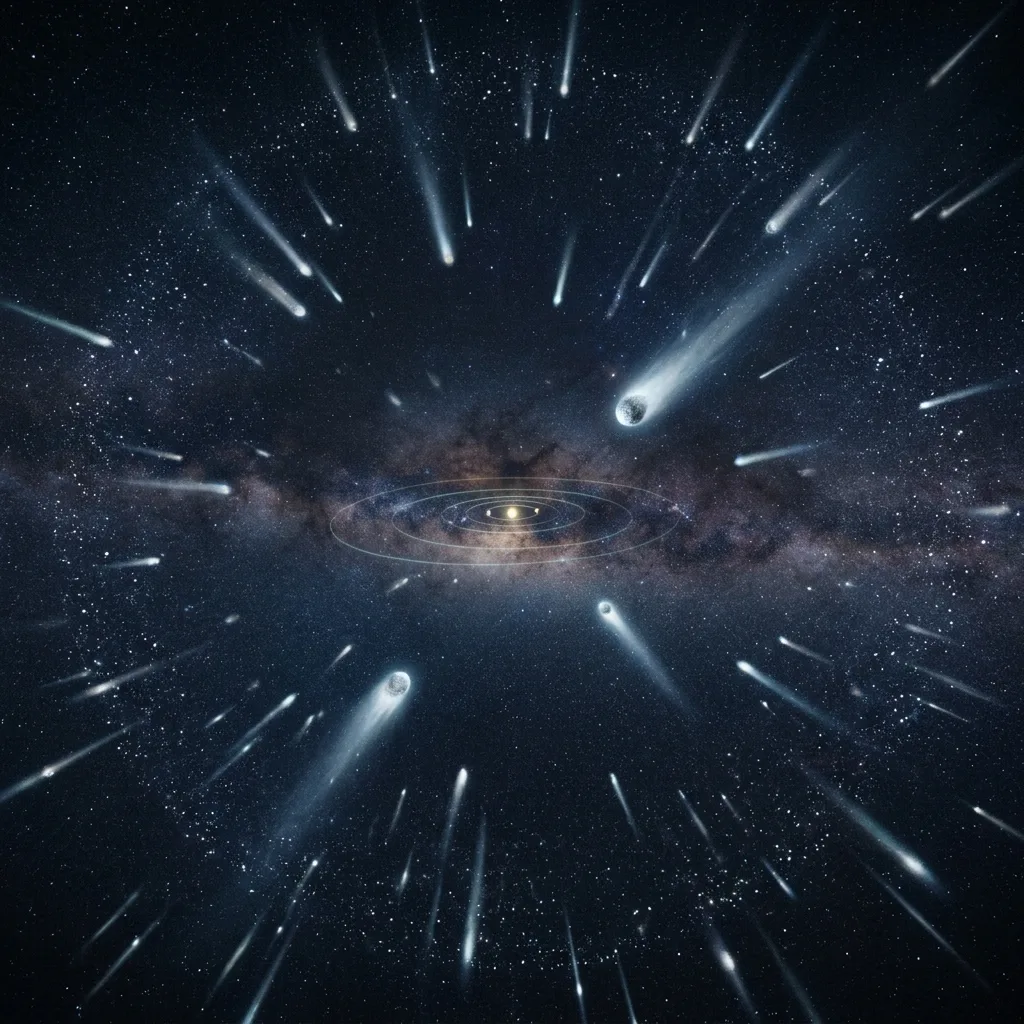
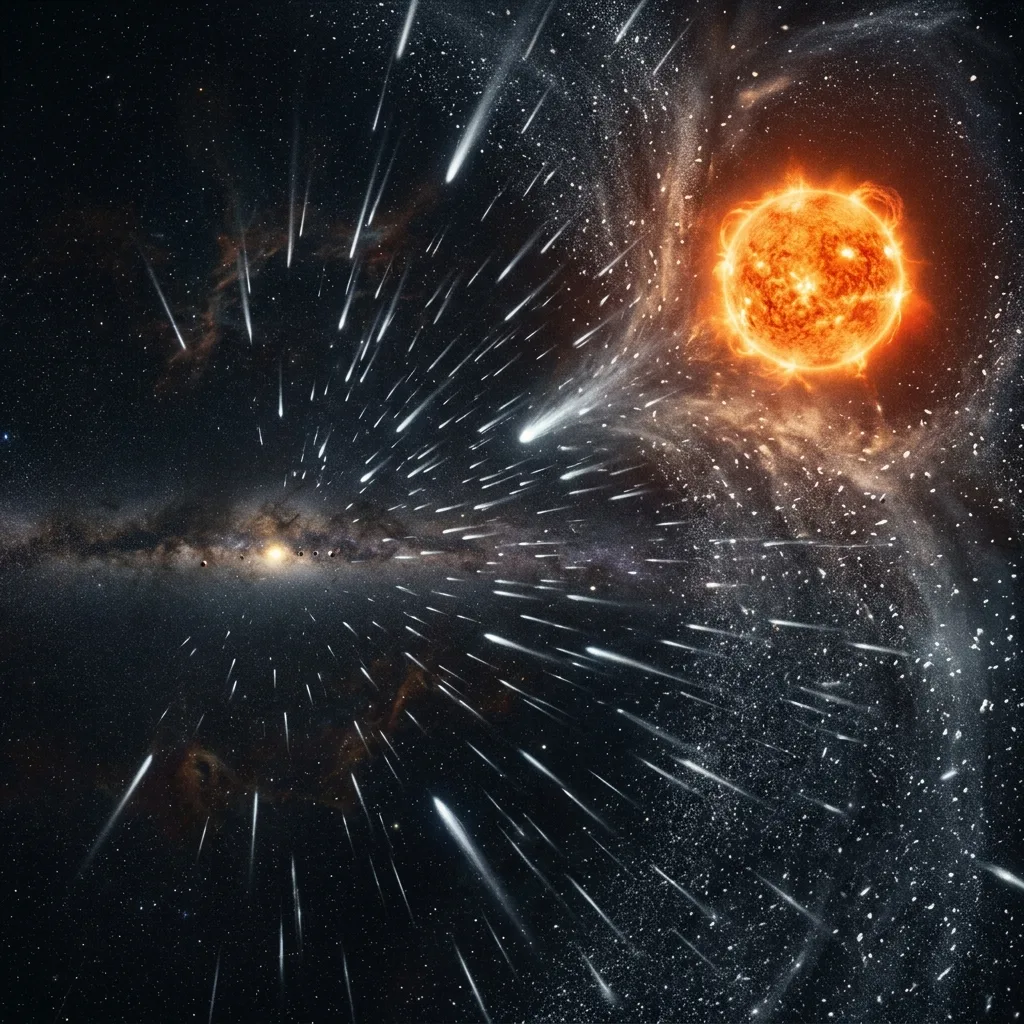
Passing stars, galactic tides, and giant planets gravitationally nudge Oort Cloud bodies, sending them plummeting toward the inner solar system in a slow, continuous stream.

Gravitational perturbations sending comets inward

Near-isotropic cloud distribution

Arriving from all directions.

Oort Cloud comets arrive from random angles across the sky, unlike Kuiper Belt comets confined to the ecliptic plane. This isotropic distribution confirms the cloud's spherical shape.

Near-isotropic cloud distribution

Stellar passes triggering comet showers

Stellar visitors.

When a star passes near our solar system, its gravity shakes the Oort Cloud, triggering comet showers. Scholz's Star passed 0.8 light-years away 70,000 years ago, likely disturbing thousands of comets.

Stellar passes triggering comet showers

Galactic tide influence

The pull of the Milky Way.

The gravitational field of the Milky Way exerts tidal forces on the outer Oort Cloud. This galactic tide is a primary driver sending fresh comets into the inner solar system.

Galactic tide influence

Life cycle of a comet

Birth, activity, and end.

Born in icy outer realms, a comet is perturbed inward. Active for thousands of solar passes, it sheds mass until it disintegrates or turns into a dead asteroid core. A multi-billion-year cycle.

Life cycle of a comet

Beyond everything known, a vast sphere of comets lies in wait.

5

Interstellar Visitors

2,500 meters

Comets originating from other stars. Travelers born in alien solar systems.

Interstellar comets

Messengers from alien stars.

Interstellar comets originate outside our solar system. Traveling on hyperbolic paths at unbound speeds, they are wanderers carrying pristine chemical samples from alien worlds.

Interstellar comets

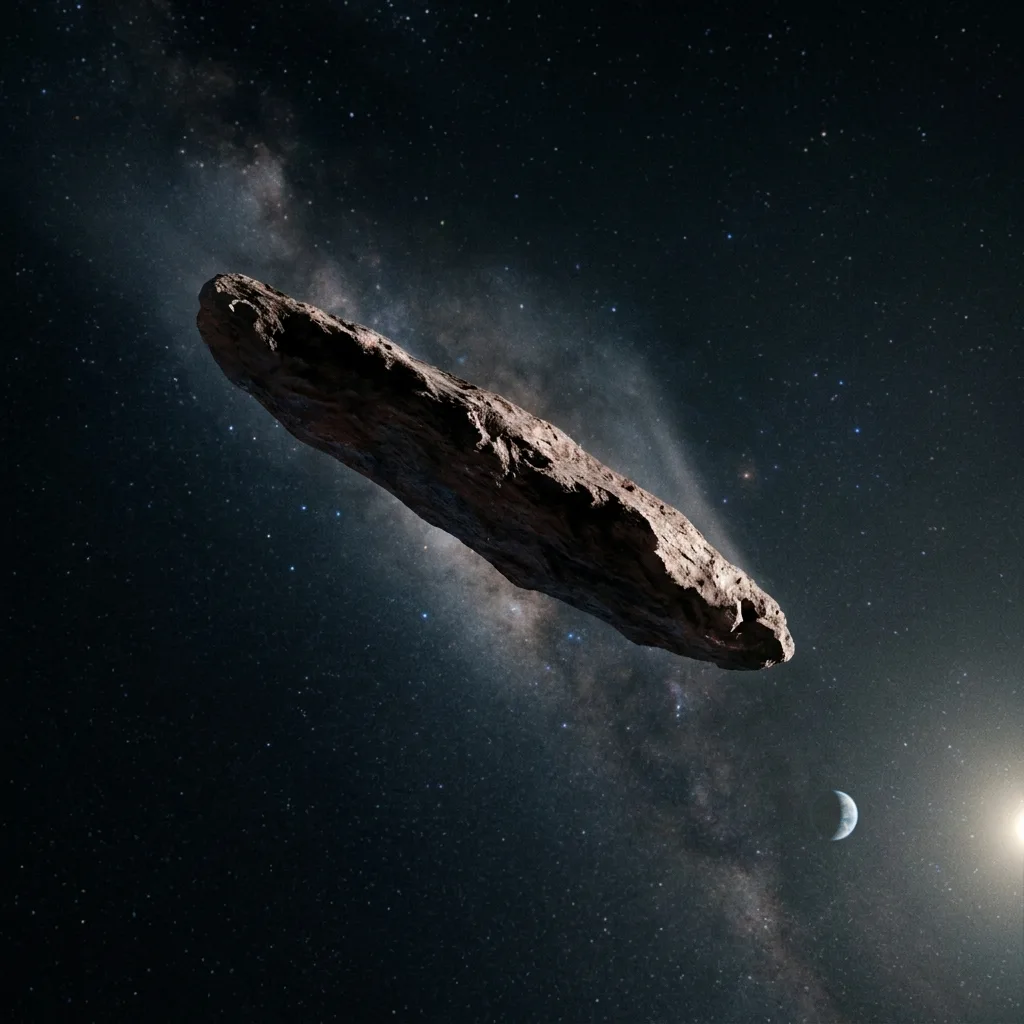
'Oumuamua as an ancient comet

The first interstellar guest.

Discovered in 2017, 'Oumuamua was the first detected interstellar object. Elongated and accelerating without a visible coma, scientists debate if it is an ancient, outgassed comet fragment.

'Oumuamua as an ancient comet

2I/Borisov: first confirmed interstellar comet

A comet from another star.

Discovered in 2019 by Gennady Borisov, 2I/Borisov is the first confirmed interstellar comet. Displaying a genuine coma and tail, it sped past the Sun at 32 km/s on a hyperbolic trajectory.

2I/Borisov: first confirmed interstellar comet

Origin in alien star systems

Born far from our Sun.

Interstellar comets formed around other stars before being ejected by giant planets. Drifting through interstellar space for millions of years, they occasionally pass through alien systems.

Origin in alien star systems

Hyperbolic trajectories

One-way journeys.

Interstellar objects possess orbital eccentricities greater than 1, tracking hyperbolic paths. They pass the Sun once and leave for eternity, cosmic tourists that never return.

Hyperbolic trajectories

Unique chemical composition

Alien chemistry.

2I/Borisov exhibited unusual carbon monoxide-to-water ratios compared to local comets. Each interstellar visitor brings distinct chemical fingerprints from its parent star system.

Unique chemical composition

Extreme velocities

Too fast to belong.

Interstellar comets travel at 20–50 km/s relative to the Sun—far exceeding escape velocity. This extreme speed is the definitive proof of their origin outside our solar system.

Extreme velocities

Rare encounters

Once in a decade guests.

While thousands of tiny interstellar objects pass through our solar system constantly, detecting them is exceedingly hard. Confirmed sightings like 'Oumuamua and Borisov remain rare treasures.

Rare encounters

Not all comets belong to us. Some hail from alien suns.

6

Space Missions

4,000 meters

Spacecraft missions sent to encounter comets in situ.

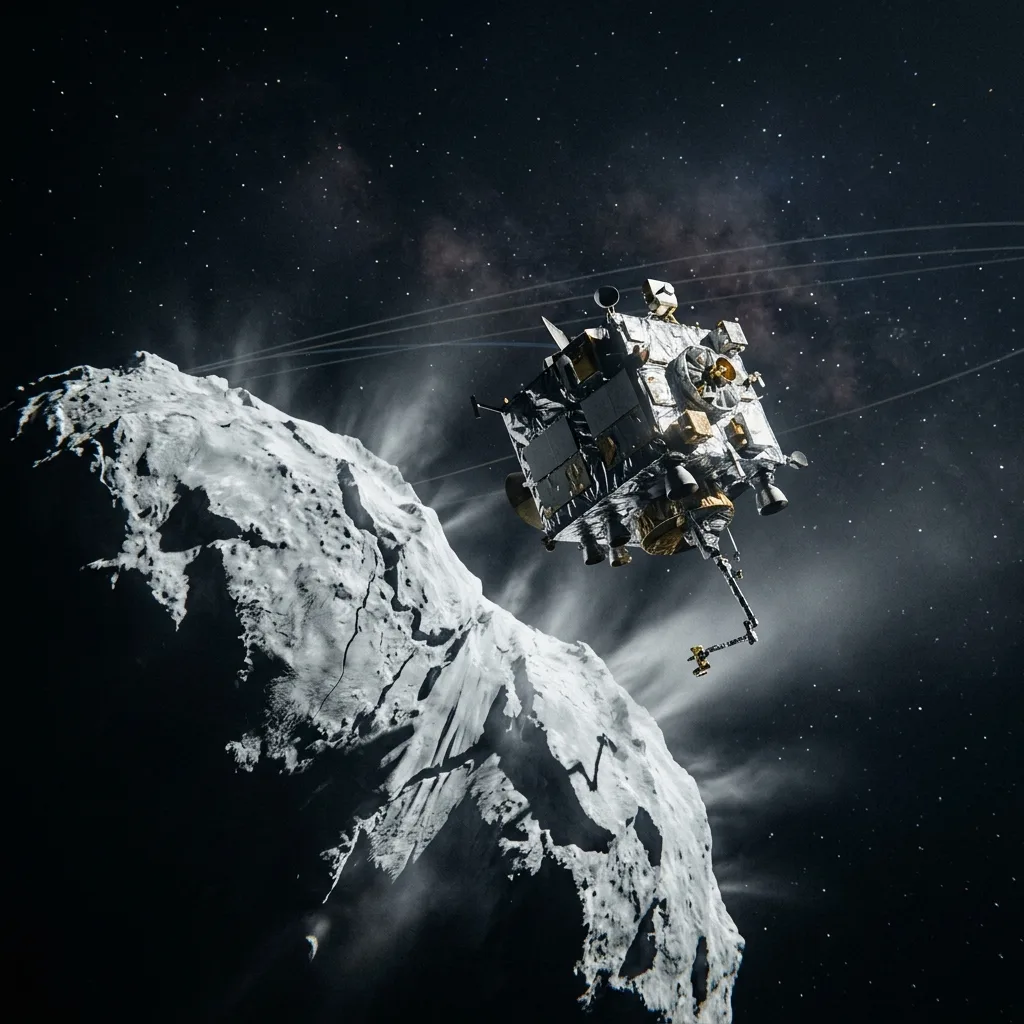
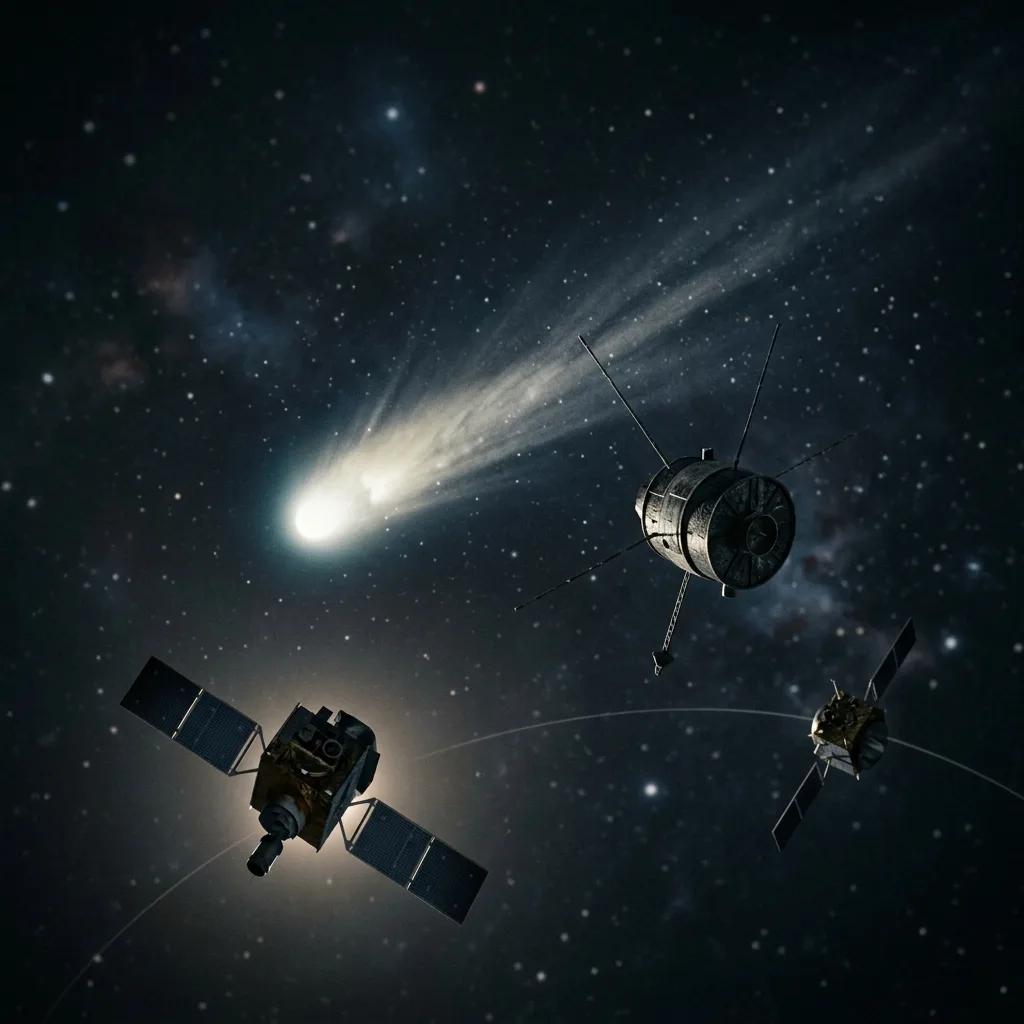
Space missions to comets

Direct exploration.

Since the 1980s, over 15 spacecraft have explored comets: Giotto, Deep Impact, Rosetta, Stardust. Each mission transformed icy myths into concrete planetary science.

Space missions to comets

Deep Impact and Tempel 1

Impactor for science.

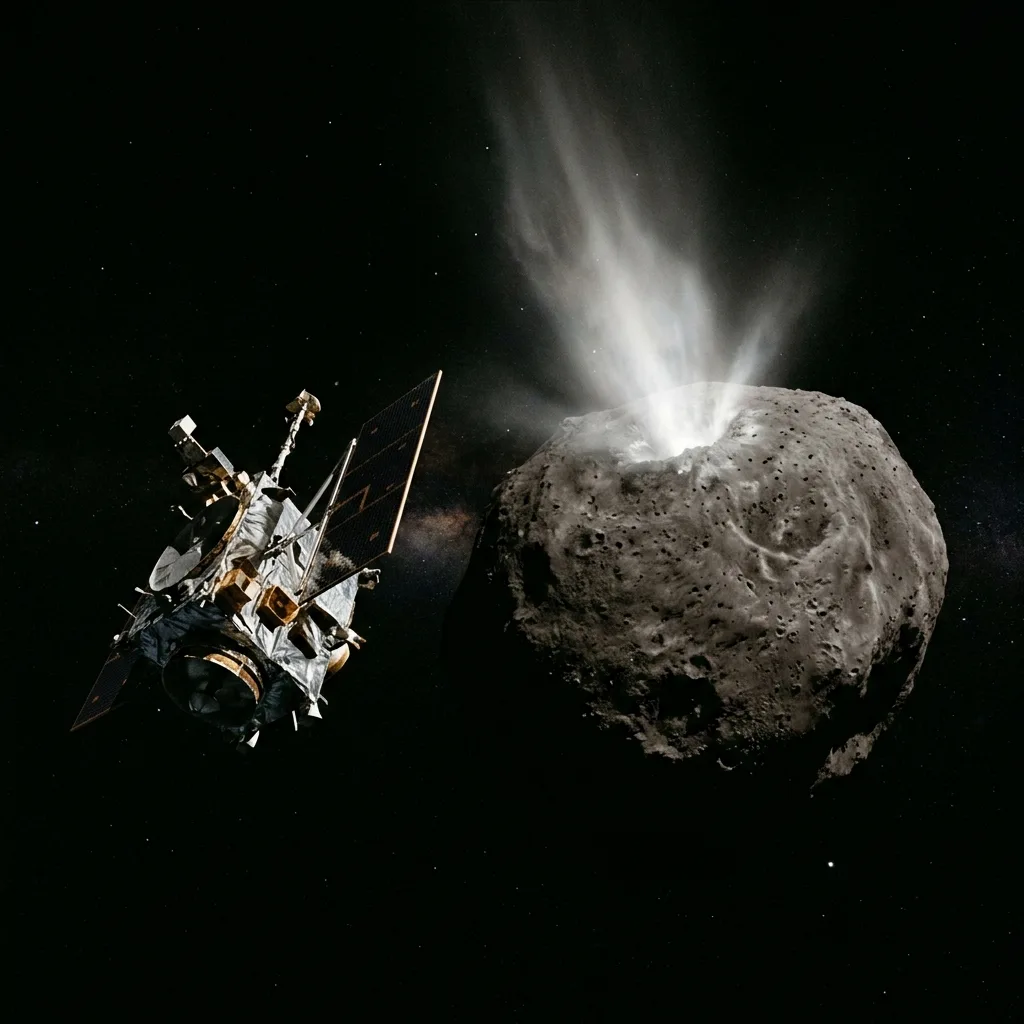
In 2005, NASA's Deep Impact slammed a 370 kg copper probe into Comet Tempel 1 at 10 km/s. The impact excavated subsurface material, revealing a porous, fragile interior.

Deep Impact and Tempel 1

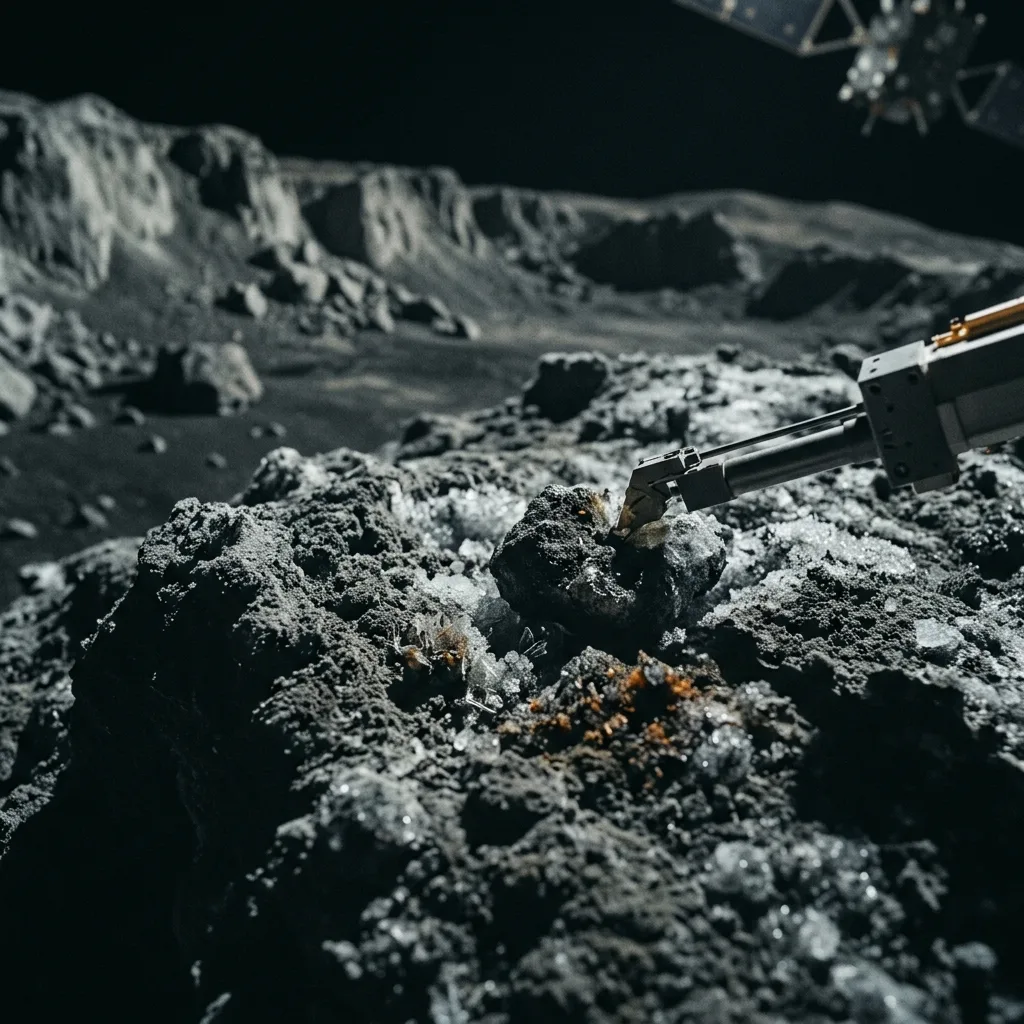
Rosetta and Comet 67P/Churyumov-Gerasimenko

The historic orbital mission.

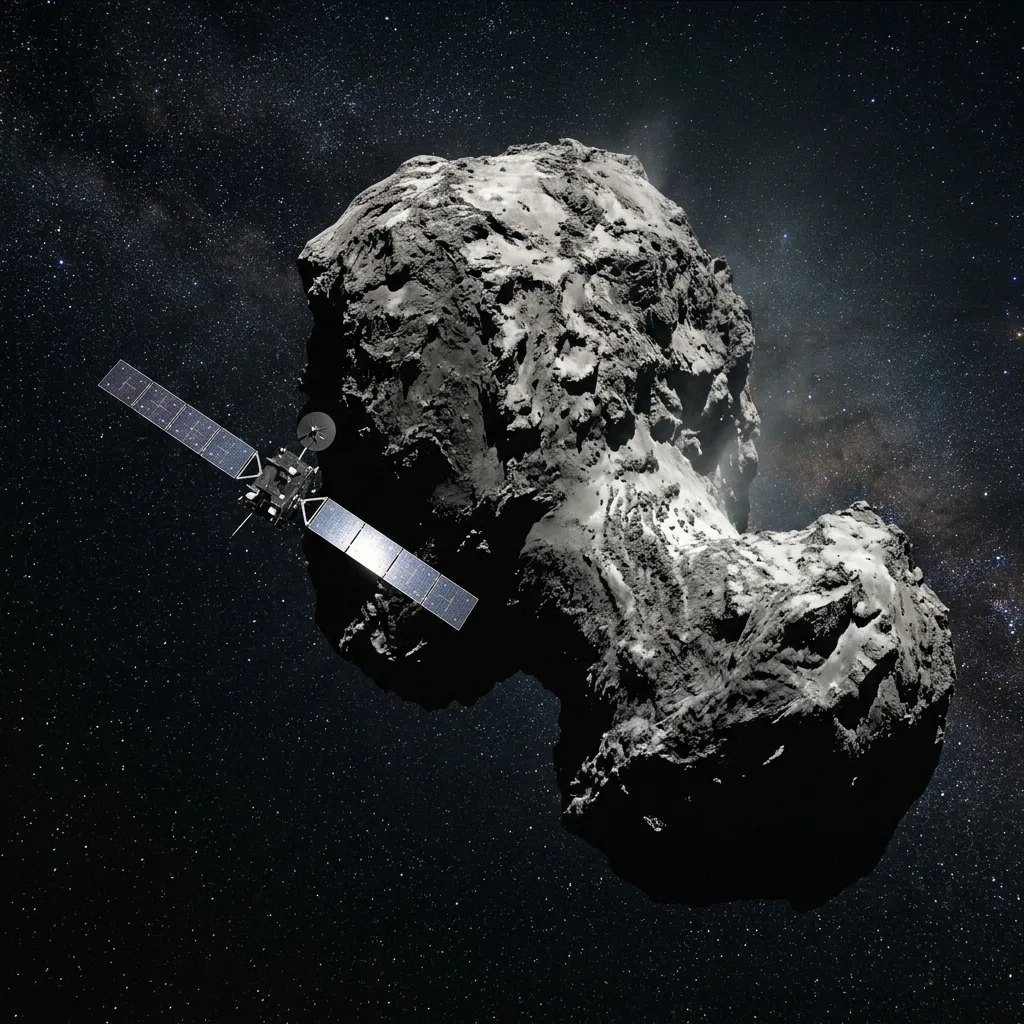
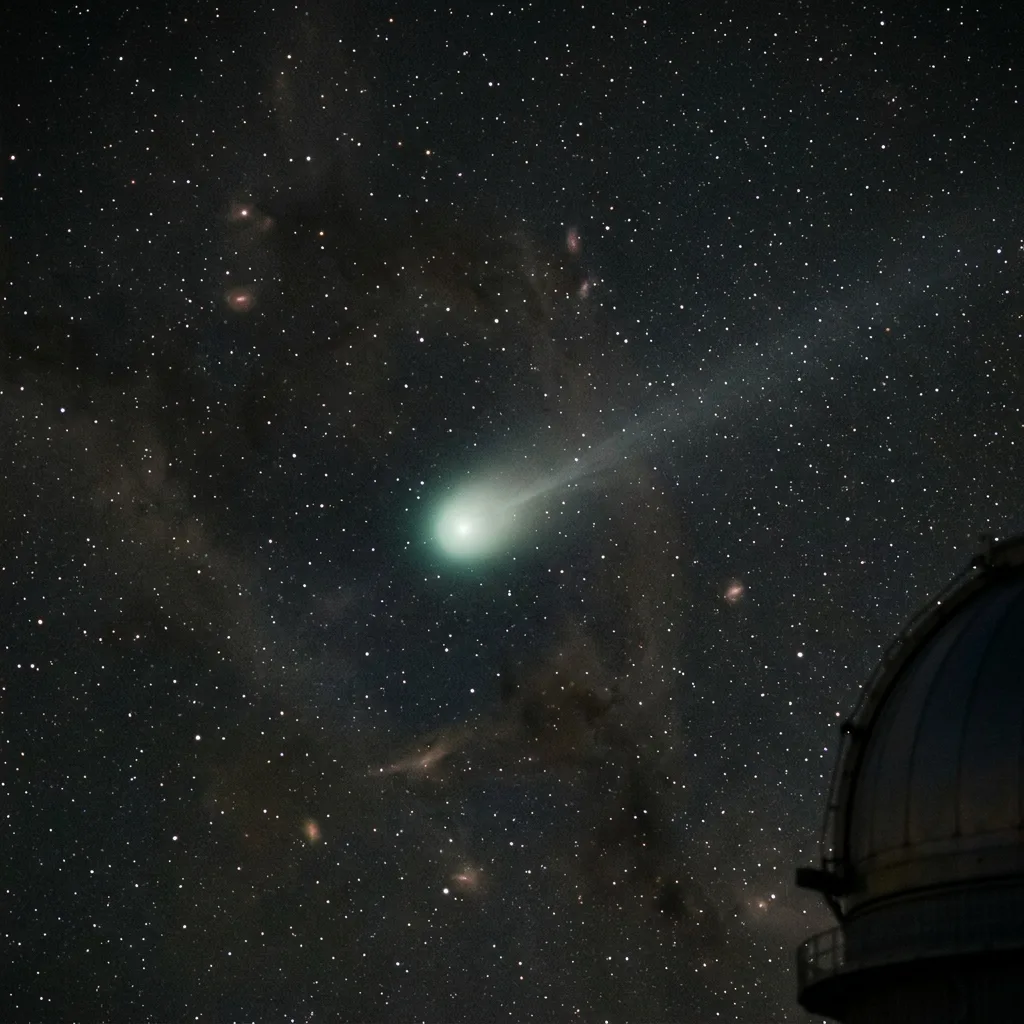
ESA's Rosetta mission (2014–2016) was the first to orbit a comet for two years. It mapped 67P's rubber-duck shape, recorded active jets, and analyzed complex organic compounds.
Rosetta and Comet 67P/Churyumov-Gerasimenko

Stardust and comet dust return

Returning samples to Earth.

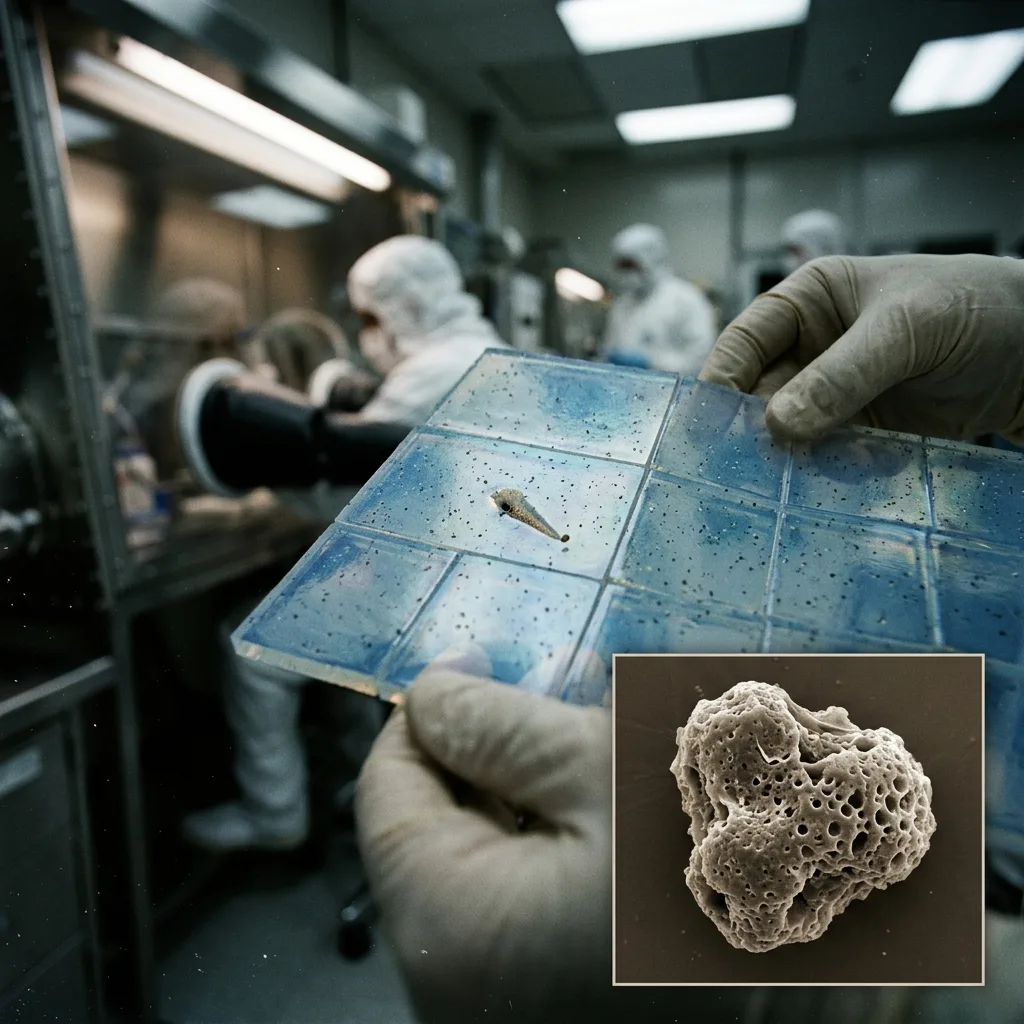
NASA's Stardust captured dust grains from Comet Wild 2 in aerogel, returning them to Earth in 2006. The samples contained high-temperature minerals formed near the early Sun.

Stardust and comet dust return

Giotto and Halley's Comet

The first close encounter.

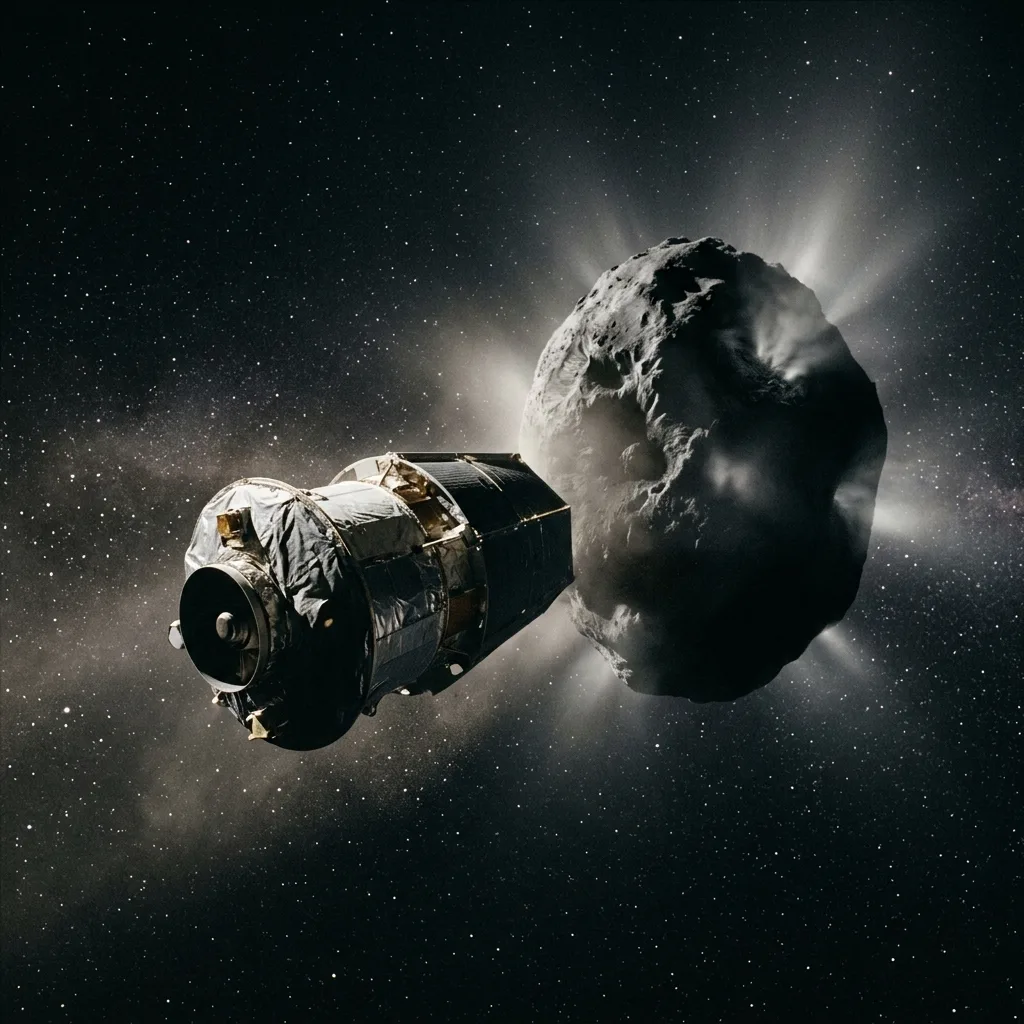
ESA's Giotto flew within 596 km of Halley's nucleus in 1986. It captured the first close-up images of a comet core, revealing a dark, peanut-shaped body venting active gas jets.

Giotto and Halley's Comet

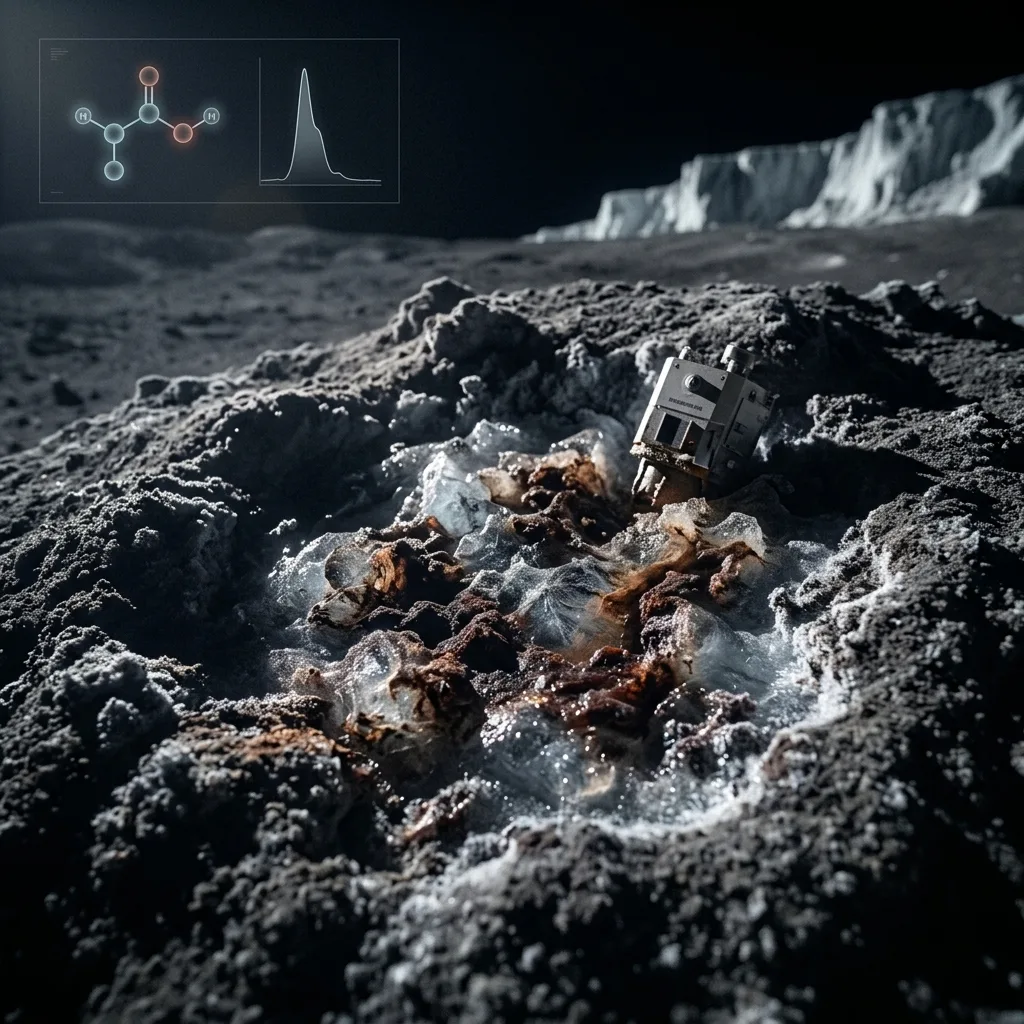
Complex organic compounds discovered

Building blocks of life.

Rosetta detected over 20 organic molecules on 67P, including the amino acid glycine and phosphorus. These findings support the theory that comets delivered life's building blocks to early Earth.

Complex organic compounds discovered

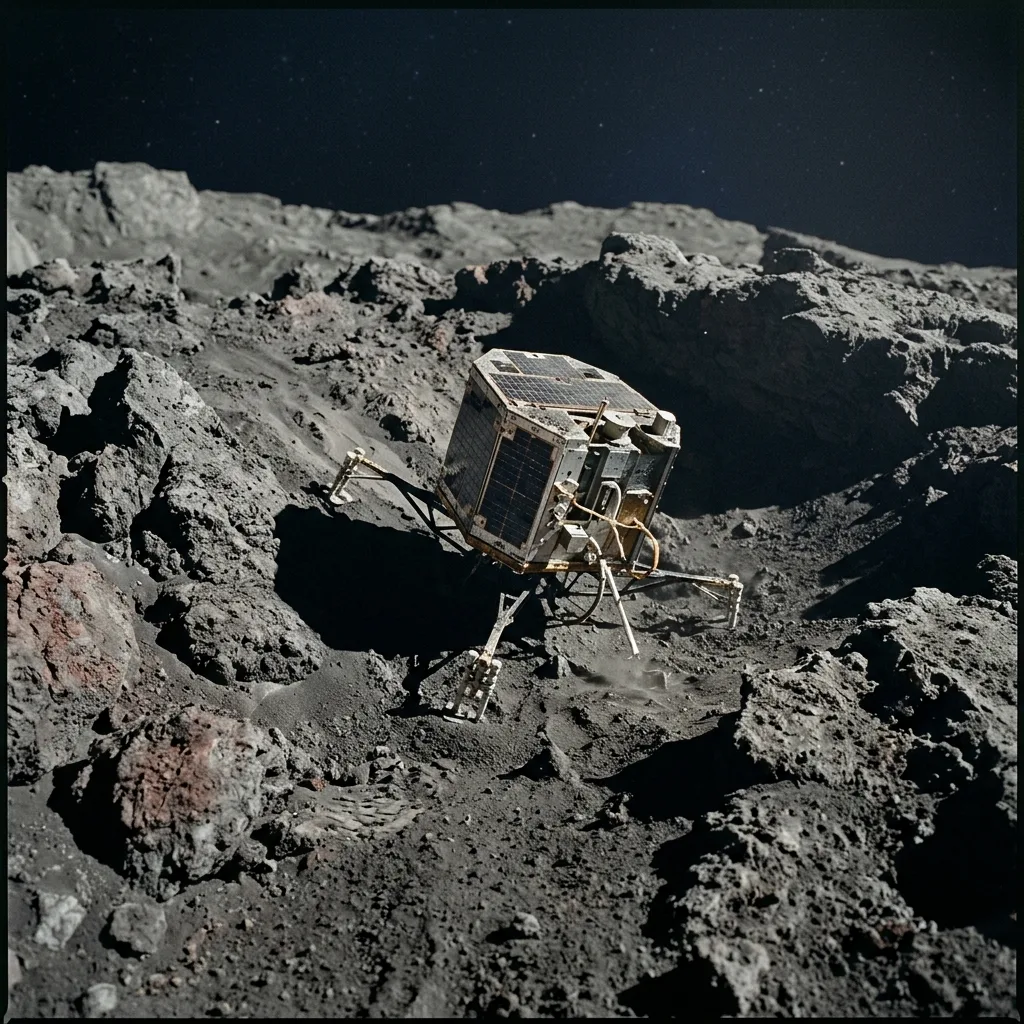
Philae: first comet landing

The lander that bounced.

In November 2014, Philae became the first lander to touch down on a comet. Bouncing into a shaded crevice, it operated for 60 hours, sending unprecedented surface data back to Earth.

Philae: first comet landing

ICE, STEREO, and SOHO

Solar and comet sentinels.

ICE made the first comet flyby in 1985. Solar observatories STEREO and SOHO have unexpectedly discovered over 4,000 sungrazing comets, serving as cosmic sentinels.

ICE, STEREO, and SOHO

We have touched comets, orbited them, landed on them, and returned samples to Earth.

7

Origin of Life

6,000 meters

Comets as cosmic delivery vessels of water and organic molecules.

Comets and the origin of life

Seeders of life?

Rich in water and organic compounds, comets are central to hypotheses suggesting they seeded early Earth with organic precursors necessary for life's emergence.

Comets and the origin of life

Organic molecules (like glycine)

Amino acids from space.

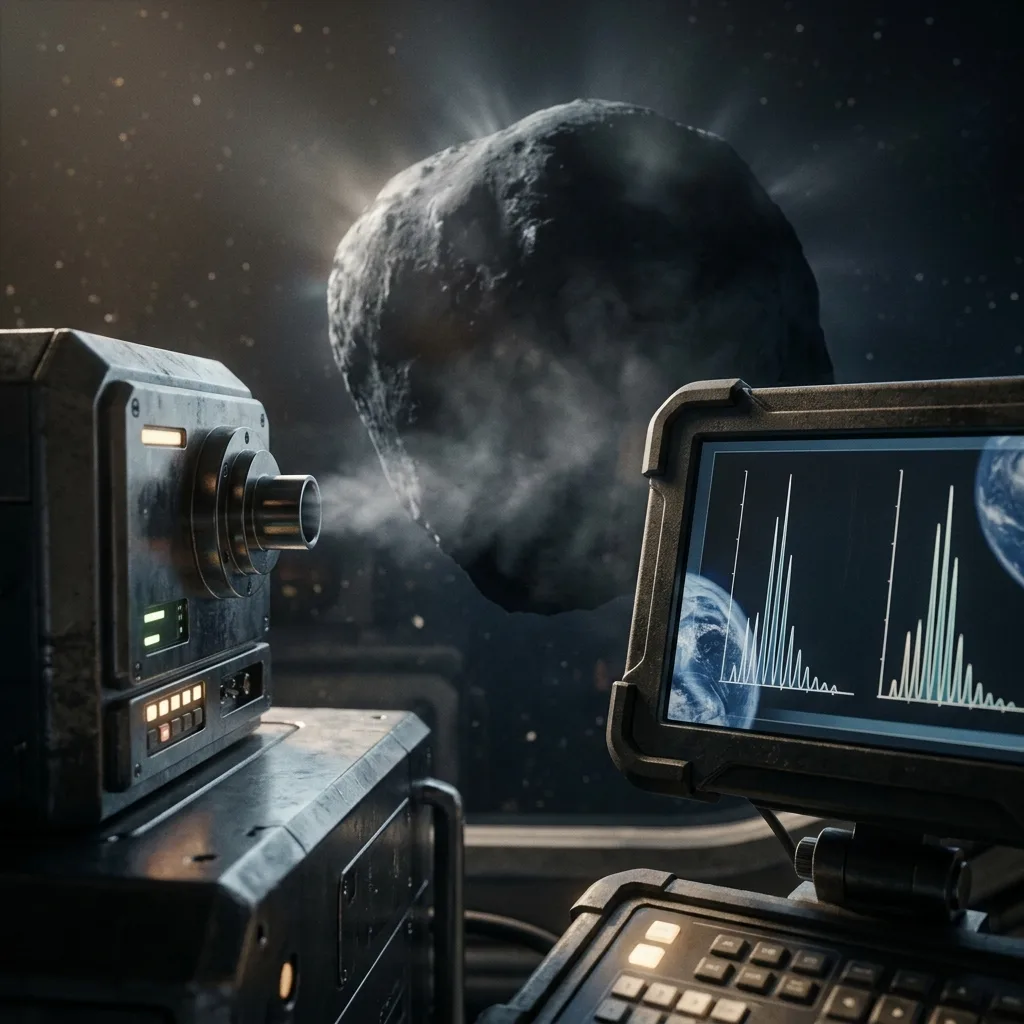
Glycine, the simplest amino acid, was confirmed on Comet 67P by Rosetta. Methanol, formaldehyde, and hydrogen cyanide are also common—comets are cosmic chemical factories.

Organic molecules (like glycine)

Panspermia hypothesis

Life traveling across space.

Panspermia suggests life's building blocks (or primitive microorganisms) are distributed across space by comets and meteorites. A compelling, albeit debated, astrobiological theory.

Panspermia hypothesis

Earth's oceans from comet impacts

Oceans from space.

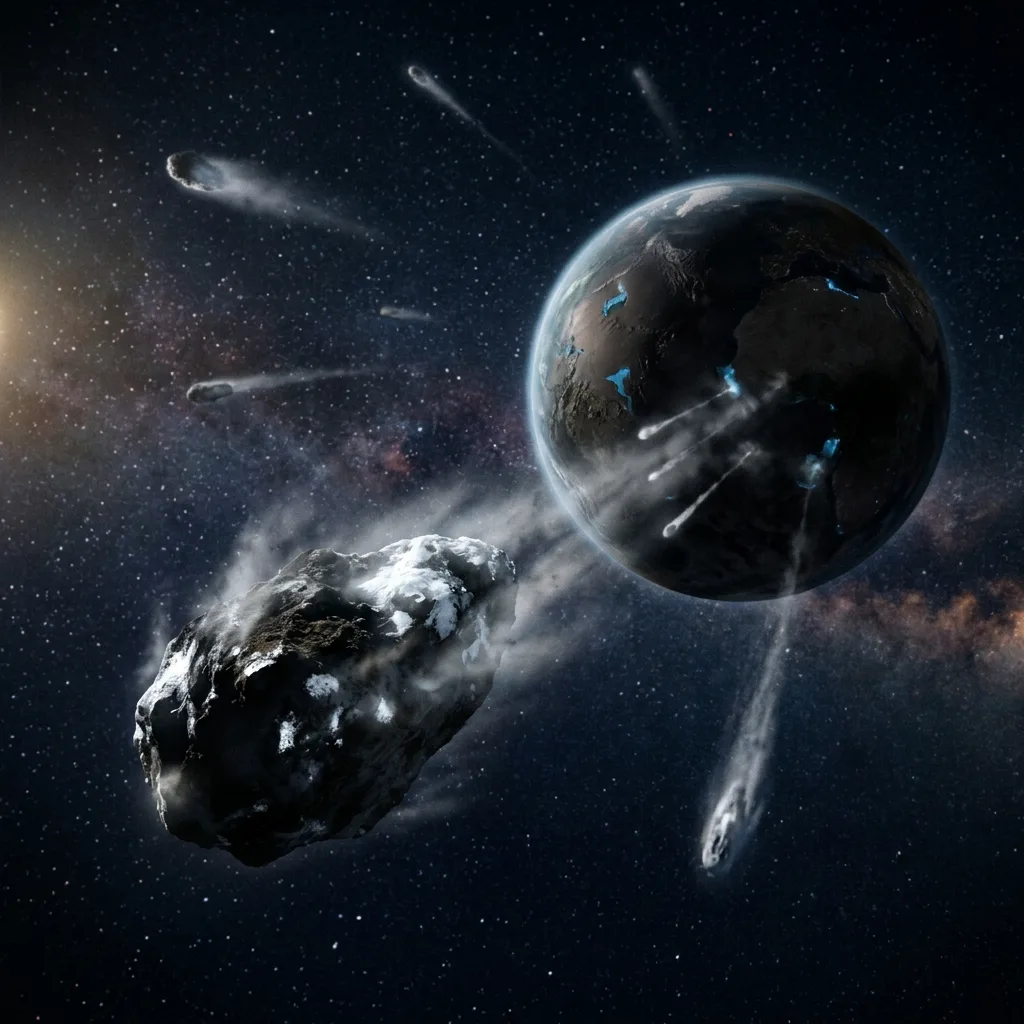
During the Late Heavy Bombardment, millions of comets bombarded Earth. Scientists propose a significant portion of Earth's water was delivered by icy cometary impacts.

Earth's oceans from comet impacts

Water distribution in the solar system

Water everywhere.

Comets are up to 80% water ice by mass. Studying comet water helps astronomers map how water was distributed across planets and icy moons during early solar system formation.

Water distribution in the solar system

Primitive chemical archives

Pristine time capsules.

Frozen in deep space for 4.6 billion years, comets underwent no geological alteration. Studying a comet's composition is akin to examining the birth certificate of our solar system.

Primitive chemical archives

Deuterium-to-Hydrogen isotopic signatures

Water fingerprinting.

Water carries isotopic signatures (D/H ratio). Some Kuiper Belt comets match Earth's D/H ratio closely, while Oort Cloud comets differ, providing clues to Earth's oceanic origin.

Deuterium-to-Hydrogen isotopic signatures

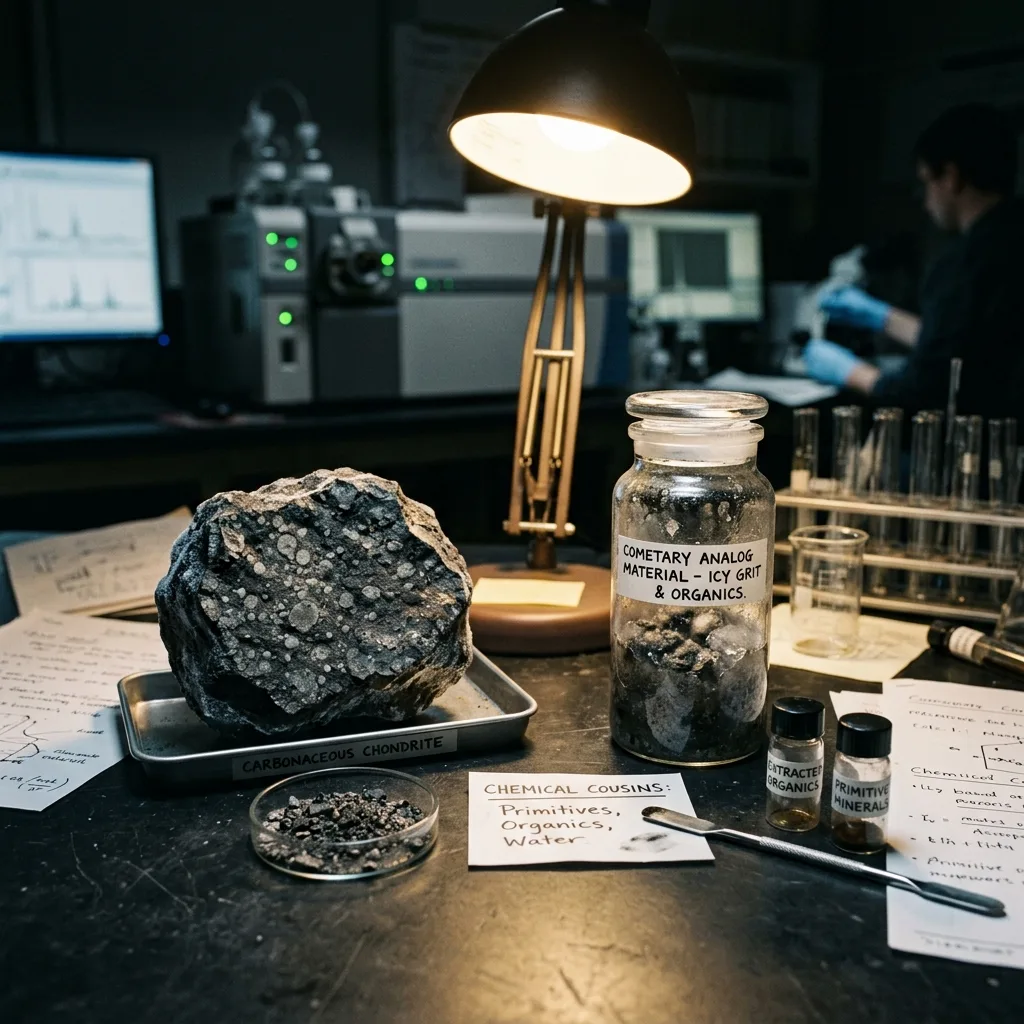
Connection to carbonaceous meteorites

Chemical cousins.

Carbonaceous chondrite meteorites share striking chemical similarities with comets. Both represent primitive, unrefined remnants of the solar nebula's original material.

Connection to carbonaceous meteorites

Comets are not dead ice: they are potential seeds of biological life.

8

Impacts and Threats

8,000 meters

Catastrophic impacts of the past and planet-crossing threats of the future.

Catastrophic impacts

When the sky falls.

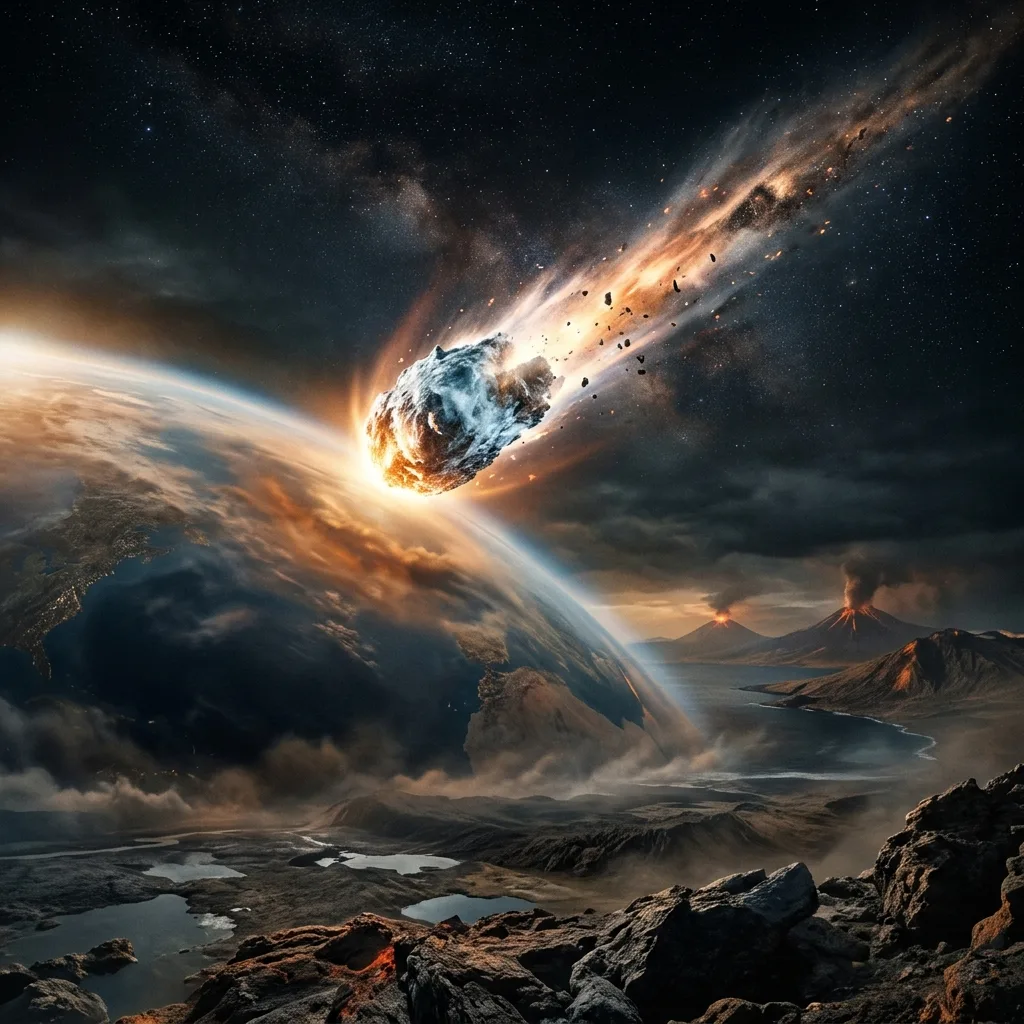
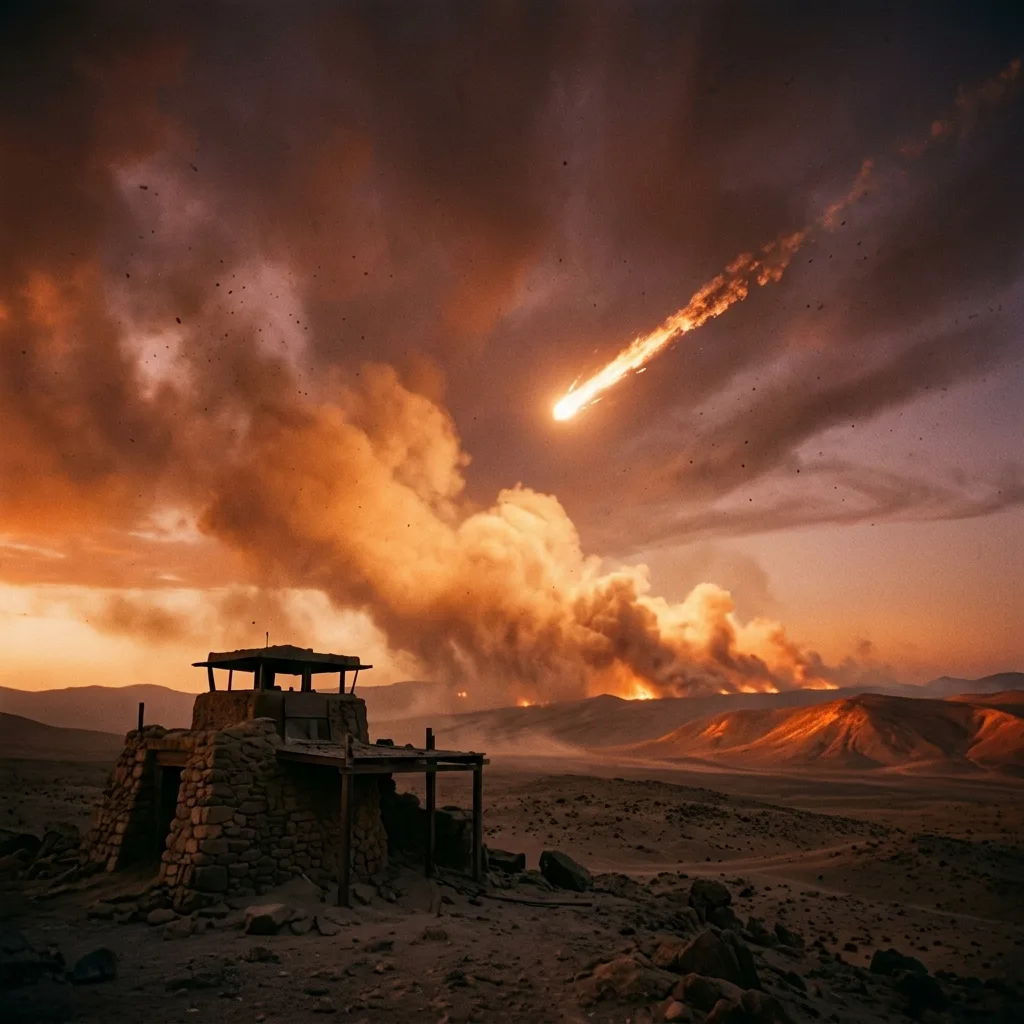
Comet and asteroid impacts have periodically reshaped terrestrial life, causing mass extinctions, global fires, and severe climate disruptions throughout Earth's history.

Catastrophic impacts

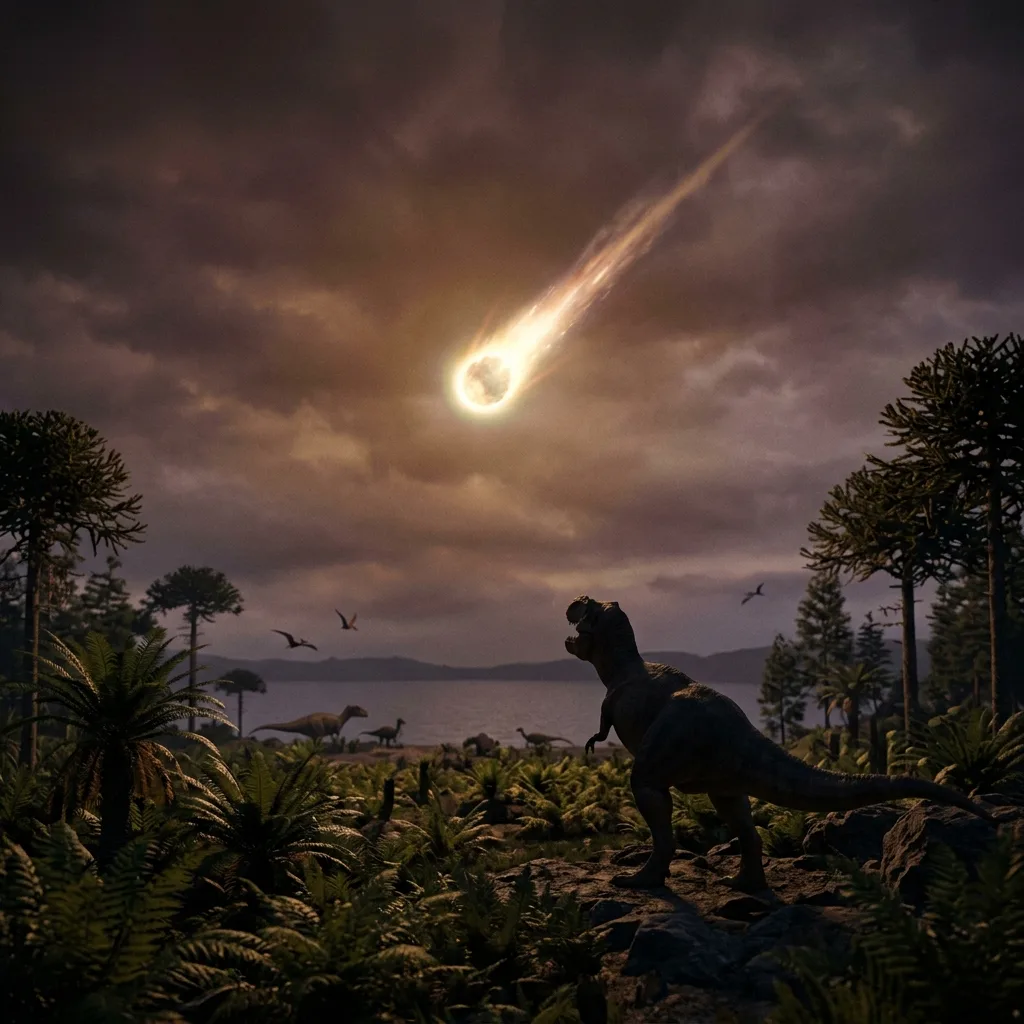
Dinosaur extinction: A comet?

A 66-million-year debate.

The Chicxulub impact 66 million years ago wiped out 75% of species. While long blamed on an asteroid, recent studies argue it may have been a fragmented long-period comet.

Dinosaur extinction: A comet?

Chicxulub crater

The scar of extinction.

Buried beneath Yucatán, the 150 km Chicxulub crater was carved by a 10–15 km impactor releasing energy equivalent to 100 trillion tons of TNT, altering Earth forever.

Chicxulub crater

Other massive terrestrial impacts

Earth's ancient wounds.

Vredefort (South Africa, 300 km), Sudbury (Canada, 130 km), Popigai (Siberia, 100 km). Over 190 confirmed impact craters on Earth bear witness to cosmic violence.

Other massive terrestrial impacts

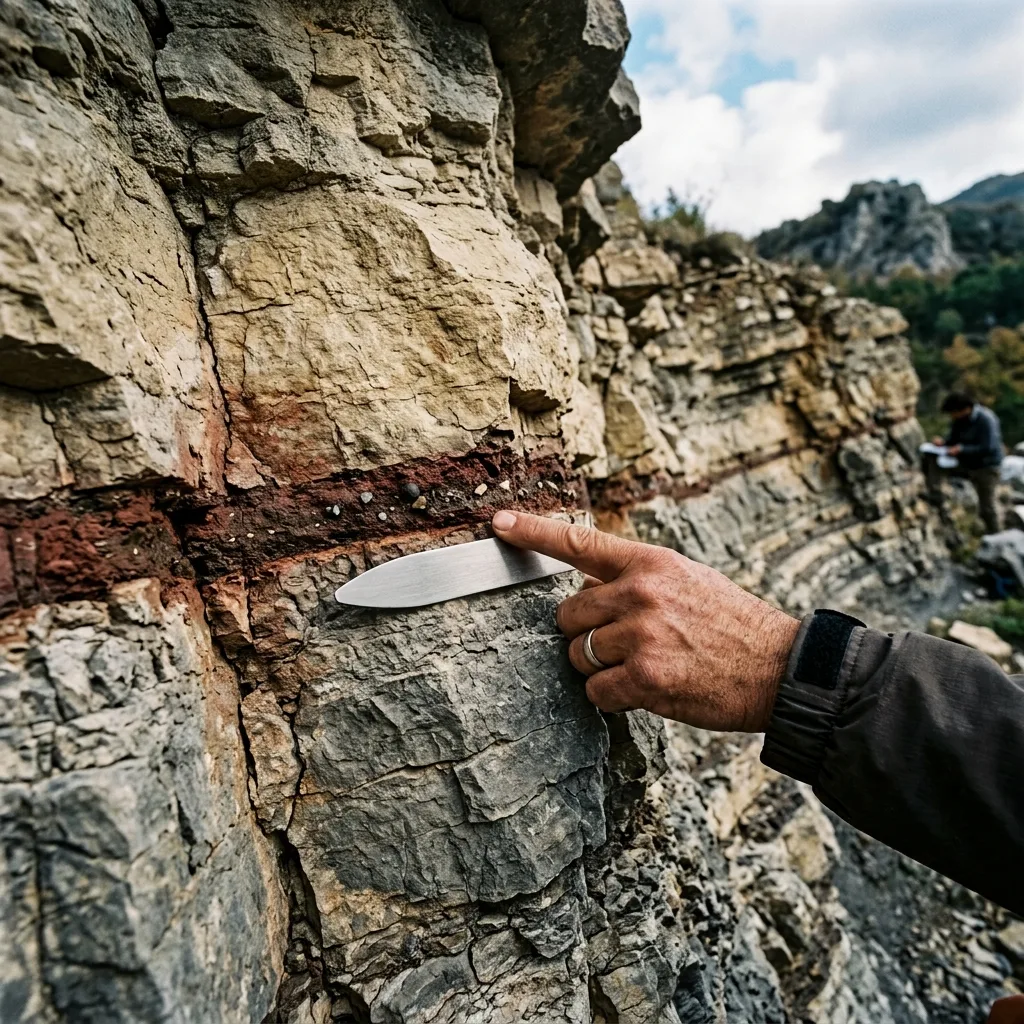
Geologic evidence of impacts

Footprints in stone.

Impacts leave iridium anomalies, shocked quartz, and tektites. The global iridium layer at the K-Pg boundary remains the undisputed smoking gun of the Chicxulub event.

Geologic evidence of impacts

Comets and sudden climate change

Impact winters.

Massive impacts launch dust and soot into the stratosphere, blocking sunlight and triggering impact winters. Photosynthesis collapses, causing food chains to crumble worldwide.

Comets and sudden climate change

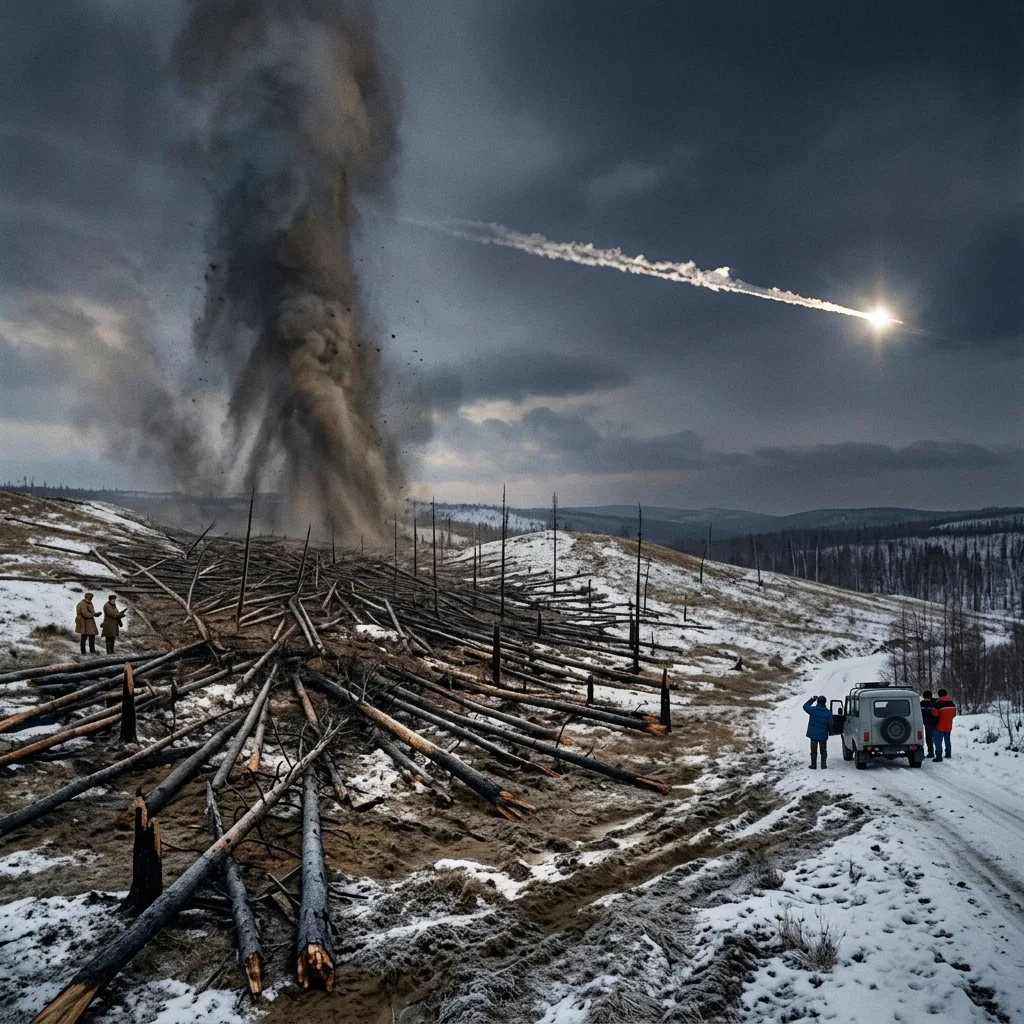
Tunguska and Chelyabinsk events

Recent warnings.

Tunguska (1908) flattened 80 million trees in Siberia with a 15-megaton airburst. Chelyabinsk (2013) injured 1,500 people. Small impacts remain active hazards.

Tunguska and Chelyabinsk events

Future impact hazards

The cosmic clock.

While near-Earth asteroids are cataloged, long-period comets approach from deep space with little warning. Planetary defense against incoming comets requires constant vigilance.

Future impact hazards

Comets bring more than water: they bring global extinction.

9

Extreme Comets

12,000 meters

The rarest, darkest, and most extreme comets challenging detection.

Extremely rare comets

Unique visitors.

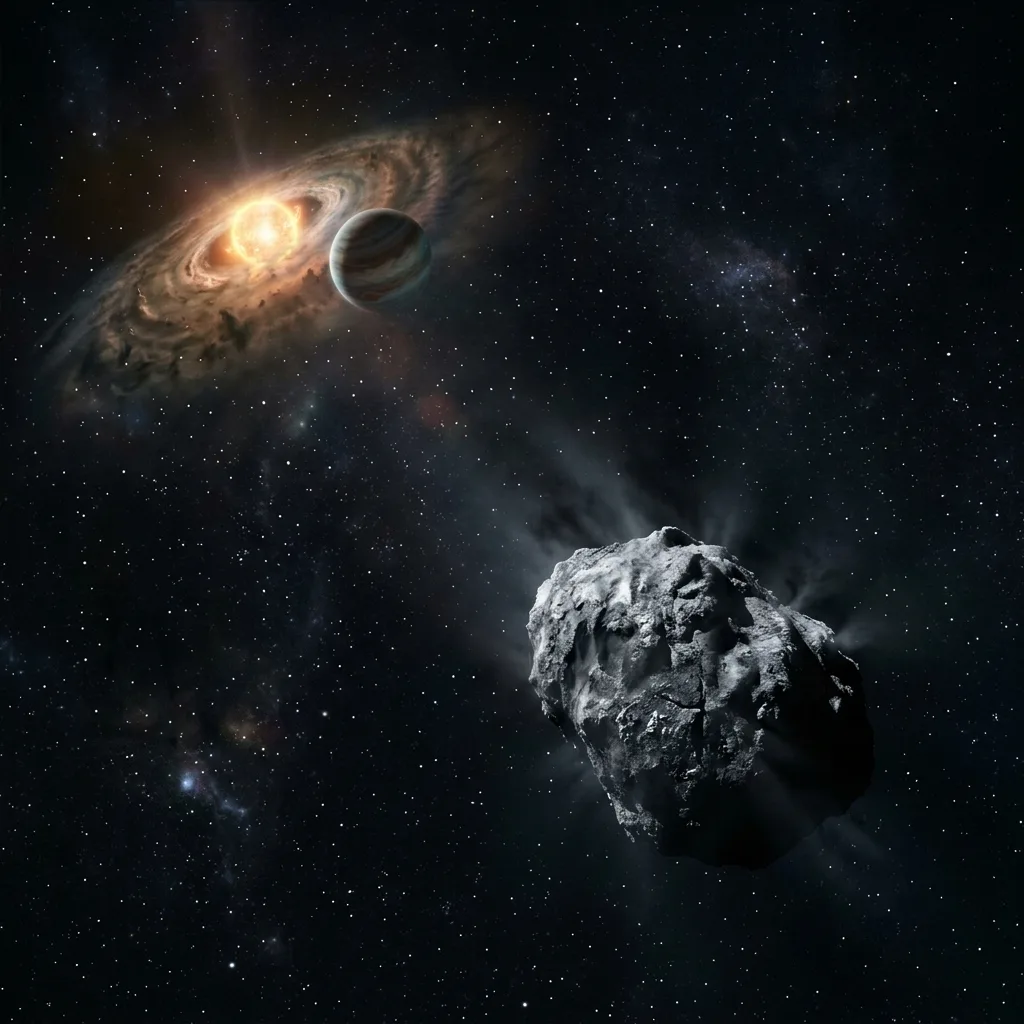
Some comets possess orbits so massive they visit the inner solar system only once every hundred thousand years. Comet C/2014 S3 is one such ultra-rare visitor.
Extremely rare comets

Comets with periods > 50,000 years

Eternal wanderers.
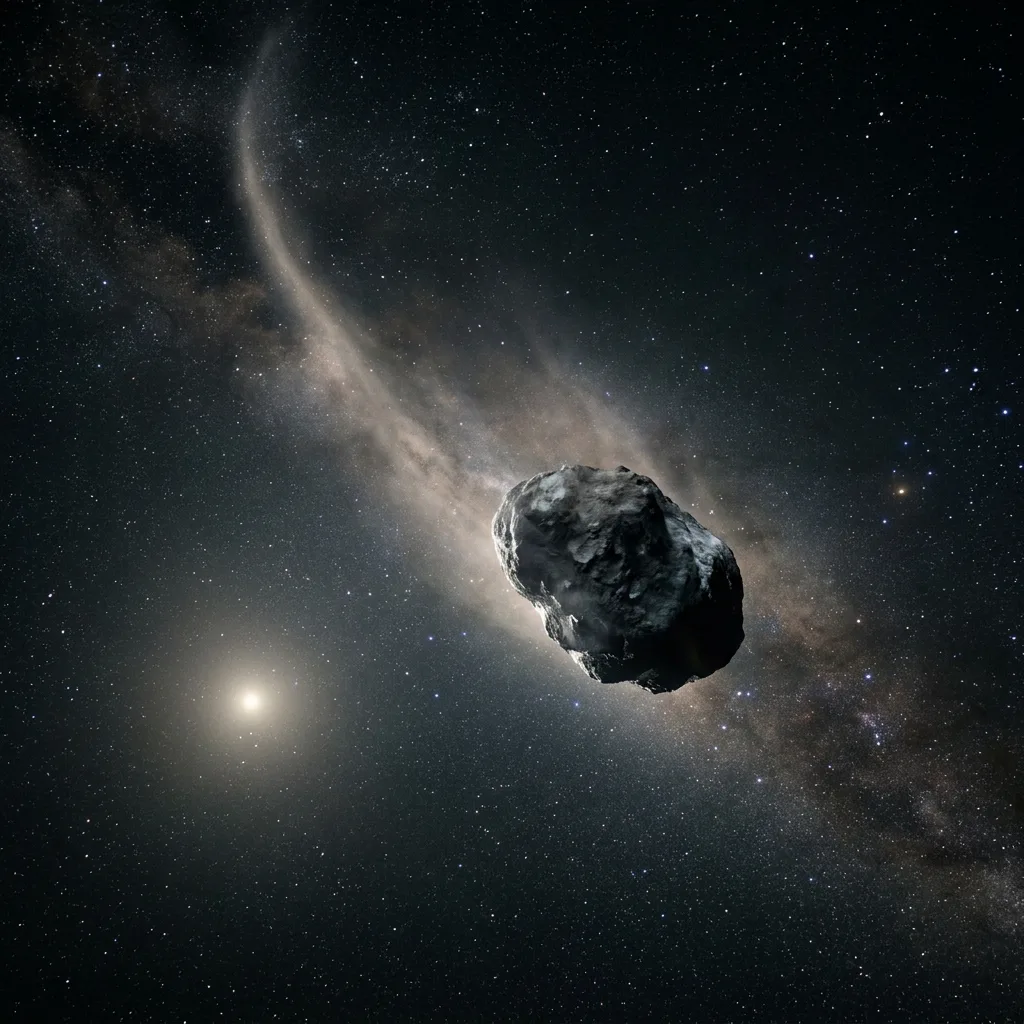
Ultra-long-period comets trek into deep Oort Cloud reaches. Returning after 50,000+ years, they encounter a solar system transformed since their last visit.
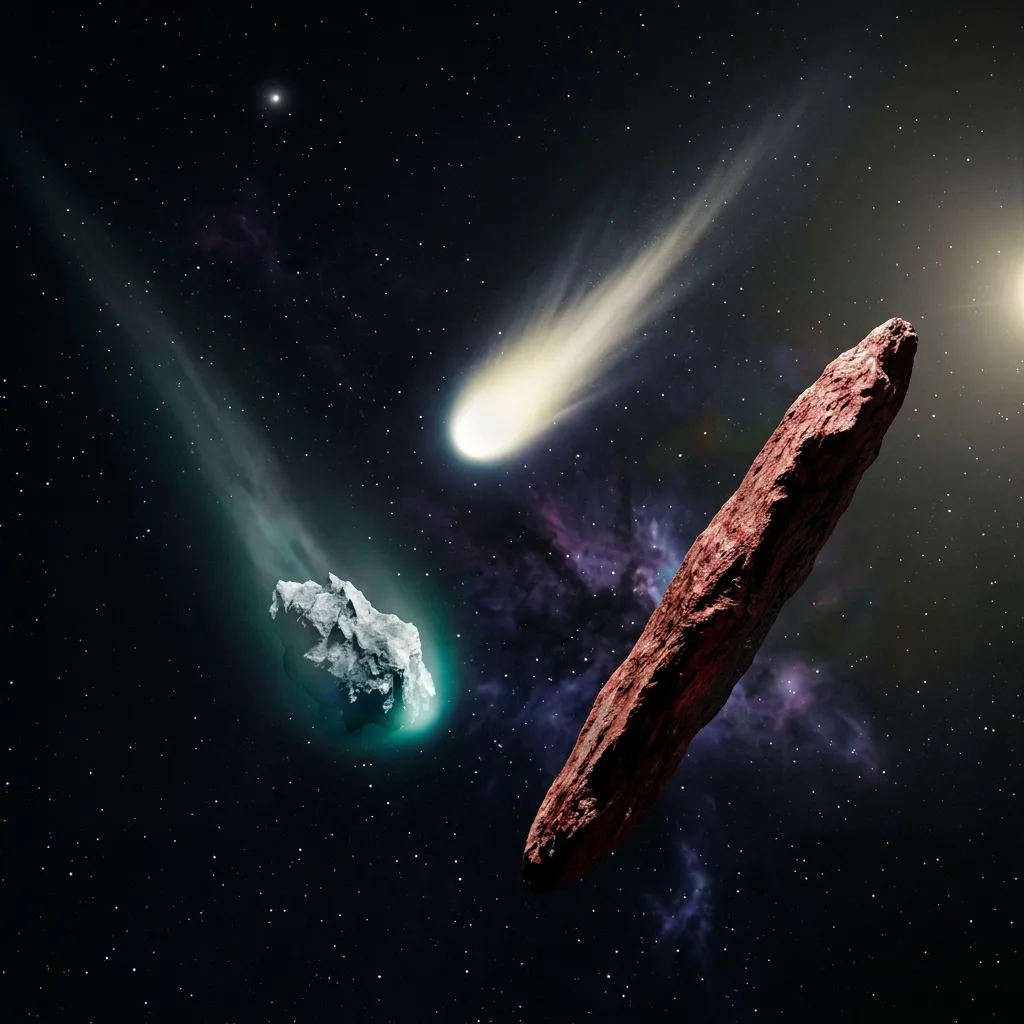
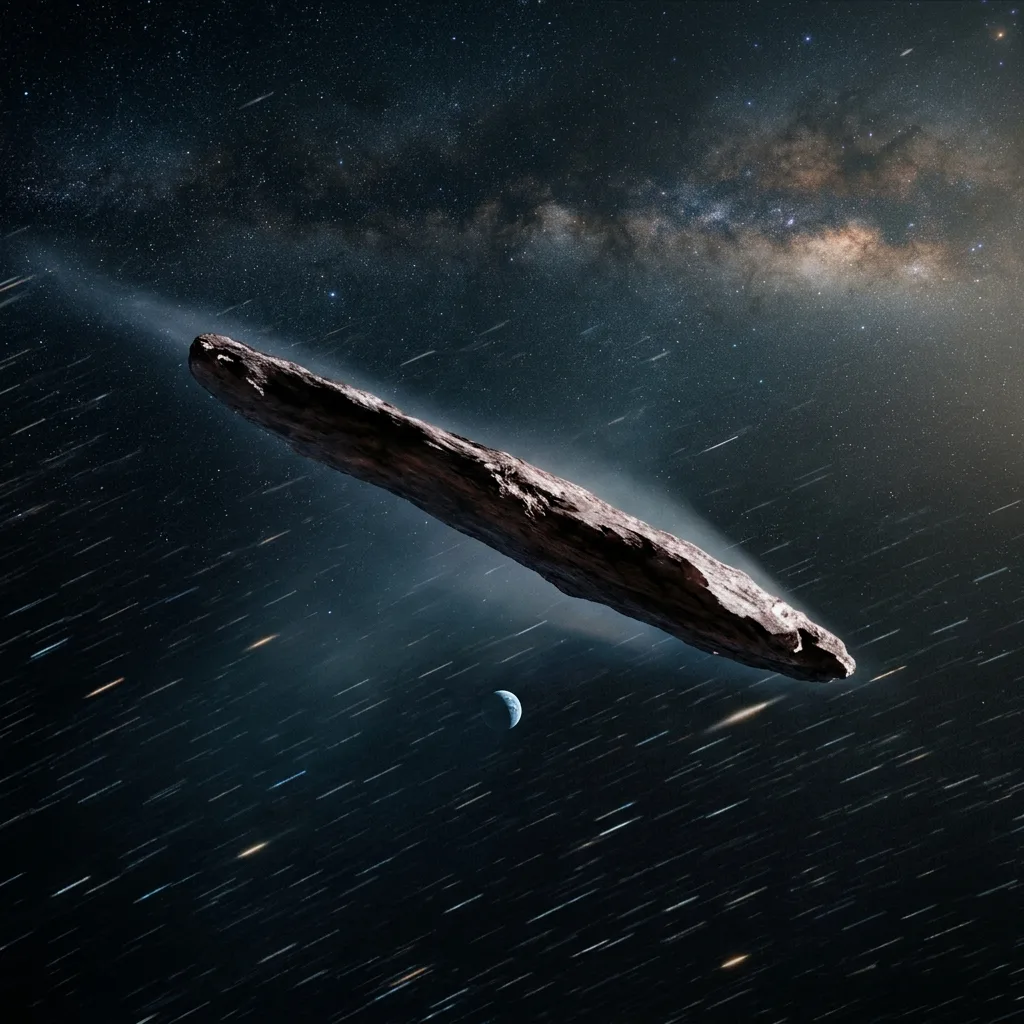
Comets with periods > 50,000 years

Kamikaze sungrazing comets

The Kreutz sungrazers.

Kreutz sungrazers skim so close to the Sun that intense solar heat evaporates them completely. SOHO has recorded thousands of these suicidal comets.

Kamikaze sungrazing comets

Retrograde extreme orbits

Reverse celestial motion.

Comets with orbital inclinations greater than 90° travel opposite to planetary orbits. Halley's Comet (162° inclination) undergoes high-velocity planetary passes.

Retrograde extreme orbits

Exocomets around alien stars

Alien comets.

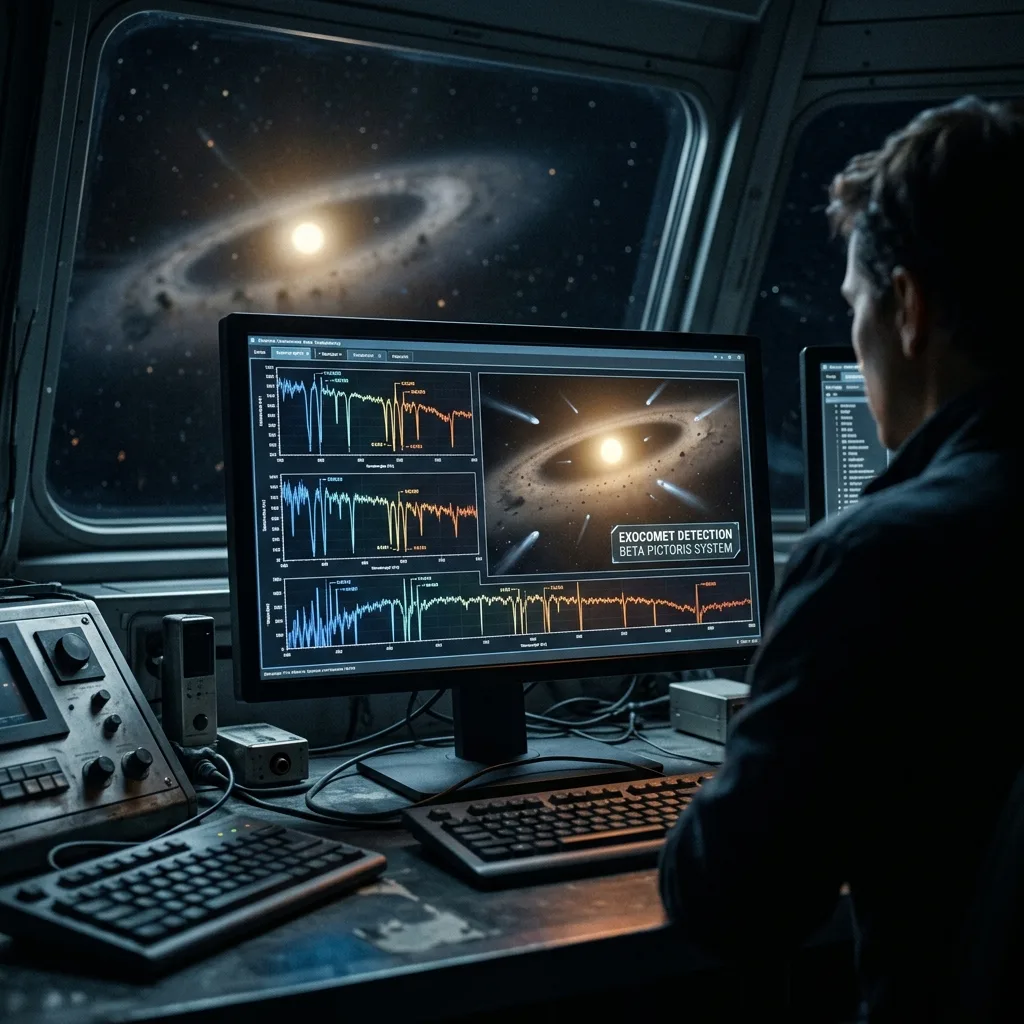
Astronomers have detected exocomets orbiting young stars like Beta Pictoris through spectroscopic dips, proving comet formation is universal across planetary systems.

Exocomets around alien stars

Captured alien comets hypothesis

Stolen travelers.

During the Sun's birth in a dense star cluster, its gravity may have captured comets from neighboring stars. Some Oort Cloud comets may be true extrasolar native bodies.

Captured alien comets hypothesis

Single-pass hyperbolic objects

One-time guests.

Objects with hyperbolic eccentricities (>1) are unbound to the Sun. They swing past once and vanish into interstellar space forever. Every sighting is unique.

Single-pass hyperbolic objects

Dark comets

Ghosts of the solar system.

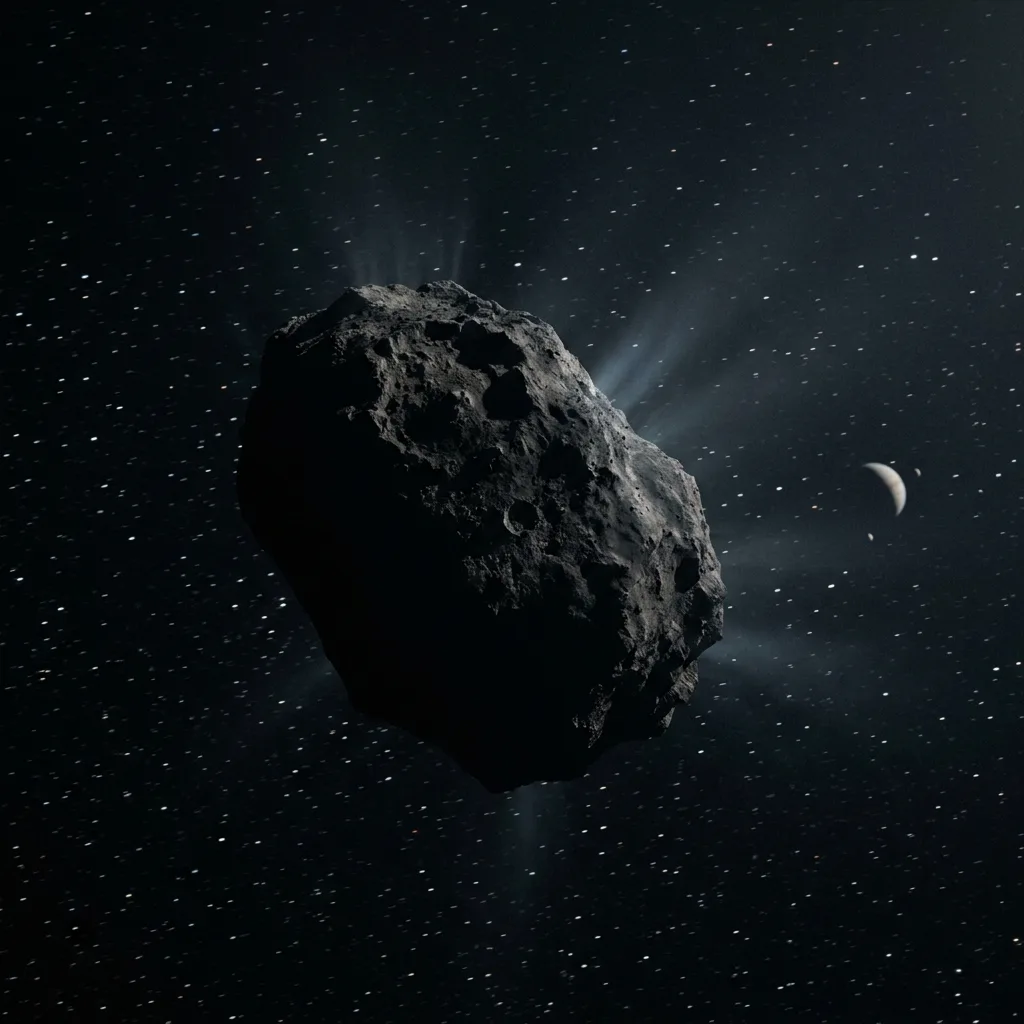
Dormant comets coated in dark organic gunk (albedo < 0.03) vent little gas, rendering them nearly invisible to optical telescopes until dangerously close to Earth.

Dark comets

Not all comets shine bright. Some are dark ghosts haunting the solar system.

10

The Abyss

Infinite meters

Comets in human mythology, omens, and unexplained cosmic mysteries.

Ancient civilizations observing comets

Sky watchers.

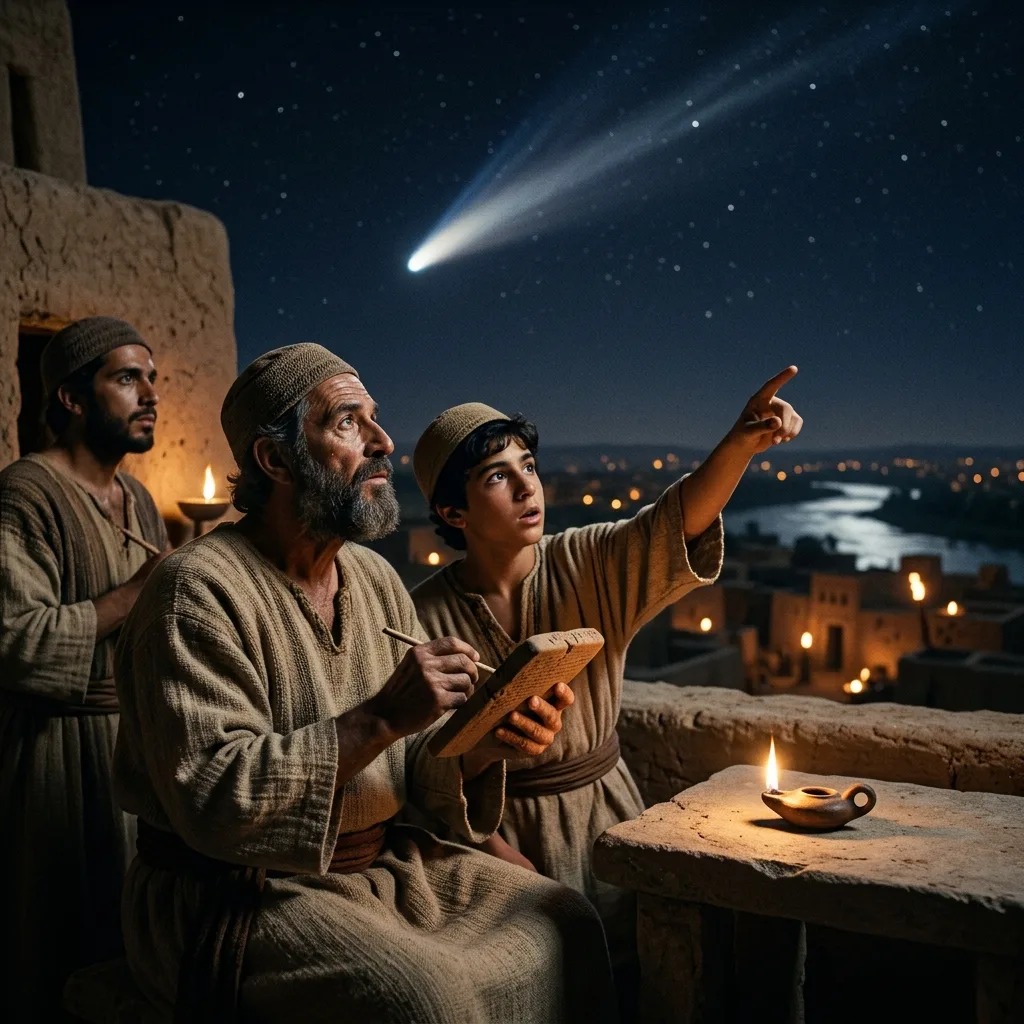
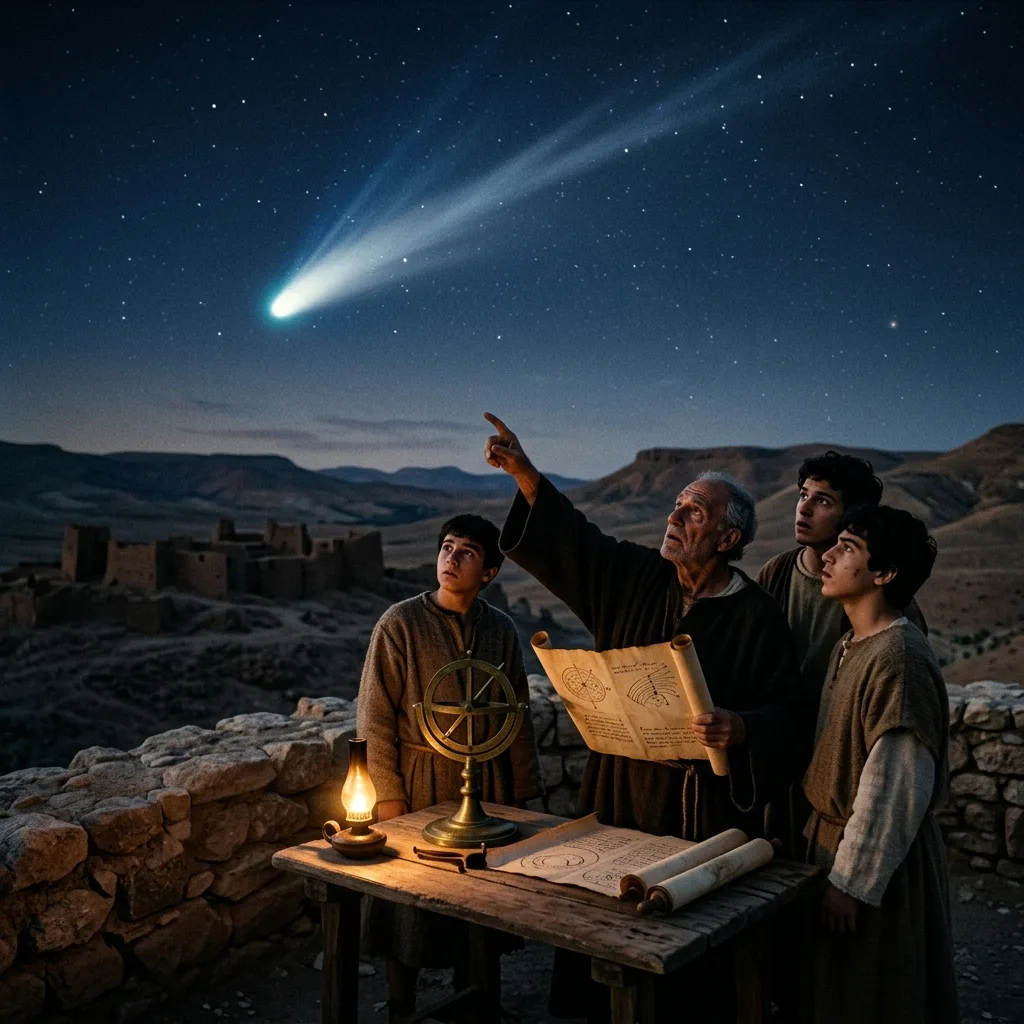
Babylonians, Chinese, Mayans, and Greeks recorded comets for millennia. Chinese astronomers kept continuous records from 240 BC, laying foundational astronomical data.

Ancient civilizations observing comets

Comets in worldwide mythologies

Mythic messengers.

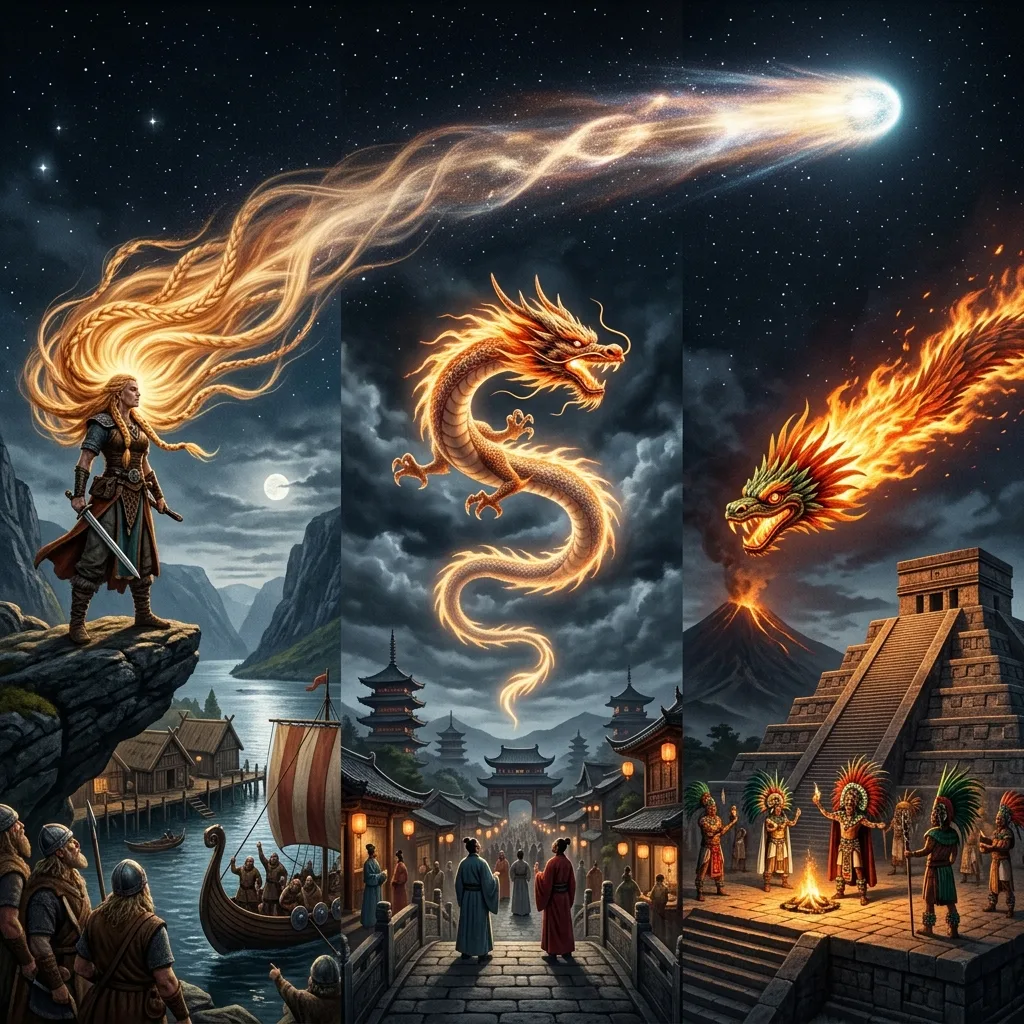
Norse myths viewed comets as Sif's hair; Chinese myth saw celestial dragons; Aztecs saw fiery serpents. Every culture projected divine messages onto comets.

Comets in worldwide mythologies

Messengers of the gods

Divine communication.

For centuries, comets were interpreted as divine warnings or harbingers of doom. Halley's Comet appears in the Bayeux Tapestry (1066) presaging the Norman Conquest.

"The gods speak across the heavens."

Messengers of the gods

Historical superstitions and fear

Ancestral dread.

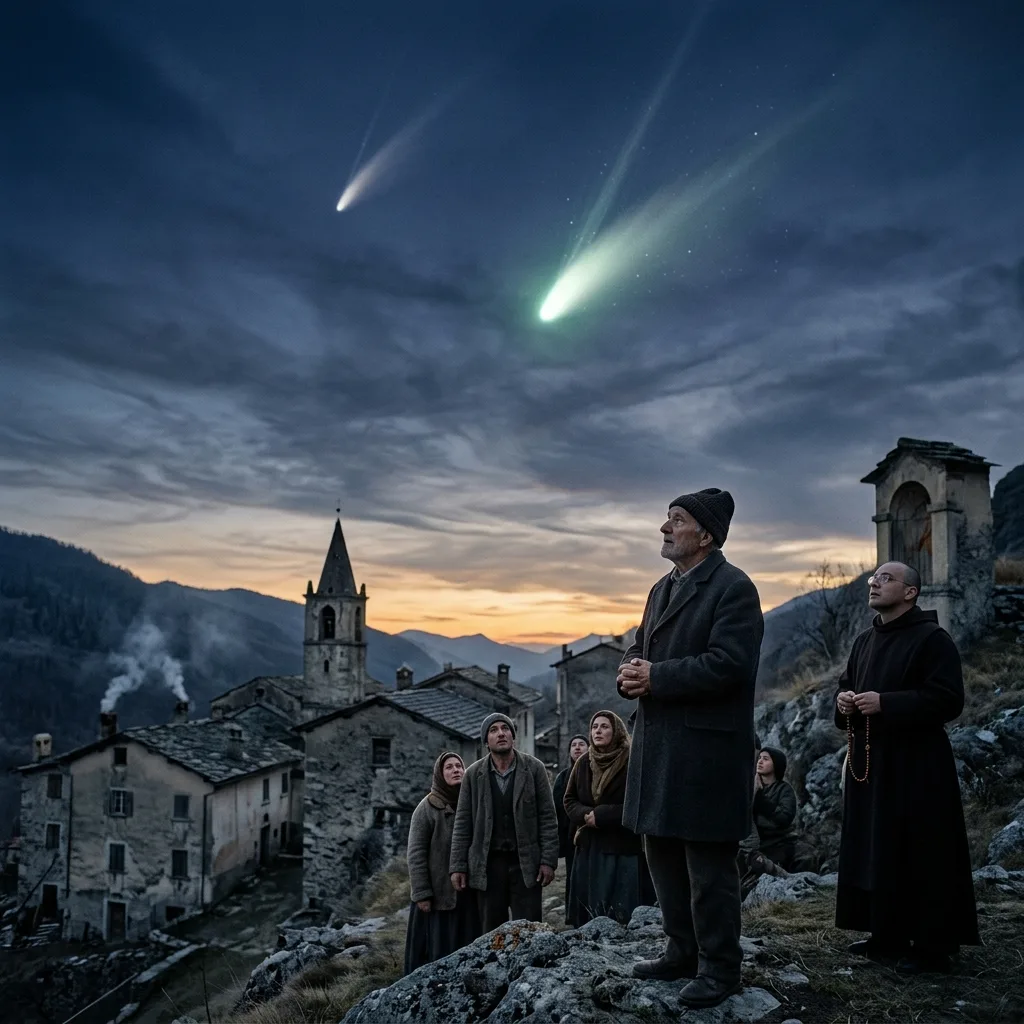
Comets were blamed for plagues, wars, and deaths of kings. The Great Comet of 1664 caused widespread panic in Europe, embedding fear deep into human culture.

Historical superstitions and fear

Signs of the end times

Apocalyptic omens.

Across religious traditions, comets herald apocalyptic shifts. Apocalypse, Ragnarök, and Kali Yuga accounts include falling stars—reminders of cosmic fragility.

Signs of the end times

Real historical turning points

Self-fulfilling prophecies.

Comets coincided with pivotal historical events: Caesar's death (44 BC), the fall of Constantinople (1453). History retroactively validated these celestial omens.

Real historical turning points

Influence on art, science, and religion

Cosmic inspiration.

Comets inspired Giotto's paintings, Shakespeare's dramas, and Newton's laws of gravitation. They serve as bridges connecting art, myth, and scientific breakthroughs.

Influence on art, science, and religion

Untold mysteries remaining

The unanswered questions.

How many comets rest in the Oort Cloud? Did they bring life to Earth? How many interstellar visitors pass unnoticed? Every comet mission uncovers fresh mysteries.

Untold mysteries remaining

You have reached the bottom. Comets are more than ice: they are omens and mysteries.

Nivel 1/100 meters

Has llegado al fondo.

Todo iceberg termina aquí.

Pero siempre hay otro esperando
ser explorado.

Explorar otro iceberg